

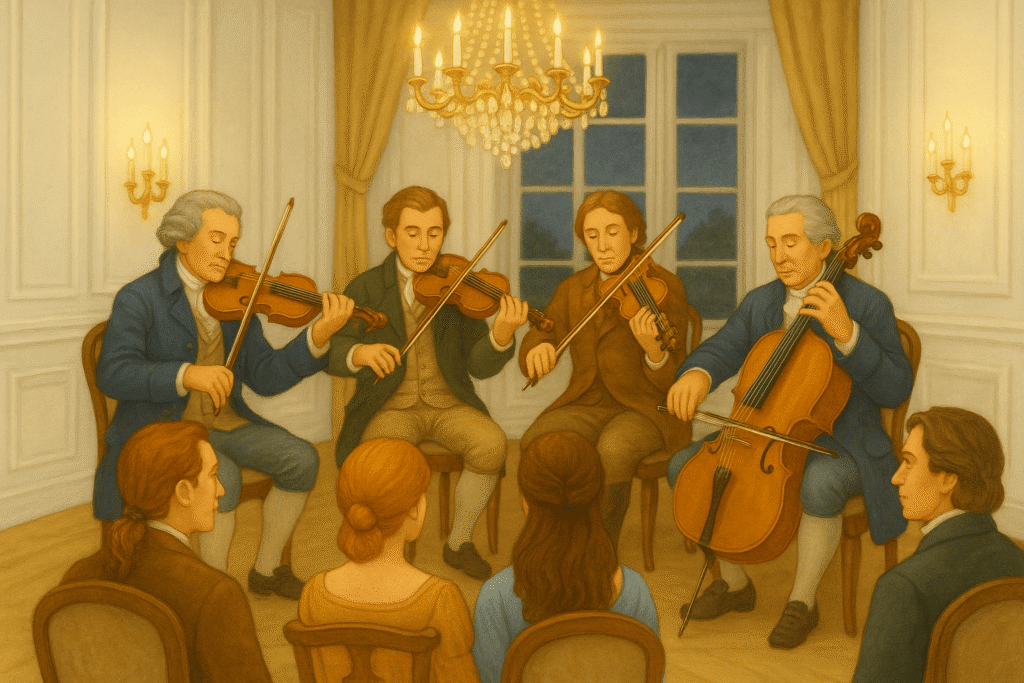
From the mid-18th to the early 19th century, the Classical period emerged as the era in which the aesthetics of balance, clarity and structural proportion became most fully realized in Western classical music. With the spread of Enlightenment thought and the rise of the bourgeois class, music expanded beyond courts and churches into public concert halls and domestic spaces.
The ornate and decorative idioms of the Baroque gradually evolved into order, formal transparency and clearly shaped musical logic. The major–minor tonal system matured into functional harmony, and music unfolded through contrasting themes and well-defined structures. Genres such as the symphony, string quartet and piano sonata were established and matured, forming the central tradition of Western classical music.
1. Social Background and Performance Culture
(1) Court Patronage and the Rise of Civil Society
In the Baroque era, nobles and the Church were the dominant patrons of music. By the late 18th century, however, as the middle class expanded and Enlightenment ideas circulated, music increasingly moved from the court and church into the public sphere, where audiences themselves began shaping musical life. Public concerts in major cities—Vienna, Paris, London—marked a decisive shift toward music as a civic cultural activity.
(2) Music Publishing and the Market for Printed Scores
The development of music publishing brought a transformative change: music once confined to aristocratic salons began entering the drawing rooms of ordinary households, accelerating the spread and democratization of Classical music.
Works such as Haydn’s string quartets and Mozart’s piano sonatas circulated widely as printed scores. For composers, publication income became a crucial foundation, and musical works increasingly functioned as public cultural goods, no longer restricted to specific patrons.
(3) Premieres and Performance Culture
In the Classical period, premieres were no longer limited to courtly events. Symphonies and concertos were introduced in public venues such as Vienna’s Burgtheater or Paris’s Concert Spirituel, where audience reaction directly influenced a composer’s reputation. Moments of enthusiasm—and sometimes confusion—at Beethoven’s premieres show how public reception became a decisive force in shaping the musical world.
(4) The Independence of Professional Composers
Haydn spent many years in service at the Esterházy court, whereas Mozart and Beethoven belonged to a generation that moved beyond permanent court employment. Mozart lived as a freelance musician, sustaining himself through publishing, teaching and public concerts, while Beethoven combined aristocratic support with subscription concerts to protect his independence. This shift reflected an important transition in the social identity and autonomy of composers, mirroring the broader cultural transformation of the Classical era.
2. Classical Musical Language
(1) Tonality and Affect — Functional Harmony and Clear Contrast
At the center of Classical music stood the fully established tonal system. The major–minor framework inherited from the Baroque developed into functional harmony, where the relationship between the tonic (I) and dominant (V) provided the structural backbone of an entire piece. This harmonic logic clarified direction, tension and resolution, and modulations served not as dramatic shocks but as structural transitions that shaped musical flow. With tonality came more immediately recognizable affect: major was often associated with brightness and vitality, while minor conveyed seriousness and dramatic weight, enabling listeners to grasp mood through tonality alone.
(2) Refined Melodies and Periodic Phrasing — Clear Musical Sentences
Decorative Baroque melodies and improvisatory ornamentation gave way to a language based on clear melodic sentences. Classical compositions often followed the balanced structure of antecedent and consequent phrases, commonly expressed as 4-bar + 4-bar periods. This call-and-response design created an effect similar to spoken rhetoric, reinforcing musical logic and proportion. Melodies were no longer simply layered over harmony; instead, they functioned within a transparent grammatical system that shaped an entire composition.
(3) The Sonata Principle and Sonata Form — The Logic of Structure
The core of Classical musical thought was the Sonata Principle. Themes were contrasted and presented in the exposition, expanded through modulation in the development, then resolved and rebalanced in the recapitulation. Sonata form became the shared structural foundation of symphonies, concertos, string quartets and sonatas, turning Classical music into an art of formal clarity and logical progression rather than purely ornamental expression.
(4) Orchestral and Chamber Standardization — A New Structural Norm
The Classical orchestra moved away from the flexible Baroque ensemble toward a more uniform arrangement centered on the string section. Standardized parts for oboes, bassoons, horns and trumpets became common, with timpani reinforcing tonal centers. In chamber music, the string quartet emerged as a genre of ideal balance, where four voices interacted with equal weight. Meanwhile, the rapid spread of the piano elevated it to the era’s central instrument, shaping the evolution of the sonata and the concerto.
3. The Development of the Orchestra — The Establishment of Classical Instrumentation
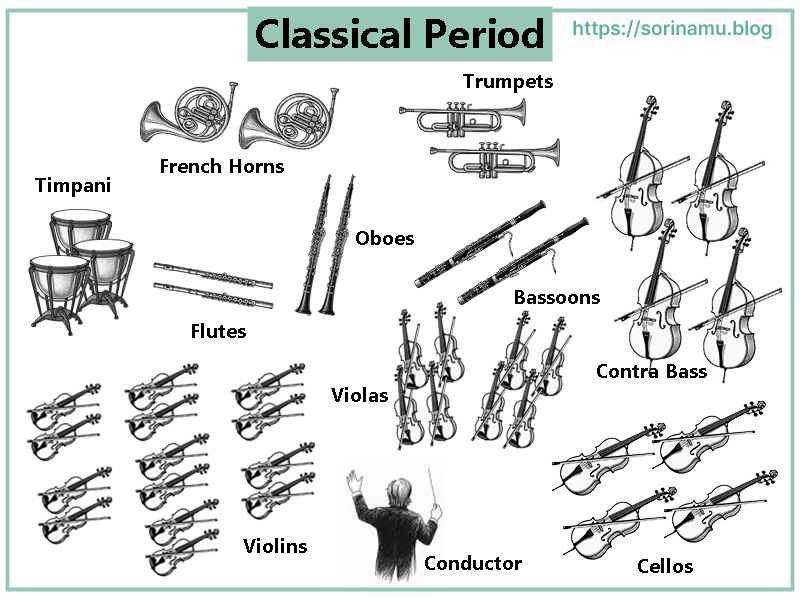
The orchestra of the Classical period evolved from the smaller Baroque ensemble into a formation that closely resembles the modern symphony orchestra. In the Baroque era, the basso continuo—played by harpsichord or organ with a bass instrument—supported the entire texture, but in the Classical period this practice disappeared and each instrumental part was written independently. As a result, the first violin often led the ensemble, or a conductor used a baton to guide the group, allowing a more balanced structure and a more coordinated performance style.
Classical Orchestra Layout
The Classical orchestra abandoned the Baroque continuo and adopted a structure guided by a conductor or concertmaster. Strings formed the central body, while woodwinds, brass and timpani were positioned with increasing symmetry to maintain clarity and balance. This layout became the basis of the orchestral seating plan still recognized today.
Early and Late Classical Instrumentation Compared
Haydn’s early symphonies, such as Symphony No. 6 “Le Matin” (1761), featured small forces built around strings, with one flute, two oboes, one bassoon and two horns. Woodwinds still served largely coloristic functions, and brass remained limited. In contrast, Beethoven’s Symphony No. 5 (1808) uses a large Classical orchestra including two flutes, two oboes, two clarinets, two bassoons, two horns, two trumpets, three trombones, timpani and full strings. The appearance of trombones and the active use of clarinets show how the late Classical orchestra already anticipated the expansion of the Romantic era.
Thus the Classical period was not only a time of stylistic change but a moment when the orchestra itself matured. The improvised and uneven textures of the Baroque ensemble gave way to a structure in which strings, woodwinds, brass and percussion were deliberately balanced. This Classical framework became the starting point for the large-scale orchestras of the 19th century.
Image Credits — Classical Orchestra Instruments
Strings
- Violin (Paris, France, 1803). Maker: François-Louis Pique. The Metropolitan Museum of Art. Object no. 1997.237.2.
- Viola (Italy, late 18th century). Maker unknown. The Metropolitan Museum of Art. Object no. 1991.28.2.
- Cello (London, England, 1782). Maker: William Forster. The Metropolitan Museum of Art. Object no. 2016.786a–c.
- Three-string Double Bass (late 18th century). AI-based reconstruction inspired by historical gamba-shaped designs.
Woodwinds
- Flute in C (Dresden, Germany, 1796). Maker: Heinrich Grenser. Library of Congress, Music Division. Object no. DCM 0644.
- Oboe (Dresden, Germany, ca. 1800). Maker: Johann Heinrich Grenser. The Metropolitan Museum of Art. Object no. X.307.
- Clarinet in C (United States, ca. 1825). Maker: Edward Riley. The Metropolitan Museum of Art. Object no. 1982.42.
- Bassoon (Paris, France, 1813–1825). Maker: Jean-Jacques Baumann; keys by C. H. Felix. The Metropolitan Museum of Art. Object no. 89.4.885.
Brass
- Natural Trumpet in D (Jettingen, Germany, 1790). Maker: Andreas Naeplaesnigg. The Metropolitan Museum of Art. Object no. 89.4.1097.
- Orchestral Horn (near Markneukirchen, Germany, ca. 1830). Sold by Carl Gottfried Glier and Sons. The Metropolitan Museum of Art. Object no. 89.4.1110a–j.
- Trombone (Europe, mid-19th century). Maker unknown. The Metropolitan Museum of Art. Object no. 89.4.3253.
- Serpent (France, ca. 1810). Wood body covered with leather. The Metropolitan Museum of Art. Object no. 2005.372.
Keyboard
- Fortepiano (Vienna, Austria, 1838). Maker: Conrad Graf. The Metropolitan Museum of Art. Object no. 2001.272.
(1) String Section — The Center of the Orchestra
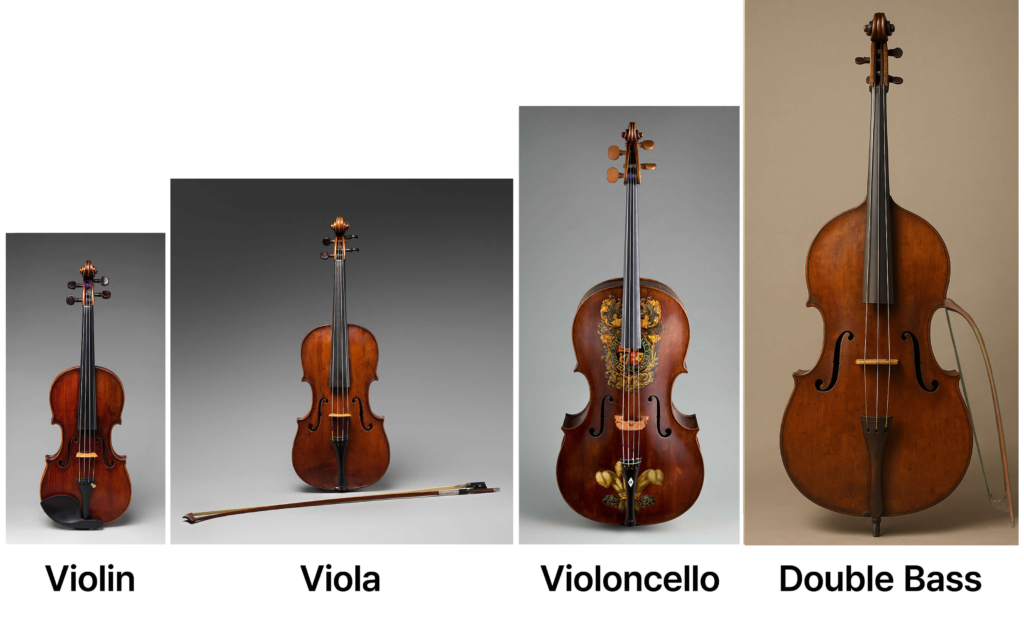
The Classical orchestra placed its foundation in the strings: violin, viola, cello and double bass formed layered textures in which each instrument served a distinct role. The violin carried principal themes, the viola filled the middle register and the cello and double bass created a firm bass foundation. This balanced hierarchy became the structural core of the orchestral sound and continues to define modern orchestration.
During this period, innovations in bow design and string materials improved clarity and projection. Instead of the short Baroque bow, players adopted the longer and more elastic bow developed by François Tourte, allowing greater control of dynamics from soft legato to powerful forte. Gut strings were gradually replaced with metal-wound strings, adding stability and strength. These innovations enabled far greater nuance and expressive shaping.
Renowned instruments by Stradivari and Guarneri became widely used, their resonant and brilliant timbres contributing to the Classical ideal of balance and clarity. In the works of Haydn, Mozart and Beethoven, the string section embodied the era’s emphasis on unity, proportion and refined musical line.
(2) Woodwinds — Adding New Color
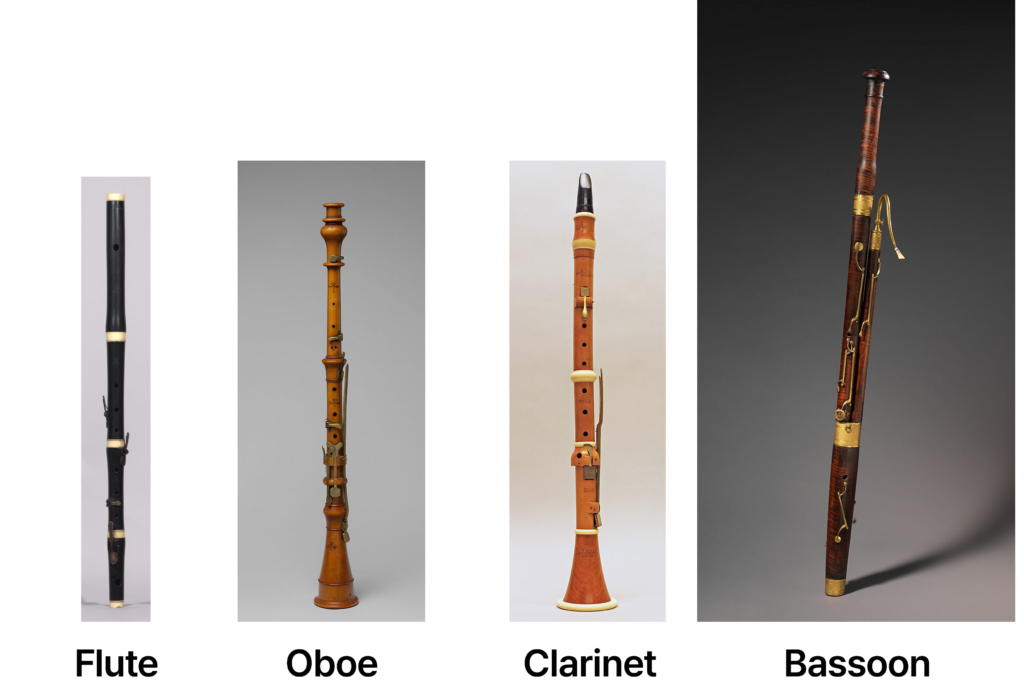
Woodwinds underwent the most significant transformation in the Classical period. While they had largely reinforced strings in earlier eras, they now emerged as fully independent voices. Flute, oboe, bassoon and the newly integrated clarinet were typically used in pairs, each contributing its characteristic sound to the ensemble’s color palette.
The wooden flute gained smoother mechanics for more fluid phrasing. The oboe adopted warmer, more vocal-like qualities through refined tone holes, while the bassoon strengthened the lower register and blended naturally with strings. The clarinet added depth and warmth with its rounded timbre; Mozart’s Clarinet Concerto in A major, K.622 showcased its expressive possibilities.
These developments gave the Classical orchestra fresh vitality. Woodwinds no longer acted merely as support but participated in a vivid exchange of musical ideas, creating a balance not only of melody and harmony but of color and character.
(3) Brass — Evolving Forms and a Richer Sound
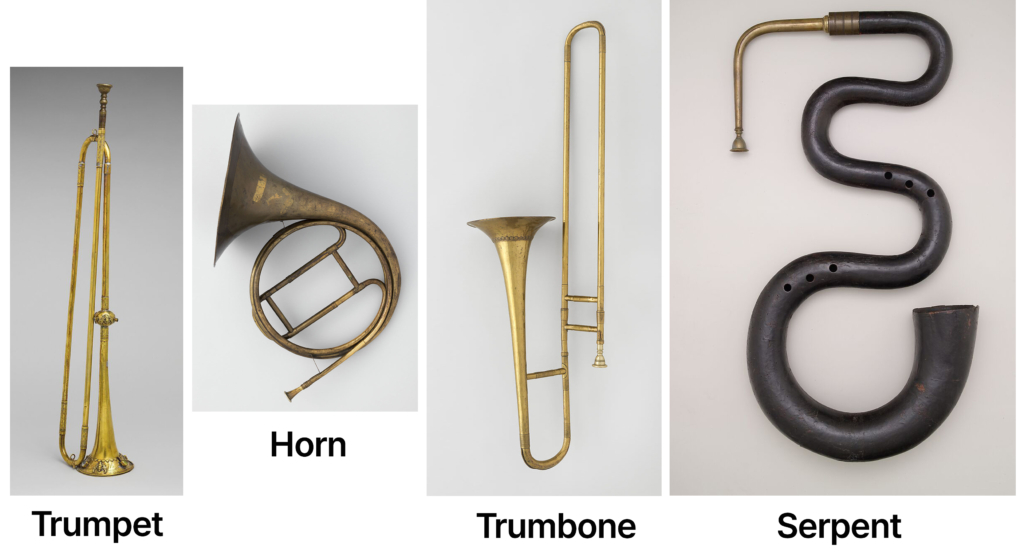
Brass instruments also developed notably during the Classical era, even though valveless natural instruments remained standard. Improvements in workmanship produced fuller and more stable sounds. Natural trumpets employed interchangeable crooks to change keys, increasing flexibility across tonalities.
The horn underwent major changes: longer tubing, more uniform coiling and the introduction of hand-stopping technique, where players adjusted pitch by inserting the hand into the bell, created warmer, expressive timbres. The horn evolved from a hunting signal instrument into an essential emotional voice of the orchestra.
The trombone advanced from the Renaissance sackbut into a form closer to today’s model, using a slide for precise intonation. By the late Classical period, it appeared in symphonic and choral works, adding solemnity and dramatic depth. Meanwhile, the serpent—a wooden, leather-covered instrument—produced tones by lip vibration like brass instruments but lacked sufficient volume and tuning accuracy for expanding orchestras. It was eventually replaced by the tuba in the mid-19th century.
(4) Keyboard Instruments — The Birth of the Piano
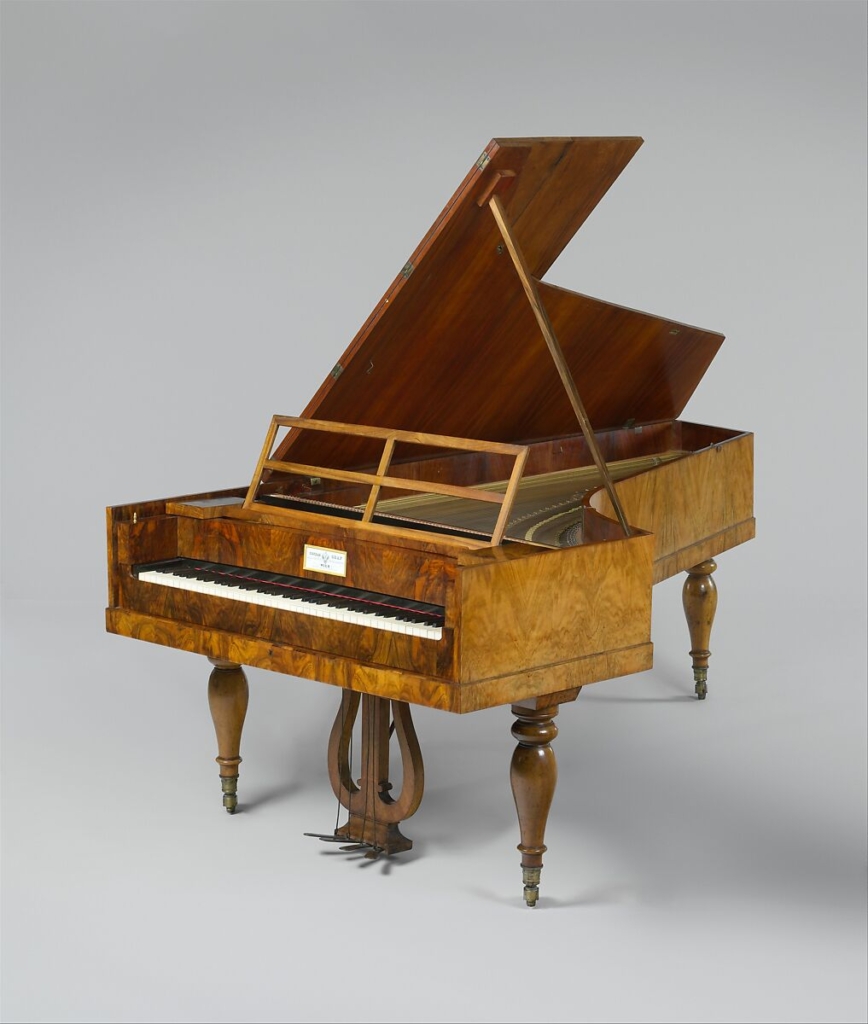
One of the most significant developments of the Classical era was the emergence of the piano. Invented around 1700 by Bartolomeo Cristofori, the piano used a hammer mechanism that allowed for dynamic control unavailable on the harpsichord. Early instruments were called the fortepiano, meaning “able to play loud or soft.”
From the mid-18th century onward, Viennese makers such as Stein, Streicher and Walter strengthened the frame and increased string tension, producing a fuller, more powerful tone. Mozart favored the delicate clarity of Anton Walter’s instruments, while Beethoven preferred the strong, resonant English Broadwood pianos, using them to explore a broader expressive range.
The piano quickly became the central instrument of the Classical era, shaping sonatas, concertos and chamber works. Its rise foreshadowed its dominance in the Romantic period, where it would become synonymous with personal expression and artistic imagination.
(5) Percussion — Driving Rhythm and Tension
Although relatively few percussion instruments were used in the Classical orchestra, they played essential structural roles. The timpani stood at the center, gaining more accurate tuning systems and increased dynamic range. No longer used only decoratively, the timpani emphasized harmonic tension and clarified dramatic climaxes.
Beethoven’s symphonies highlight the timpani’s expressive force with repeated strokes that heighten urgency and structural definition. Other percussion instruments—triangle, cymbals and bass drum—began appearing gradually. Used sparingly, they enriched orchestral color and introduced rhythmic brilliance, foreshadowing the large percussion sections of the Romantic orchestra.
4. Development of Musical Genres
(1) Symphony – The Center of Orchestral Music
The symphony became the representative genre of the Classical period. Although it had its roots in the Italian overture of the Baroque era and in the concerto grosso tradition, the Classical period established the fast–slow–fast three-movement structure, which later expanded into the four-movement Classical model. This structure was standardized through Haydn, Mozart, and Beethoven, and continued into the Romantic era.
Early symphonies were composed for court concerts and aristocratic patronage, but gradually became the core repertoire of public concerts. As orchestras expanded and the active inclusion of woodwinds and brass enriched the orchestral sound, the overall sonority became fuller and more colorful.
Haydn left more than 100 symphonies, establishing the foundation of the genre. His late “London” Symphony (No. 104) shows a grand scale and brilliant orchestration tailored for major urban audiences, demonstrating that the symphony had developed into an international genre.
Mozart combined emotional depth with contrapuntal precision in his symphonies. Symphony No. 41, “Jupiter,” brings fugal techniques and dramatic tension into a clear Classical form, reaching the height of Classical symphonic writing.
Beethoven transformed the symphony into a stage for personal narrative and the spirit of the age. His Symphony No. 3, “Eroica,” with unprecedented length and dramatic storytelling, is a monumental work that embodies the revolutionary spirit of its time.
(2) String Quartet – The Essence of Chamber Music
The string quartet became the central chamber genre firmly established during the Classical period. Two violins, viola, and cello engage in a balanced conversational texture, creating an ensemble that embodies Classical ideals of clarity, proportion, and mutual interaction. Rather than a simple contrast between melody and accompaniment, the four parts support, answer, and develop each other, forming a structure that distills the Classical aesthetic into its purest chamber form.
Haydn is often called the “father of the string quartet.” Moving beyond the early, orchestral-like style, he established a truly dialogic approach in which each instrument participates independently. His Op.76 quartets are masterpieces of his mature period; the famous theme of the second movement of the “Emperor” Quartet later achieved national symbolic significance.
Mozart deepened the expressive range of the string quartet in the works dedicated to Haydn. Pieces such as the G major K.387 and the D minor K.421 condense the tension, lyricism, and operatic sensitivity found in his orchestral and vocal music into the intimate density of chamber writing.
Beethoven’s late quartets reveal a pioneering spirit that anticipates both Romanticism and modern music. While his early quartets follow the tradition of Haydn and Mozart, the late works (Op.130–135) contain innovative, sometimes challenging forms that opened entirely new artistic paths.
(3) Concerto – Dialogue Between Soloist and Orchestra
The concerto experienced remarkable development during the Classical era. While it inherited ideas from the Baroque concerto grosso and solo concerto traditions, the Classical period established a new identity: a close dialogue between the solo instrument and the orchestra. As ritornello patterns merged with the sonata principle, the concerto increasingly emphasized structural unity, harmonic tension, and thematic contrast.
Haydn, though less prolific in concertos compared to his symphonies and chamber works, left an important early example. His C major Cello Concerto (Hob.VIIb:1) displays the early Classical concerto style through its clarity, bright themes, and elegant phrasing.
Mozart became the true pioneer of the Classical concerto. He composed concertos for violin, flute, and horn, but it was the piano concerto in which he reached the pinnacle of Classical instrumental expression. Instead of confrontation, Mozart shaped a conversational balance between soloist and orchestra, laying the foundation for the Romantic concerto.
Beethoven expanded the concerto into a symphonic-scale drama. His Violin Concerto in D major, Op.61 blends lyricism with monumental structure, while the Piano Concerto No.5 in E♭ major, Op.73 (“Emperor”) presents the soloist and orchestra as equal partners in a bold, heroic narrative.
(4) Sonata – The Center of Keyboard Music
The sonata became the most important musical form of the Classical era and rose to the center of music history alongside the spread of the piano. Rather than being a simple structural template, the sonata form was defined as a process in which themes are presented, developed, and then returned, creating musical tension and resolution. This principle spread into symphonies, concertos, and chamber music, becoming the underlying system of Classical musical language.
Haydn first composed sonatas for early keyboard instruments such as the clavichord and harpsichord, but as the piano evolved, his works gained richer character. His Sonata in F major, Hob.XVI:23 shows the clear melodies and concise structure that represent the foundation of the Classical sonata.
Mozart heightened lyricism and elegance in his piano sonatas. Sonata No.11 in A major, K.331—beginning unusually with a theme and variations and ending with the famous “Turkish March”—is one of his most beloved works. Its singing melodic lines reflect Mozart’s characteristic charm.
Beethoven expanded the piano sonata into a space of personal expression and musical experimentation. Sonata No.21 in C major, Op.53 “Waldstein” is considered a turning point, with its large-scale design, innovative harmony, and dramatic climax opening the path toward Romanticism.
(5) Opera – The Completion on Stage
Opera remained a central genre of musical culture in the Classical period. With the coexistence of opera seria (serious opera) and opera buffa (comic opera) inherited from the Baroque period, it gradually spread from aristocratic circles to the cultural life of urban citizens and the general public. During this period, dramatic sincerity and psychological depiction of characters became increasingly important, and music and drama grew more closely integrated.
Christoph Willibald Gluck pursued the harmony of drama and music through his reform operas. Prioritizing storyline and emotion over decorative vocal ornamentation, “Orfeo ed Euridice” (1762) became a turning point in Classical opera.
Haydn composed many operas for the Esterházy court, though they largely remained within the court and did not achieve wide public success. Nevertheless, his comic sensibility and lyrical melodies also appear in his operatic works.
Mozart was the true master of Classical opera. “Le Nozze di Figaro,” “Don Giovanni,” and “Die Zauberflöte” embody a wide spectrum of human emotion—comedy and tragedy, reality and fantasy—interwoven into richly layered musical drama. Through choruses, arias, and ensembles, Mozart elevated opera into a multidimensional musical theater.
5. Major Composers and Works
First Viennese School
Haydn, Mozart, and Beethoven all worked primarily in Vienna, Austria. For this reason, the three composers are grouped together under the name First Viennese School. Their music established the core of Classical-era style—symphonies, string quartets, and the sonata form—and left behind a model of balance and structural clarity. Beethoven, in turn, carried this tradition forward and laid a bridge toward Romanticism, securing his place at the center of Western music history.
Franz Joseph Haydn (1732–1809)
“Father of the Symphony and String Quartet, the architect of Classical musical foundations”
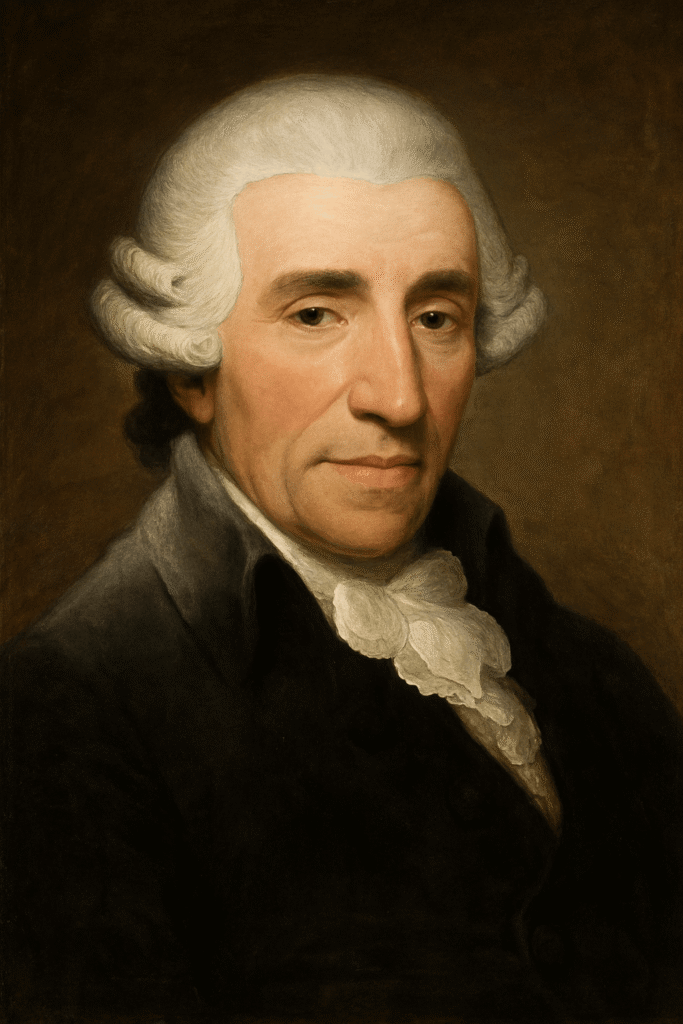
Nationality: Austrian
Activity: Kapellmeister at the Esterházy court; later active in Vienna
Main genres: Symphonies, string quartets, piano sonatas, sacred music
Haydn composed more than 100 symphonies and an extensive body of string quartets, solidifying the Classical style. Works such as the “Surprise” and “Clock” symphonies, the London Symphonies, and the Emperor Quartet reveal structural mastery combined with humor and warmth. His oratorios The Creation and The Seasons are considered the most monumental sacred works since Bach. Haydn’s originality, formal innovation, and experimental spirit became a decisive influence on Mozart and Beethoven.
Wolfgang Amadeus Mozart (1756–1791)
“A composer who perfected Classical music through extraordinary melody and dramatic sensitivity”
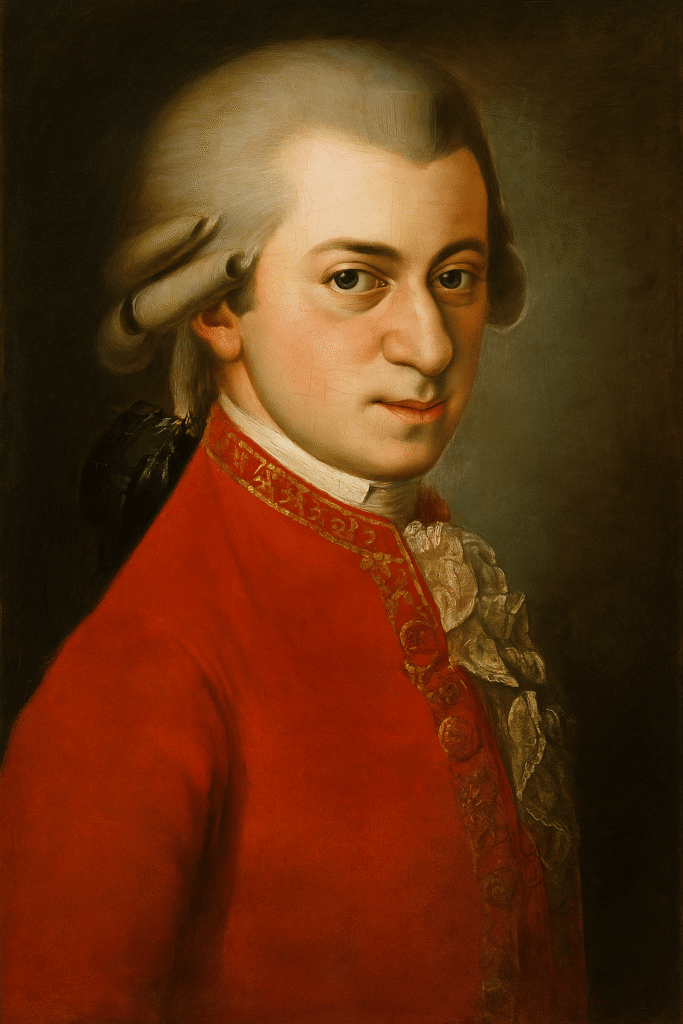
Nationality: Austrian
Activity: Salzburg court musician; later an independent composer in Vienna
Main genres: Symphonies, concertos, operas, chamber music, sacred music
Mozart left over 600 works across nearly every genre. From Symphonies No.40 and No.41 to Piano Concertos Nos.20–27, from quartets and quintets to operas such as The Marriage of Figaro, Don Giovanni, and The Magic Flute, and the sacred Requiem, his music blends elegant melody, balance, and human emotion. His art combines Classical clarity with Romantic sensitivity, inspiring Beethoven and Schubert. Mozart’s melodic invention, dramatic expression, and perfect structural balance became defining achievements in Western Classical Music.
Ludwig van Beethoven (1770–1827)
“A revolutionary musician who opened the door from Classicism to Romanticism”
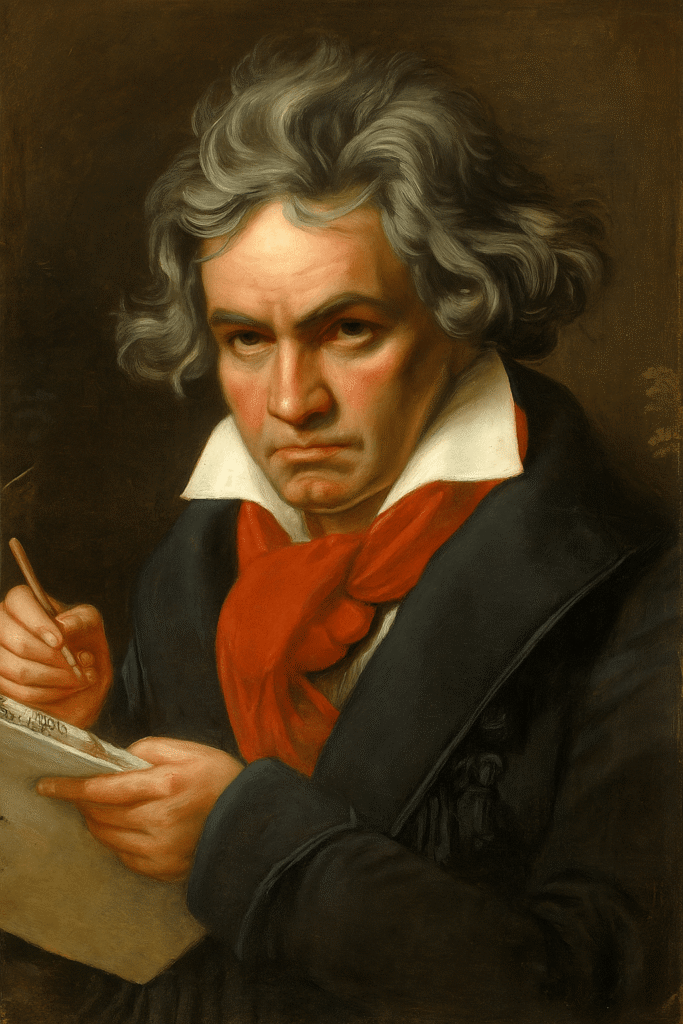
Nationality: German
Activity: Childhood in Bonn; later active in Vienna
Main genres: Symphonies, concertos, piano sonatas, string quartets, sacred music
Beethoven developed Classical form to its limits while infusing it with personal emotion and the ideals of his era. His hearing loss pushed his music toward new expressive depth. His works bridge two eras and reshape the concept of musical expression. Beethoven’s redefinition of musical form, elevation of individual expression, and integration of philosophical ideals reshaped Western Classical Music.
Conclusion
The Classical period (1750–1827) was a stage in which Western Classical Music achieved balance, order, and a new sense of universality. The major–minor tonal system became firmly established, and the sonata form shaped musical logic across all genres. Symphonies, string quartets, concertos, piano sonatas, and opera reached full maturity and opened a clear path toward Romanticism.
Haydn laid the foundation, Mozart refined its harmonic clarity, and Beethoven expanded beyond it to create a new musical direction. Their shared aim was to unite emotional depth with structural clarity.
This principle of Classical Music—“free emotion within balanced form”—became a central axis of later musical thought. What emerged in the Baroque period gained structure in the Classical period and blossomed with renewed expressive intensity in the Romantic period.
Further Reading
Western Music History ③ Renaissance Music (1400–1600) | The Music of Human Emotion
Western Music History ③ Renaissance Music (1400–1600) | The Music of Human Emotion