

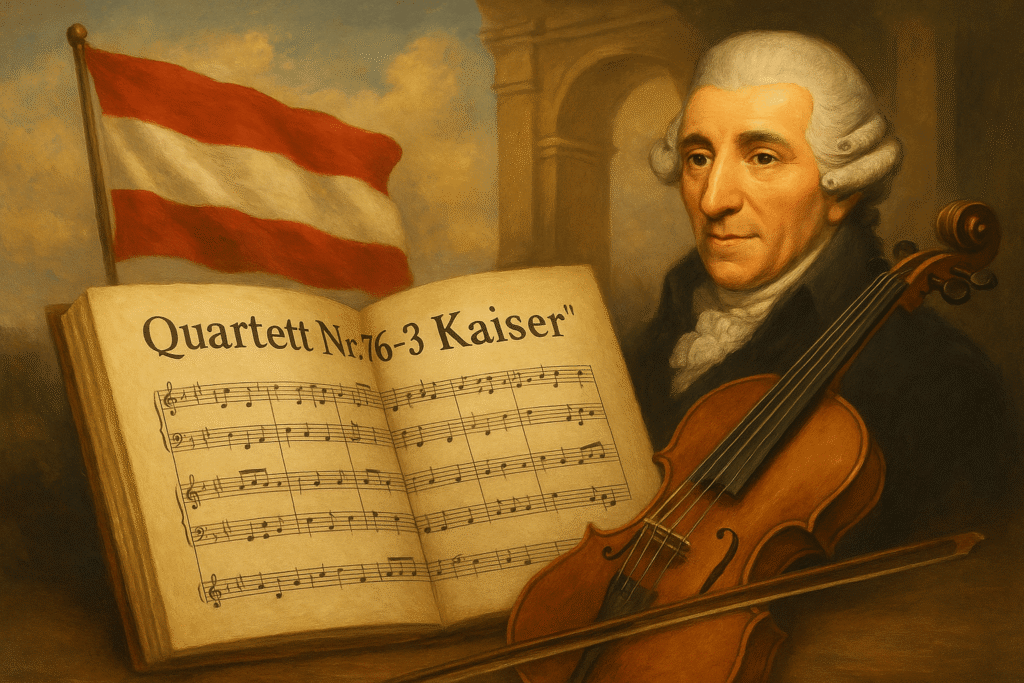
The Haydn Emperor Quartet is far more than a ceremonial composition. Written as a hymn honoring the Austrian emperor, it has become a cherished work of the Classical period that continues to move listeners with its quiet dignity. The melody of its second movement later became the tune of the German national anthem, a fact that gives the Haydn Emperor Quartet a rare blend of historical symbolism and lasting musical grace.
Within the broader history of the string quartet, the Haydn Emperor Quartet stands out as a work in which personal devotion, political anxiety, and Classical balance quietly intersect. Its theme is simple, yet the way Haydn shapes and varies it turns a modest tune into something enduring.
Franz Joseph Haydn (1732–1809) – A Composer of Quiet Greatness
“The Eternal Mentor of Classicism”
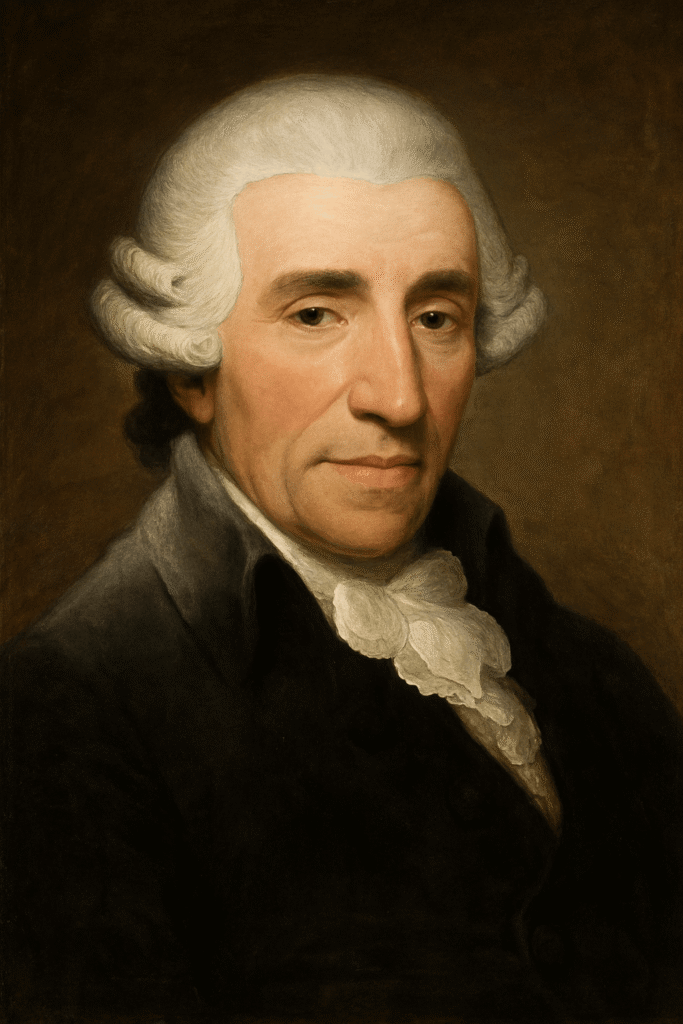
- Nationality: Austrian
- Activity: Esterházy court musician; major figure of the Viennese Classical era
- Main genres: symphonies, string quartets, chamber music, sacred works
- Notable contribution: established the structural foundations of the symphony and the string quartet
Franz Joseph Haydn was born in 1732 in the small Austrian village of Rohrau. His father was a wheelwright, and the home was filled with folk songs and simple melodies. Even before formal training, Haydn possessed an instinctive ear; he remembered and imitated tunes naturally. At six he entered a church choir, eventually joining the choir of St. Stephen’s Cathedral in Vienna, where his musical path truly began.
His youth, however, was not easy. Lacking structured instruction in composition, Haydn taught himself by borrowing and copying scores, studying counterpoint and harmony alone in a cold attic. These self-driven efforts created the technical foundation that would later shape the Classical style. Through persistence and independence, he developed a musical language that would influence generations.
At twenty-nine, Haydn became a court musician for the Esterházy family, a position he held for more than thirty years. Though far from major cities, he found the freedom to experiment and refine his craft. During this long period of service he established the forms of the symphony and the string quartet, creating a large body of orchestral and chamber works that defined Classical instrumental music.
Mozart and Beethoven both admired Haydn deeply. Beethoven even studied with him for a time, and Haydn generously supported younger musicians. His music blends poise with depth, wit with sincerity, and restraint with humanity—qualities that also shape this quartet.
Haydn passed away in 1809, during Napoleon’s invasion of Vienna. In his final writings he expressed gratitude for a long life spent composing with the talent he believed he had received from God. His character—steady, humble, and devoted—resonates throughout his late works.
The Birth of the Haydn Emperor Quartet – A Hymn of Loyalty and Dignity
In 1797, Haydn composed what is now known as the Haydn Emperor Quartet to celebrate the birthday of Emperor Francis II. Europe was unsettled in the aftermath of the French Revolution, and Haydn responded by shaping his patriotism into music. The central theme of the second movement began as a hymn with the text “Gott erhalte Franz den Kaiser,” and was then adapted into the structure of a string quartet.
Its journey did not end there: the melody later became the German national anthem, passing through different political eras while retaining the line that Haydn had first written as a prayer for unity and stability in uncertain times.
For this reason, the Haydn Emperor Quartet is more than praise for a monarch. It is the response of a musician confronting political upheaval, and a record of the era’s spirit rendered in sound.
What Is a String Quartet?
A string quartet consists of two violins, viola, and cello. Each instrument carries its own line, yet all four combine in close dialogue. Haydn played a central role in shaping this ensemble, using it to balance emotional expression with musical logic. In this work the ensemble becomes a vehicle for both public symbolism and quiet, personal feeling.
The clarity and equilibrium found here would influence later composers such as Mozart and Beethoven, but the basic model of four independent, equal voices speaking together is already complete in the Haydn Emperor Quartet.
The Four Movements
I. Allegro
The first movement presents a confident and lucid sonata form. Bright phrases unfold with Classical symmetry and a proud ceremonial character, setting the stage for the more intimate second movement.
II. Poco adagio cantabile – The “Emperor’s Hymn”
The second movement opens with the first violin presenting the hymn-like theme. Each remaining instrument—cello, viola, and second violin—takes up this melody in turn, weaving a sequence of variations that preserve a gentle, noble calm.
III. Menuetto: Allegretto
This movement follows the elegant minuet tradition. Its graceful lines carry subtle wit, while the trio section offers a softer, pastoral mood that briefly steps away from ceremony into something more rustic.
IV. Finale: Presto
The finale is lively and rhythmic, closing the work with clarity rather than weight. Its driving energy provides a bright sense of conclusion after the inward focus of the slow movement.
The Second Movement – Theme and Four Variations
The second movement of the Haydn Emperor Quartet is built on a theme and four variations. Its beauty lies in refinement rather than virtuosity; the music flows with disciplined form and gentle emotion, each variation revealing a new color of the same melody.
The theme is first stated by the first violin with the calm of a quiet prayer. In Variation I, the cello leads the melody while the first violin adds gentle decoration above. In Variation II, the viola sings the tune as the surrounding lines grow more active.
Variation III moves into the minor mode, introducing soft tension and a sense of muted sorrow without losing composure. Finally, Variation IV returns to major; all four instruments share the material in balanced interplay, and the movement comes to a peaceful, dignified close.
Through this sequence—theme followed by four variations—Haydn lets a single melody gather multiple voices, expressing both sincerity and restraint.
Historical Meaning of the Haydn Emperor Quartet
The hymn at the center of this piece was originally written for the Austrian emperor, but over time it was adapted with different texts and later became the German national anthem. When Haydn composed it, however, his purpose was not political provocation but a musical gesture meant to unify people in a turbulent age.
As the nineteenth century unfolded and new nation-states emerged, the melody took on various roles. After the upheavals surrounding the Second World War, the present text of the German anthem was established. Even so, the line itself still carries the quiet devotion with which Haydn first set it on the page.
Music often outlives its moment of origin, gathering new meanings as communities hear it anew. The Haydn Emperor Quartet is remembered not only for national symbolism, but for the quiet humanity woven into its lines.
Key Points for Listening
- The melody of the second movement of the Haydn Emperor Quartet later became the German national anthem.
- The slow movement is structured as one theme and four variations, a clear example of Classical variation technique.
- Each instrument taking the theme in turn highlights Haydn’s mastery of balance within the string quartet.
- The quartet carries meaning that transcends its original ceremonial purpose, embodying dignity that feels timeless.
- Heard in its historical context, the work reveals a deeper resonance that blends personal devotion with shared cultural memory.
Conclusion
The Haydn Emperor Quartet is not merely a hymn for a ruler. Though born of a specific moment, it has traveled far beyond its origin to speak with restraint, grace, and quiet comfort. Within the classical form of the string quartet, Haydn distilled a voice that remains luminous and sincere.
Whether this is your first encounter with the Haydn Emperor Quartet or a familiar return, its lines reveal new subtleties with each hearing, leaving a calm and lasting impression.
Further Reading
String Quartet | How Four Instruments Shape a Musical Conversation
String Quartet | How Four Instruments Shape a Musical Conversation
String Quartet History | From the Trio Sonata to a Free Language of Expression
String Quartet History | From the Trio Sonata to a Free Language of Expression