
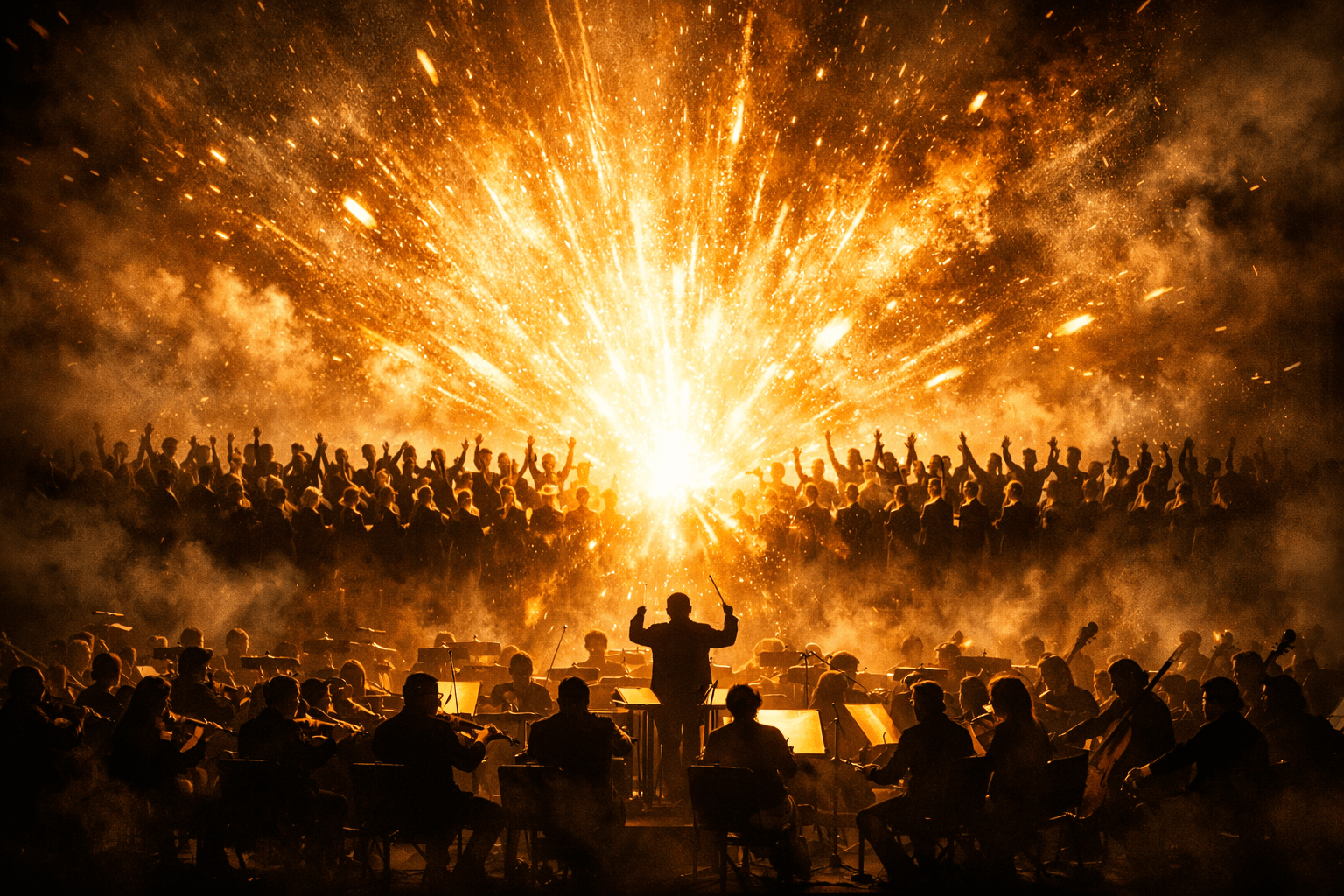
1. May 7, 1824 — Vienna
On the evening of May 7, 1824, the Kärntnertortheater in Vienna was packed to capacity. The audience had come for the premiere of Beethoven Symphony No.9 — his first major orchestral work in over a decade.
When the final movement ended, the hall erupted in applause. But Beethoven, standing at the front of the stage, did not turn around. He was still facing the orchestra, studying his score. He had not heard the music. He did not hear the applause.
The contralto soloist, Caroline Unger, stepped forward and turned him to face the audience. What he saw was five standing ovations.
2. The Loss of Hearing
Beethoven began losing his hearing in his late twenties. For a composer and concert pianist at the height of his career, this was a professional and personal catastrophe.
In 1802, he withdrew to the small town of Heiligenstadt outside Vienna. There he wrote a letter addressed to his brothers — never sent, found among his papers after his death. Known today as the Heiligenstadt Testament, the letter describes the humiliation of being unable to hear a shepherd’s flute in the distance, and admits to thoughts of ending his life.
But he also wrote: “It seemed impossible to leave the world until I had produced all that I felt called upon to produce.”
He returned to Vienna. He continued composing. By the time he completed Beethoven Symphony No.9 in 1824, he was functionally deaf. Every note of the symphony existed first and only in his mind.
(For a closer look at Beethoven’s life and musical language: Beethoven Spring Sonata — The Dialogue of Two Instruments Blossoming Within Classical Form)
3. What Made Beethoven Symphony No.9 Different
Beethoven Symphony No.9 in D minor, Op. 125, broke with one of the most established conventions in Western music: it introduced the human voice into the symphony for the first time.
Four vocal soloists and a full chorus join the orchestra in the fourth movement to set Friedrich Schiller’s poem An die Freude (“Ode to Joy”) to music. Before this, the symphony had always been a purely instrumental form. Beethoven changed that permanently.
This was not a spontaneous decision. Beethoven had been drawn to Schiller’s poem since his youth in Bonn — decades before he finally set it to music. The Ninth was in many ways the work of a lifetime.
The symphony is in four movements:
- 1st movement (Allegro ma non troppo) — Opens with bare, hollow fifths in the strings, barely audible, building gradually into a full orchestral storm. One of the most recognizable openings in the symphonic repertoire. To audiences at the time, this beginning was disorienting — the music seemed to emerge from nowhere, as if order were being created out of chaos.
- 2nd movement (Scherzo) — Driving rhythmic energy. Unusually, Beethoven places the scherzo second rather than third. The timpani-driven rhythm propels the entire movement forward, building tension to its peak before the slow movement that follows.
- 3rd movement (Adagio) — A long, lyrical slow movement. A moment of stillness before the finale. Two themes alternate and vary throughout, and between the intensity of the surrounding movements, it feels like a voice speaking from deep within.
- 4th movement (Finale) — The structural and emotional center of the work. One of the most innovative movements in the history of the symphony.
4. The Fourth Movement
The finale opens with what scholars call the “terror fanfare” — a violent, dissonant outburst from the full orchestra. What follows is unusual: the opening themes of the first three movements are each recalled in turn, and each is rejected. The music seems to be searching for something it has not yet found.
Then the cellos and basses introduce a new theme. Simple, stepwise, song-like. This is the “Ode to Joy” theme.
It begins in the lowest strings and is passed upward through the orchestra — strings, then winds — growing in weight with each repetition. When the baritone soloist finally enters, his opening words function almost as a stage direction:
“O Freunde, nicht diese Töne!” — “O friends, not these sounds!”
The choral finale that follows sets verses from Schiller’s poem, building toward the thunderous final pages. Structurally, the movement combines elements of theme and variations, sonata form, and choral cantata — a hybrid unlike anything that had come before it.
5. The Premiere of Beethoven Symphony No.9
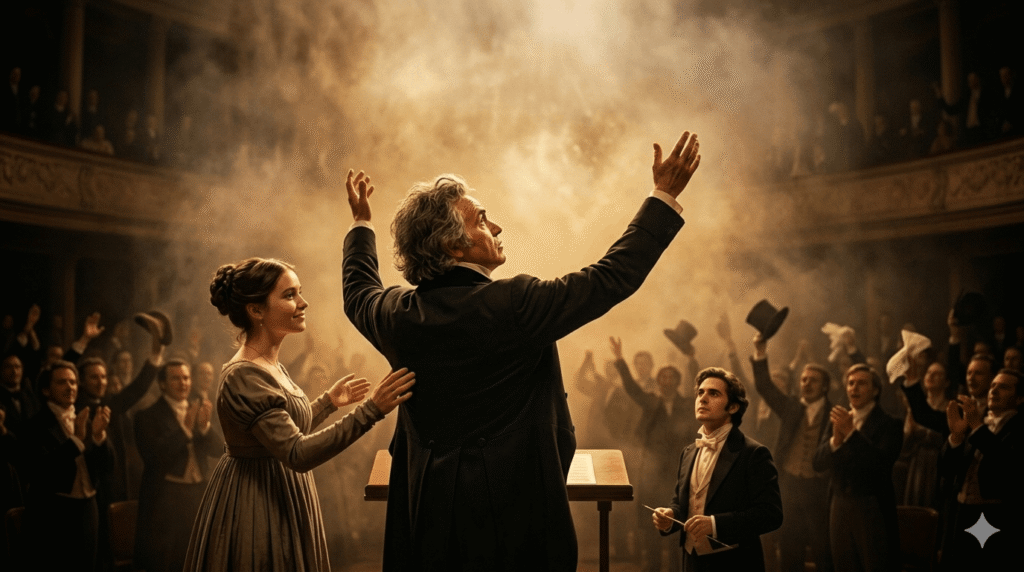
An AI-assisted reconstruction of the 1824 premiere, featuring the historic moment between Beethoven and Caroline Unger.
The premiere of Beethoven Symphony No.9 on May 7, 1824 was not without its complications. There were disputes over the choice of venue, tensions with other musicians, and a logistical problem at the center of the event: Beethoven insisted on being present despite his deafness.
The solution was quietly arranged by the conductor Michael Umlauf, who instructed the performers beforehand to follow him, not Beethoven.
The performance proceeded. Beethoven stood on stage, marked the tempo, and heard nothing. When the final note sounded, Caroline Unger stepped forward and turned him to face the audience.
The response shook the theater. Some accounts report that the police had to intervene to restore order.
6. Why It Still Matters
Beethoven Symphony No.9 has traveled far beyond the concert hall.
The “Ode to Joy” theme was adopted as the official anthem of the European Union in 1985. In 2001, the manuscript was inscribed in UNESCO’s Memory of the World Register.
It was performed when the Berlin Wall fell. It has been heard at Olympic opening ceremonies, and at historical moments large and small around the world.
Two hundred years after its premiere, Beethoven Symphony No.9 is still performed everywhere. Not only because it is a historical masterpiece, but because the “Ode to Joy” theme is instantly recognizable even to those with no background in classical music. The melody Beethoven spent a lifetime crafting has become that universal.
Further Reading
Western Music History ⑤ Classical Music (1750–1820) | Balance, Clarity, and the Logic of Form
Western Music History ⑤ Classical Music (1750–1820) | Balance, Clarity, and the Logic of Form