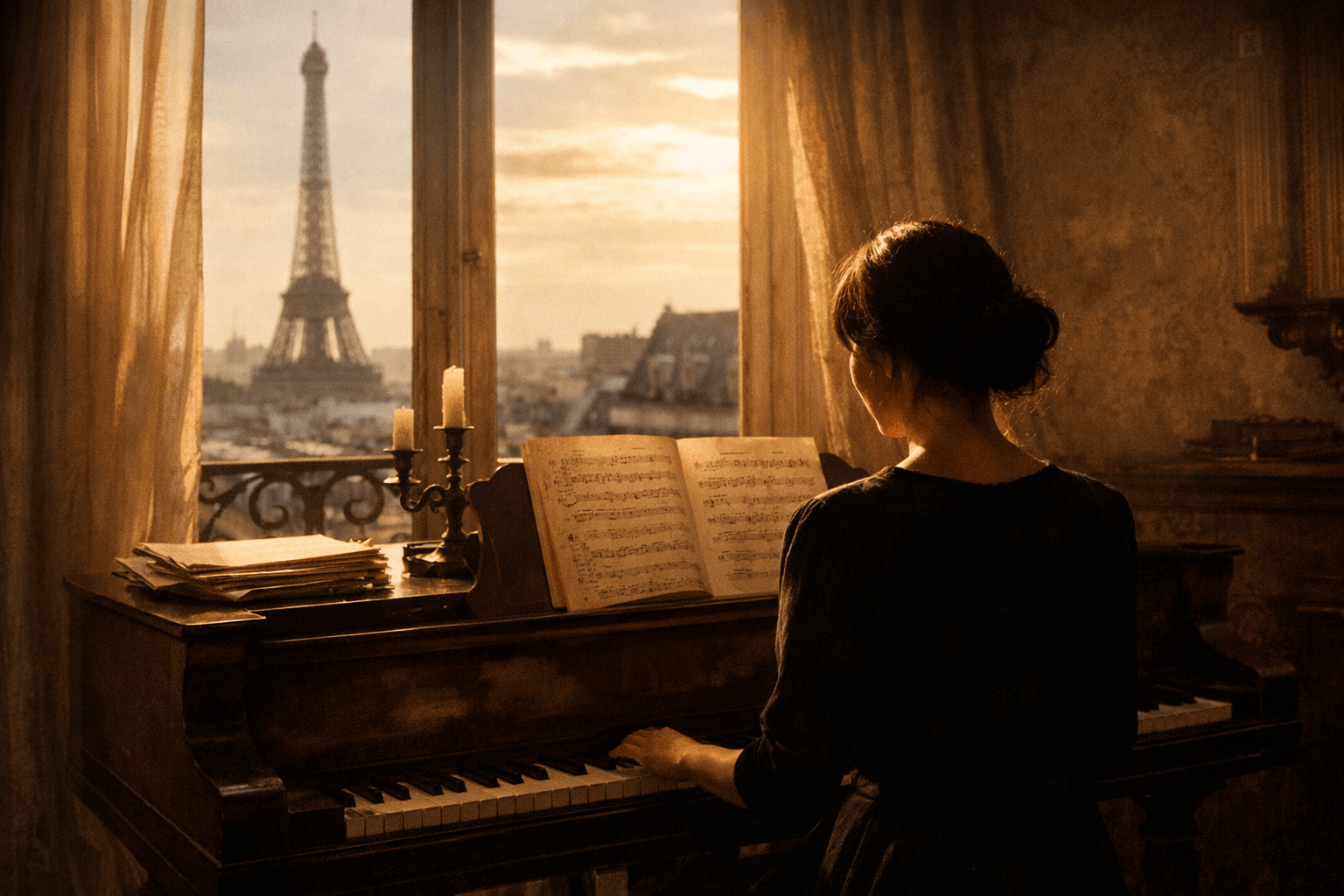
Ethel Smyth and Amy Beach represented as a woman playing piano in a quiet 19th-century interior, symbolizing the hidden lives of female composers
Ethel Smyth (1858–1944) & Amy Beach (1867–1944) | Two Forgotten Voices of Britain and America
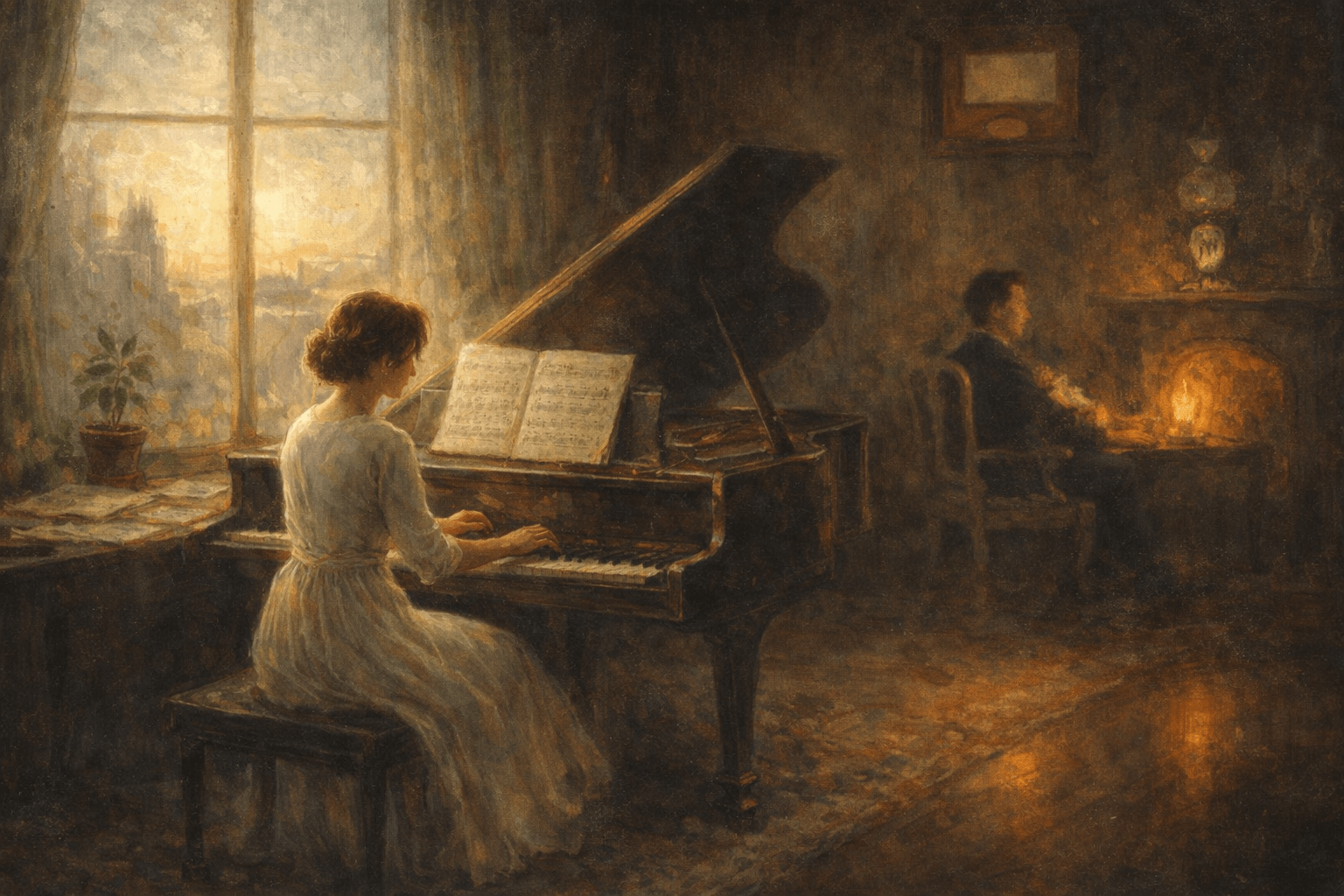
Ethel Smyth and Amy Beach represented as a woman playing piano in a quiet 19th-century interior, symbolizing the hidden lives of female composers

Women Behind the Score Series 1. Mel Bonis (1858–1937) | A Forgotten French Female Composer and the Music Hidden Behind a Name 2. Mel Bonis and Fauré | A 50-Year Musical Friendship Born in Room 7 of the Paris Conservatoire 3. Cécile Chaminade (1857–1944) & Augusta Holmès (1847–1903) | Two Forgotten Voices of Paris 4. … Read more
A foggy Vienna street with a torn and burned sheet of music overlaid at the bottom, representing how war erased the legacies of Johanna Müller-Hermann and Dora Pejačević
Johanna Müller-Hermann (1868–1941) & Dora Pejačević (1885–1923) | Two Forgotten Voices of Vienna

A foggy Vienna street with a torn and burned sheet of music overlaid at the bottom, representing how war erased the legacies of Johanna Müller-Hermann and Dora Pejačević

Women Behind the Score Series 1. Mel Bonis (1858–1937) | A Forgotten French Female Composer and the Music Hidden Behind a Name 2. Mel Bonis and Fauré | A 50-Year Musical Friendship Born in Room 7 of the Paris Conservatoire 3. Cécile Chaminade (1857–1944) & Augusta Holmès (1847–1903) | Two Forgotten Voices of Paris 4. … Read more
Cécile Chaminade and Augusta Holmès inspired scene of a woman playing piano by a Paris window with the Eiffel Tower in the background, symbolizing forgotten female composers
Cécile Chaminade (1857–1944) & Augusta Holmès (1847–1903) | Two Forgotten Voices of Paris

Cécile Chaminade and Augusta Holmès inspired scene of a woman playing piano by a Paris window with the Eiffel Tower in the background, symbolizing forgotten female composers

Women Behind the Score Series 1. Mel Bonis (1858–1937) | A Forgotten French Female Composer and the Music Hidden Behind a Name 2. Mel Bonis and Fauré | A 50-Year Musical Friendship Born in Room 7 of the Paris Conservatoire 3. Cécile Chaminade (1857–1944) & Augusta Holmès (1847–1903) | Two Forgotten Voices of Paris   … Read more

Illustration of The Clustered Sound of Horns in an orchestral setting, highlighting the harmonic blocks, dynamic divisions, and dense layering characteristic of Bruckner, Mahler, and Richard Strauss.
The Clustered Sound of Horns | A Comparison of Organizational Methods in Bruckner, Mahler, and Strauss

Illustration of The Clustered Sound of Horns in an orchestral setting, highlighting the harmonic blocks, dynamic divisions, and dense layering characteristic of Bruckner, Mahler, and Richard Strauss.

1. Introduction – How the Clustered Sound of Horns Expanded In the late 19th century, as the double horn became a standard fixture, orchestrations featuring four or more horns became commonplace. 4 became the standard, and by the Late Romantic period, it expanded to 6 or 8 depending on the work. From this point forward, … Read more

composer mbti
Composer MBTI | Resonance of Temperament Through Classical Music

composer mbti

1. Composer MBTI as an Interpretive Lens Have you ever wondered about the Composer MBTI behind famous works? Classical music often feels distant or difficult. But when we begin to see composers not as monuments of history but as individual human beings, their music starts to feel surprisingly intuitive. I find myself emotionally inclined, much … Read more

Ravel, Piano Concerto for the Left Hand: A Sublime Design Drawn from the Abyss of Loss
Ravel, Piano Concerto for the Left Hand | A Sublime Design Drawn from the Abyss of Loss

Ravel, Piano Concerto for the Left Hand: A Sublime Design Drawn from the Abyss of Loss

Maurice Ravel’s Piano Concerto for the Left Hand is not a work written merely to showcase a performer’s virtuosity. It is a vast musical epic born from the convergence of two forces: the despair of a pianist who lost his right arm in the catastrophe of the First World War, and a composer’s relentless determination … Read more

carlo gesualdo and moro, lasso, al mio duolo
Harmony Designed Outside the Norm | Carlo Gesualdo and Moro, lasso, al mio duolo

carlo gesualdo and moro, lasso, al mio duolo

1. Carlo Gesualdo: A Noble Composer Who Broke the Grammar of His Time When discussing Carlo Gesualdo (1566~1613), his tragic life cannot be avoided as a point of departure. A Neapolitan nobleman, he is recorded in history for the 1590 murder of his wife, Maria d’Avalos, and her lover, Fabrizio Carafa. Even by the standards … Read more

The Red Violin
The Red Violin(1998) | A 300-Year Musical Journey Through Classical Music History

The Red Violin

1. The Dark Shadows of Classical Music History: The Curse of the Ninth, and The Red Violin The world of classical music may seem elegant and neatly ordered, but beneath it, strange legends and tragic “curses” that cannot be explained by logic have long been passed down. Perhaps the most famous is “The Curse of … Read more

major and minor
The Collapse of Modal Thinking and the Birth of Major and Minor

major and minor

Medieval Modal Theory Series 1. From Neumes to Mensural Notation | From Music Remembered to Music Measured in Time 2. The Birth of Solmization: Guido of Arezzo and the Beginning of Do–Re–Mi 3. 8 Church Modes: Musical Order Before Major and Minor 4. Same Final, Different Modes: Authentic and Plagal Modes in Gregorian Chant 5. … Read more

Frederick Delius - On hearing the first cuckoo in spring
Frederick Delius – On Hearing the First Cuckoo in Spring

Frederick Delius - On hearing the first cuckoo in spring

On Hearing the First Cuckoo in Spring is a tone poem composed by Frederick Delius in 1912, and first performed in Leipzig on 23 October 1913. The work forms the first of Two Pieces for Small Orchestra, the second being Summer Night on the River. Although conceived as a paired set, the two pieces have … Read more

error: This content is protected. Copying or selection is disabled.