

Chopin and George Sand remains one of the most complex and emotionally charged relationships in the history of Romantic music.
1. Chopin and George Sand: The Cross-Dressed Woman and the Frail Pianist
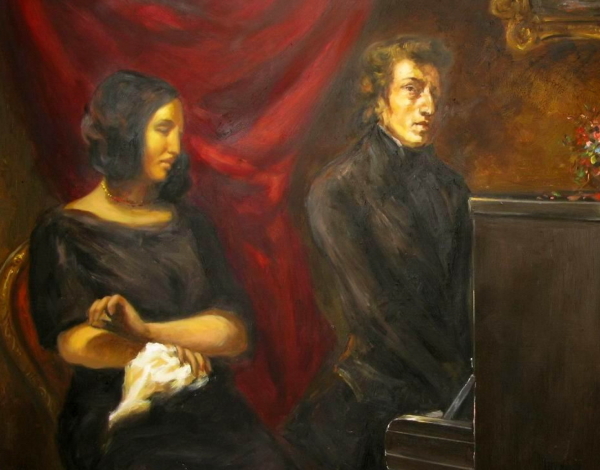
Image Source: Portrait of Frédéric Chopin and George Sand – Oil on canvas, 2008, based on Eugène Delacroix’s c.1837 preliminary sketch. Collection of Ordrupgaard, Denmark (Public Domain)
In 1836, when Parisian salon culture was at its height, Frédéric Chopin and George Sand first encountered one another. Already known as the poet of the piano and standing at the center of the Parisian musical world, Chopin found Sand to be a rather shocking presence. Dressed in men’s clothing, smoking cigars, and openly mocking social conventions, she was the kind of figure who constantly stirred conversation in Parisian society. To the pale and physically fragile Chopin, such a personality could only feel uncomfortable and unfamiliar at first.
Yet the two shared an unexpected common ground. Beneath her outward appearance, Sand deeply understood the sensitive and delicate temperament of artists, while Chopin himself was a composer who handled human emotion with extraordinary subtlety in music. The contrast between a strong and independent writer and a frail yet sensitive musician became, paradoxically, the very force that drew them toward one another. As time passed, the two developed into lovers, and this encounter came to be remembered as one of the most famous relationships in the history of Romantic music.
This relationship carried a meaning far beyond a simple romance. For Chopin, who had left Poland and was living in Paris, Sand became both an emotional refuge and a practical protector. For Sand, Chopin was an artist who occupied a special place within her life and literature. Their personalities and ways of living were profoundly different, yet it was precisely within that difference that the two began an unusual relationship that would endure for many years. In that sense, Chopin and George Sand was not merely a love story, but an artistic and emotional alliance shaped by contrast.
2. The Winter in Majorca: Melodies Forged in the Hallucinations of Death

Image Source: Valldemossa village, Mallorca – Photograph taken in September 2006 in Valldemossa, Mallorca, Spain by Olaf Tausch (Public Domain)
In the winter of 1838, Chopin and George Sand left for Majorca, an island in Spain. On the surface, it was a journey for health and recovery, but in reality it was also an attempt to escape Parisian social life and spend time in quiet isolation. However, the journey soon turned into a brutal ordeal. Chopin’s health, already weakened by tuberculosis, deteriorated rapidly in the damp and cold winter climate, and the hostility of locals who distrusted outsiders pushed the two ever further into isolation.
Eventually they settled in the Carthusian monastery in Valldemossa. The cold walls of the old monastery and the endless winter rain drove Chopin’s nerves into an extreme state of sensitivity, and it is said that he sometimes suffered from a terror of death and from hallucinations. Yet it was precisely within this extreme condition that Chopin entered an astonishingly concentrated period of creation. Cut off from the outside world, the isolated environment drove his inner life even more deeply into music.
It was during this period that he completed the work now known as the “24 Preludes, Op. 28.” Each prelude is short, but the contrasts of key and mood are sharply defined, painting human feeling in a wide range of colors. In particular, Prelude No. 15 in D-flat major is often called the “Raindrop Prelude” because of the repeated low note that sounds like falling rain. Born amid the long winter rains of Majorca, this music feels like a scene that reveals Chopin’s inner world, holding onto music to the very end in the midst of anxiety and loneliness.
3. The Summer of Nohant: The Golden Age of Creation Born of Controlled Calm
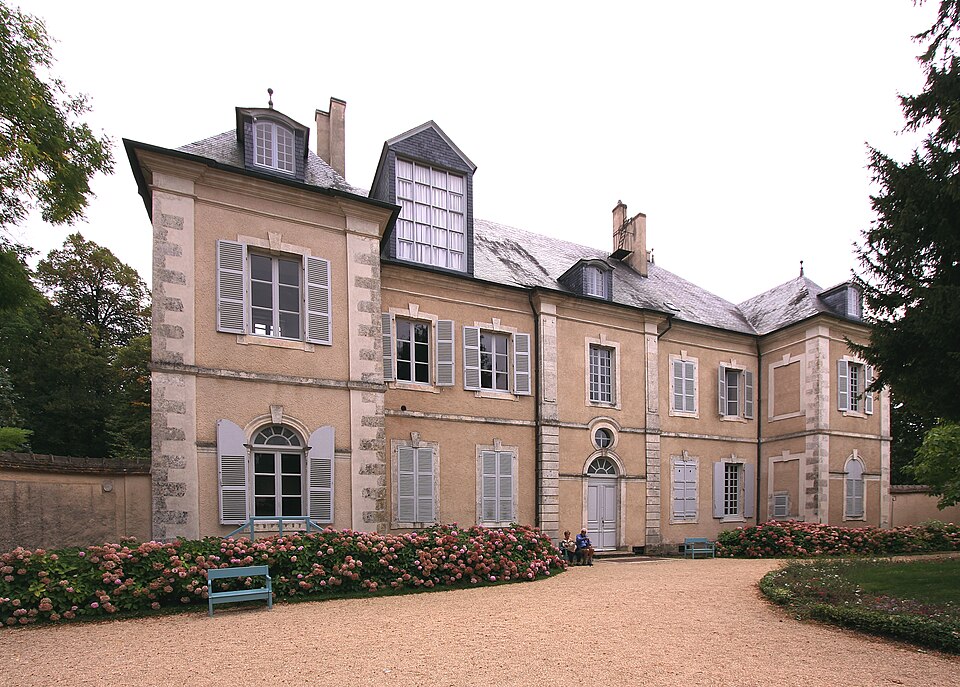
Image Source: Maison de George Sand, Nohant-Vic, France – Photograph taken on September 2, 2009 by Manfred Heyde (CC BY-SA 3.0)
After the brutal winter in Majorca, the two settled at Nohant, George Sand’s estate in the Berry region of central France. Unlike the noisy salons of Paris, it was a place of spacious gardens and quiet rural scenery. Sand carefully managed the living environment so that Chopin could remain stable, limiting outside visitors and creating a space in which he could devote himself entirely to music. For Chopin, the summers there were remembered as a rare period of peace after a long absence.
Life in Nohant unfolded with a steady rhythm. During the day there were walks and rest, and at night Chopin would sit at the piano and spend long hours composing. Sand managed the household and the visitors, carefully adjusting the environment so that Chopin’s delicate temperament would not be unsettled. Within this atmosphere of protection, Chopin was able to unfold his musical imagination more freely than before.
During this period in Nohant, a succession of Chopin’s major works came into being. Works such as the Polonaise Op. 53, Ballade No. 4 Op. 52, and Barcarolle Op. 60 are regarded as music of greater structural maturity and wider expressive range. In contrast to his fragile body, his music grew increasingly full of strength and confidence, and the summers in Nohant would remain the brightest period in Chopin’s creative life. The years that Chopin and George Sand spent in Nohant became, in many ways, the most fertile and stable period of his artistic life.
At times, even the small everyday sight of Sand’s pet dog chasing its own tail became a musical image for Chopin. Life in Nohant was a period when ordinary scenes and small incidents were transformed into melody. Away from the tension of Parisian salons, Chopin’s music began to reveal freer and more varied expressions within the quiet rhythm of country life.
4. The Beginning of the Rupture: A Soul Cut by the Blade of a Novel
The peace that had continued in Nohant gradually began to show cracks. Chopin’s health worsened steadily, and his sensitive nature and unstable physical condition cast a long shadow over their life together. George Sand, who had long been both protector and lover, also began to feel exhaustion within the relationship, and the quiet summers of Nohant slowly began to be colored by tension.
The decisive event was the publication in 1846 of Sand’s novel “Lucrezia Floriani.” In the novel appears a sickly, jealous, and emotionally dependent prince named Karol. Sand insisted that this character was not modeled on any specific individual, but in Parisian society, stories quickly spread that this character called Chopin to mind. The resemblance seemed too close to ignore, since the figure of the fragile and sensitive artist appeared to be reproduced there almost exactly.
For Chopin, this was not merely a literary controversy. Within a relationship in which he believed he was understood and protected by the person closest to him, it must have felt as though his vulnerabilities had been exposed before the public. This event deeply shook the trust between them, and from that moment onward, the relationship between Chopin and George Sand, which had lasted for nine years, began to collapse in a direction from which there was no return. The peaceful time that had continued in Nohant began, from this moment, to move slowly toward its end.
5. Silence After the Separation: The Last Melody Left Upon the Ruins
In 1847, the relationship between Chopin and George Sand finally came to an end. Their love, which had lasted for nearly nine years, came to its close. The time they had spent together in the summers of Nohant, sharing music and literature as parts of their lives, became a past to which there could be no return. This separation was not simply the end of a romance, but the collapse of an entire world that had sustained Chopin’s life.
After the break with Sand, Chopin’s creativity began visibly to come to a halt. For roughly two years afterward, he was no longer able to write major works on the same scale as before. With the stable environment and emotional support of Nohant gone, his music no longer flowed as naturally as it once had. His body, already weakened by illness, and his shaken spirit could no longer return him to the creative state he had once known.
In 1848, Chopin set out on a concert tour through England and Scotland. Yet this journey was less a triumphant artistic tour than a painful series of performances carried out with a steadily weakening body. Traveling from city to city to continue performing, he grew more and more exhausted, and after each concert his health deteriorated noticeably. To those around him, it had already become painfully clear that his body was reaching its limit.
For Chopin in this period, music was no longer the freely flowing melody it had been in the summers of Nohant. It had become something like a final language he was barely able to hold on to with the strength he had left. The music that had once illuminated the world now sounded quietly, like the last melody left upon the ruins.
6. Chopin and George Sand: Savior or Destroyer?
Even after Chopin’s death, people continued to ask what George Sand truly had been to him. Was she the lover who destroyed his life, or the protector who allowed a fragile artist to live longer and leave behind more music? Their relationship contained a complex paradox that cannot be explained as a simple love story.
One fact is undeniable: Sand shared the most important period of Chopin’s creative life. During the years they spent in Nohant, Chopin composed works such as the Polonaise Op. 53, Ballade No. 4, and Barcarolle, deepening his musical world more profoundly than ever before. During that period, Sand cared for his health and organized daily life in such a way that he could concentrate entirely on music. In this sense, Sand undeniably helped sustain Chopin’s creative life.
Yet at the same time, this relationship also left deep wounds. After the “Lucrezia Floriani” affair, the trust between them was badly shaken, and their separation left an irreversible fracture in Chopin’s life. In the two years that followed, he could no longer write works on the same scale as before, and his health declined rapidly. Once the relationship that had sustained the summers of Nohant disappeared, his life and music quickly began to weaken.
For that reason, the story of Chopin and George Sand cannot easily be reduced to a single conclusion. Sand was the person who wounded Chopin, yet also the one who shared the years in which his most radiant music was born. Perhaps, in the end, this relationship remains one of the most complex love stories left by the Romantic era, one in which salvation and destruction existed at the same time.
Within the quiet resonance of this short prelude, we seem to sense, faintly, the traces of a love that once passed through the life of an artist. The story of Chopin and George Sand remains there in the music, continuing to be interpreted even today.
Further Reading
Yunchan Lim Goldberg Variations 2026 | A Spiritual Journey Recorded at Carnegie Hall
Yunchan Lim Goldberg Variations 2026 | A Spiritual Journey Recorded at Carnegie Hall