

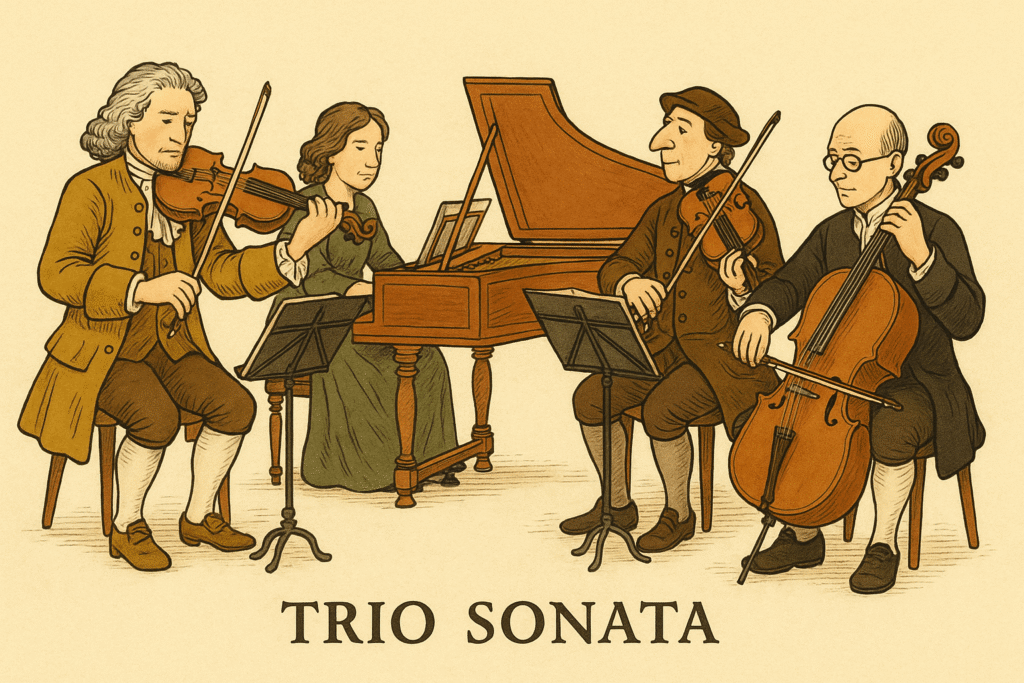
The string quartet is a representative chamber-music form consisting of two violins, a viola, and a cello.
This genre is characterized by a conversational musical flow among four performers, emphasizing cooperation, balance, and subtle expression.
This article offers a concise overview of String Quartet History, tracing how the ensemble developed from the Baroque trio sonata through the Classical, Romantic, and 20th-century periods.
Baroque Period – Chamber-Music Traditions Rooted in the Trio Sonata
In the broader line of string quartet history, the earliest structural foundation is found in the trio sonata, a popular genre of the Baroque period (c. 1600–1750).
A trio sonata consists of two melodic instruments (often violins) and one basso continuo line.
The basso continuo pairs a low-pitched instrument such as the cello with a keyboard instrument like the harpsichord, providing harmonic support across the texture.
Although the trio sonata formally contains three musical parts, it was typically performed by four musicians, because the cello and harpsichord jointly realized the continuo line.
This four-player layout—two violins, cello, and harpsichord—became the practical starting point for the evolution of the string quartet.
The conversational texture of the trio sonata also carried into the emerging quartet form, even though the independence of the four parts was not yet fully established.
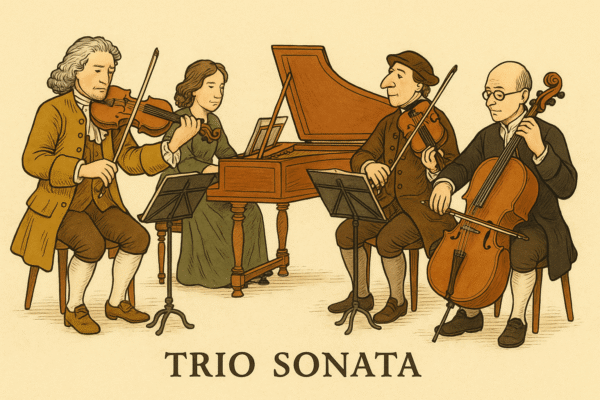
Trio sonatas have three musical parts, but they were performed by four players. The cello and harpsichord together formed a single continuo line and played the low register.
Classical Period – Establishing Form and the Equal Dialogue of a String Quartet
The Classical period (c. 1750–1820) marks one of the defining phases in string quartet history, when the genre finally became independent.
Joseph Haydn clarified each instrument’s role and created a balanced four-part texture, establishing the quartet as one of the most logical and refined mediums for a composer’s ideas.
Haydn codified the familiar four-movement structure:
- First movement – Fast, in sonata form
- Second movement – Slow and lyrical
- Third movement – Minuet and Trio
- Fourth movement – Fast finale
Wolfgang Amadeus Mozart continued Haydn’s model and enriched it with melodic beauty and harmonic refinement, contributing significantly to the continuity of string quartet history.
Ludwig van Beethoven gradually moved beyond Classical norms.
His early quartets follow Haydn’s structure, but his later works increase structural freedom, deepen thematic development, and pursue philosophical expression.
The celebrated Op. 131 unfolds across seven continuous movements, dismantling traditional boundaries and forming a unified whole within the broader development of the quartet.
Ludwig van Beethoven – String Quartet No. 14, Op. 131
(Performers: Quatuor Arod / provided by YouTube Hochrhein Musikfestival Productions channel)
A monumental late quartet in seven linked movements, often cited as one of Beethoven’s most introspective and structurally innovative works.
Romantic Period – Emotion, Narrative, and Personal Expression
During the Romantic period (c. 1820–1900), the string quartet evolved into a vehicle for emotion, narrative, and personal introspection, expanding the expressive possibilities explored throughout string quartet history.
Franz Schubert’s quartet “Death and the Maiden” captures the tension between life and death, despair and consolation, giving the work a dramatic, almost narrative dimension.
Antonín Dvořák maintained Classical clarity while integrating Czech folk melodies and rhythms.
His “American” Quartet conveys the brightness and freedom he felt during his time in the United States, blending folk color with structural transparency.
Throughout this period, the traditional four-movement structure remained, but movement length and expressive priorities became more flexible, allowing the genre to expand its emotional reach and further shaping string quartet history.
20th Century – Experimentation and New Directions in the String Quartet
The 20th century introduced new aesthetic aims and bold experimentation within string quartet history, as composers broke away from inherited frameworks and sought new musical languages.
Claude Debussy applied Impressionist techniques, emphasizing timbre, harmonic color, and atmospheric motion.
Although structurally traditional, his quartet allows for great fluidity in tonal and expressive character.
Arnold Schönberg, breaking decisively with tonality, introduced atonal methods.
His Second String Quartet, which uniquely features a soprano solo, marks a pivotal moment in redefining quartet expression and expanding the quartet’s sonic world.
Béla Bartók merged folk rhythms and modes with modernist techniques.
His quartets preserve the traditional movement counts while embracing radical rhythmic, timbral, and structural innovation.
The Fourth Quartet presents a five-movement arch form that balances folk influence with modern logic, becoming one of the essential works encountered in advanced studies of string quartet history.
Conclusion – The Enduring Evolution of the String Quartet
Across string quartet history, the ensemble has reflected the shifting ideals of Western music—from the Baroque trio sonata to Classical balance, Romantic intensity, and 20th-century experimentation.
This compact four-instrument formation remains one of the most versatile and expressive vehicles available to composers, performers, and listeners, offering endless possibilities for artistic exploration.
Further Reading
String Quartet | The Most Intimate Form of Chamber Music
String Quartet | How Four Instruments Shape a Musical Conversation
String Quartet | How Four Instruments Shape a Musical Conversation