

Medieval Modal Theory Series
1. From Neumes to Mensural Notation | From Music Remembered to Music Measured in Time
2. The Birth of Solmization: Guido of Arezzo and the Beginning of Do–Re–Mi
3. 8 Church Modes: Musical Order Before Major and Minor
4. Same Final, Different Modes: Authentic and Plagal Modes in Gregorian Chant
5. Musica Ficta | The Hidden Order Beyond the Score
6. The Collapse of Modal Thinking and the Birth of Major and Minor
7. Modern Modes | A New Musical Language Chosen by Jazz and Contemporary Music
Guido of Arezzo and the Limits of Memory-Based Chant
In medieval Europe, the center of Western music was vocal music. Musical practice existed primarily in the form of religious chant, and a refined notational system like the one we know today had not yet been established. During this period, chants were transmitted by listening to senior singers and imitating their voices, and repeated singing and complete memorization were virtually the only ways to learn them.
Under this system, the same chant inevitably varied depending on who first sang it and in which region it was learned. Over time, these differences became increasingly pronounced from place to place, and chants gradually took on distinct local forms. To preserve music in this era did not mean writing it down on paper, but storing it in human memory.
The situation began to change when attempts were made to record sound visually. With the emergence of neumes—symbols that indicated the movement of a melody—it became possible to follow the contour of a chant with the eyes. Chant was no longer dependent solely on the ear, and variations arising during transmission could be reduced to some extent.
Nevertheless, neumes alone had clear limitations. They made it difficult to sing an unfamiliar chant immediately from notation, and melodies still had to be memorized through repetition. Since the same neumes could be interpreted at different pitch levels, singing at the same pitch was far from guaranteed. This article examines the methods devised by Guido of Arezzo to transform this memory-based system of music education, and traces the birth of solmization, the foundation of what we now know as Do–Re–Mi.
The Problems Neumes Could Not Solve
Neumes made it possible to see the general direction of a chant’s melody, but they failed to solve one crucial problem. While a singer could tell whether a pitch moved upward or downward, it was difficult to determine exact pitch height. As a result, the same neumes could lead different singers to perform the same chant at slightly different pitch levels.
For this reason, the way chants were learned did not fundamentally change even after neumes appeared. New chants still had to be heard first from another singer, and notation functioned mainly as an aid to memory. Singing an unfamiliar chant directly from notation remained difficult, and during practice, students continually relied on their teacher’s voice.
The issue was not the presence or absence of neumes, but the lack of a shared reference. Without a common standard for pitch, notation alone could not free music from dependence on memory. At this point, chant education once again reached its limits.
What Guido of Arezzo Sought to Change
One of the people who felt these limitations most keenly was Guido of Arezzo. Rather than composing new music, he devoted much of his time to teaching existing chants. The problem was not the number of chants, but the amount of time required to learn them. Students took too long to master the same melody, and even after learning it with difficulty, they often had to correct it again when moving to another place.
Guido did not view this situation as a problem of individual ability or memory. Instead of searching for ways to help singers memorize more efficiently, he believed it was necessary to create a system that would allow unfamiliar chants to be sung at the same pitch from the outset. In other words, the core issue was not memorization, but a shared standard. Everyone needed to point to the same pitch and begin from the same sound.
What Guido sought to change was not neumes themselves. Neumes showed the direction of a melody, but he believed it was now necessary to indicate where each pitch was located. Relying on memory alone, he concluded, had inherent limitations.
Teaching Pitch as “Place,” Not Memory
Guido of Arezzo did not focus on pitch names or melodies themselves. Everyone already understood the sensation that one pitch was higher or lower than another. The problem was that there was no common way to verify that height. When pitch was left to memory, even the starting note of the same chant could vary.
Guido sought to treat pitch not as a sensation or a memory, but as a visible location. If everyone could identify where a pitch was placed in the same way, it would no longer be necessary to hear a chant before singing it. This was the shift from memorizing sound to reading pitch.
From this idea emerged the concept of the staff. Once lines were drawn on the page, pitch was no longer an abstract height but a fixed position. Other pitches could be compared in relation to that position, and individual judgment became more consistent. The attempt to transform pitch from something to be remembered into something that could be visually confirmed began here.
The Change Brought by Four Lines: The Four-Line Staff
Guido of Arezzo used lines to fix pitch on the page. In manuscripts without lines, it was difficult to judge pitch precisely, but once lines were introduced, the situation changed. Each pitch was placed either on a line or in a space, and that position itself became a reference for pitch height. Pitch was no longer a vague sense of “high” or “low,” but a place that could be seen.
Guido used four lines. This number was sufficient to notate the vocal range of chant and avoided unnecessary complexity. What mattered was not the number of lines, but the fact that everyone could judge pitch using the same reference. From the same notation, singers could clearly see where a chant began and how far each pitch moved upward or downward.
Within Guido’s system, certain lines were given particular emphasis. Rather than drawing lines alone, the line corresponding to F was often marked in red, and the line for C in yellow, making pitch references immediately visible. This practice, which embodied Guido’s educational thinking within scribal traditions, helped singers avoid losing their way among pitches and allowed them to identify starting points and pitch locations with greater accuracy. The concept of such reference lines later formed the conceptual foundation for clefs as indicators of pitch height.
As a result, the role of notation itself changed. Whereas earlier notation served mainly as a memory aid, the four-line staff became a tool for directly reading pitch. Singers could follow pitch placement by looking at the page without first hearing the chant. The long-standing challenge of ensuring that everyone sang at the same pitch finally began to be resolved.
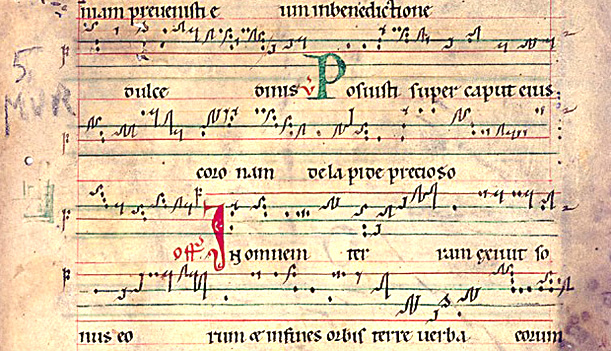
Image source: Detail of four-line staff neumes from a 12th-century chant manuscript, Offertorium In omnem terram, Schøyen Collection MS 207. Cistercian notation on a four-line staff. Wikimedia Commons, Public Domain.
Why Solmization Became Necessary
Although the four-line staff clarified pitch location, a new problem emerged during practice. To teach from notation, it became necessary to name the pitches being pointed to. One could not simply gesture at a spot on the page and say “this pitch,” nor could instruction rely solely on demonstration by sound.
Here Guido took another step forward. If pitch now had a fixed place, he reasoned, that place needed a spoken name. With names for pitches, a teacher could instruct students by pointing at notation without singing, and students could confirm pitches for themselves by reading. This was the moment when reading music became central to training.
Thus solmization was born. It was not primarily a mnemonic device to help memorize melodies, but a method for translating written pitch directly into sound. Fixed pitch locations were verified through spoken syllables, dramatically increasing the speed and accuracy of chant education.
The Starting Point of Solmization: Ut queant laxis
To construct solmization, Guido of Arezzo chose a chant already familiar to singers: the hymn to Saint John the Baptist. It was frequently used in liturgy and regularly sung in teaching contexts. Guido believed that using a well-known chant, rather than inventing a new example, would be more effective for learning pitch relationships.
The hymn begins with the following lines:
Ut queant laxis (later changed to Do)
Resonare fibris
Mira gestorum
Famuli tuorum
Solve polluti
Labii reatum
Guido observed that each phrase of this hymn begins on a pitch one step higher than the previous one. He took the first syllable of each phrase and used it as a pitch name. In this way, the six syllables Ut, Re, Mi, Fa, Sol, La were created.
This system was not designed to help memorize melodies, but to practice pitch relationships through repetition. Singing through the hymn while following the syllables made the upward motion of pitch immediately apparent. Crucially, this was a six-note educational structure, not a complete scale.
Why Ut Became Do, and Why There Was No Si
In Guido of Arezzo’s solmization system, the first syllable was Ut. Over time, however, this syllable gradually changed to Do. The reason was simple. Ut, ending with a closed consonant, was awkward to sustain and inconvenient for repeated singing. Do, by contrast, allowed for an open and natural vocal production, making it far more suitable for chant instruction and vocal training. Solmization was thus refined through actual singing practice and moved closer to its modern form.
Meanwhile, Guido’s solmization system did not include the syllable we now know as Si. This was not an omission, but an intentional exclusion. The system was based on six notes, and chant pedagogy deliberately avoided points where semitones occurred. As a result, the pitch corresponding to Si lay outside the structure.
Understanding this makes it clear that Guido’s solmization was not intended to create a complete scale. It was a practical educational tool designed to teach chant more accurately and efficiently. The transition from Ut to Do, and the later addition of Si, were adjustments that emerged as the system continued to be used and adapted in real teaching contexts. The Do–Re–Mi system we know today took shape gradually across generations.
Teaching Without Notation: The Guidonian Hand
In Guido of Arezzo’s time, manuscripts were not always readily available. They were rare, and it was difficult for every student to practice with the same written music. Even when a system for organizing pitch existed, there still needed to be a way to use it in actual instruction.
This need gave rise to the Guidonian Hand. Guido mapped pitch locations onto the joints of the left hand, turning the hand itself into a kind of musical map. When a teacher pointed to a specific joint, the student would immediately sing the corresponding syllable. This made it possible to practice pitch even without written notation.
The Guidonian Hand functioned in conjunction with solmization. Because pitches had names, each position on the hand could be directly linked to sound. Students learned pitch through both visual reference and bodily sensation. This demonstrate
Image source: Diagram of the Guidonian Hand, 16th-century music theory manuscript, Music Library MS 1087, University of California, Berkeley, Wikimedia Commons, Public Domain
In this diagram, the fingers and joints do not represent single fixed pitches. Multiple hexachords are overlaid across the hand, so the same syllables—Ut, Re, or Mi—can carry different functions depending on their position. The Guidonian Hand was not meant to fix sounds on the page, but to help singers sense how a melody moves within its underlying system.
Conclusion: Guido of Arezzo and the Problem of Pitch
Before written musical notation became reliable, music was transmitted primarily through memory, and neumes represented the first attempt to support that fragile process. Yet neumes alone could not ensure that the same pitch would be sung at the same height. Guido of Arezzo addressed this problem by establishing a clear reference for pitch, a line of thinking that led to the four-line staff and the system of solmization.
Solmization was not intended to construct a complete musical scale, but to function as a practical educational tool for teaching chant with greater accuracy. The six syllables that began with Ut later shifted to Do, and over time Si was added, forming the Do–Re–Mi system we recognize today. At the root of this transformation was Guido of Arezzo’s determination to turn notation from a mere aid to memory into a system that could be read directly.
This article has focused on the historical problem of pitch notation. The question of how rhythm and note duration came to be recorded belongs to the next stage of this process.
Further Reading
From Neumes to Mensural Notation | From Music Remembered to Music Measured in Time
From Neumes to Mensural Notation | From Music Remembered to Music Measured in Time