

Medieval Modal Theory Series
1. From Neumes to Mensural Notation | From Music Remembered to Music Measured in Time
2. The Birth of Solmization: Guido of Arezzo and the Beginning of Do–Re–Mi
3. 8 Church Modes: Musical Order Before Major and Minor
4. Same Final, Different Modes: Authentic and Plagal Modes in Gregorian Chant
5. Musica Ficta | The Hidden Order Beyond the Score
6. The Collapse of Modal Thinking and the Birth of Major and Minor
7. Modern Modes | A New Musical Language Chosen by Jazz and Contemporary Music
Part I – Structural criteria for distinguishing Authentic mode and Plagal mode
When we speak about church modes, we often begin by thinking in terms of pitch collections. This habit reflects the long influence of major and minor. However, the modal system that shaped medieval chant was based on a concept quite different from the scale-centered thinking familiar today.
In chant, a mode is defined less by which notes are used and more by how the melody actually moves. How far the melody rises and falls, which pitch it tends to linger on, and how it comes to an end were all elements that remained relatively stable in a musical culture grounded in repetition and memory.
The concepts of Ambitus, Tenor, and Cadence exist to describe this reality. They are not abstract theoretical terms, but structural criteria through which chant melodies were distinguished and recognized.
Ambitus — the range in which the melody resides
The melodies of medieval chant do not move freely across any pitch range. Instead, they tend to rise and fall within a relatively fixed span, rarely exceeding it. This was not a compositional restriction, but a natural outcome of a musical practice based on memorization and repetition.
For a chant to be recognized as the same melody, it needed to begin at similar heights, rise to comparable upper points, and return to familiar locations. If a chant were to extend far upward on one occasion and remain low on another, it would no longer be perceived as the same piece. As a result, chant melodies developed relatively stable ranges of motion.
This actual range in which a melody consistently unfolds is referred to as its Ambitus. Ambitus is not simply the distance between the lowest and highest pitches, but the entire region in which the melody habitually settles and moves. Even when chants share the same final, one may concentrate primarily above that final while another surrounds it from both above and below.
The reason Authentic mode and Plagal mode, even when sharing the same final, could still be distinguished lies precisely here. Although the ending pitch is identical, the principal melodic range differs.
Tenor — the pitch on which the melody centers
If Ambitus defines the range of melodic motion, the Tenor defines the point of repose within that range. In medieval chant, the Tenor is not a passing tone, but a pitch of melodic gravity.
Because chants carried long texts and were sung repeatedly, the melody needed to return frequently to a stable pitch. Over time, the pitch that received the greatest duration and repetition naturally emerged as the Tenor. For singers, it functioned as a reference height, and for listeners, it was perceived as the melodic center.
Even when chants aim toward the same final, the placement of the Tenor fundamentally alters the musical character of Authentic mode and Plagal mode. When the Tenor is positioned far above the final, the melody projects openness and tension. When the Tenor lies closer to the final, the melody remains lower and conveys a more inward and grounded impression.
Cadence — the manner of convergence toward the end
In chant, what matters is not only where a melody ends, but how it arrives there. Cadence refers not merely to the final pitch, but to the entire process by which the melody converges upon it.
Medieval chant does not conclude spontaneously. Because it is shaped by repetition and memory, its endings follow relatively stable patterns. Which pitch the melody lingers on before the final, and which tones are emphasized immediately before closure, function as important cues for recognition.
Cadence completes the structural distinction established by Ambitus and Tenor between Authentic mode and Plagal mode. Even when chants end on the same pitch, differences in cadential motion produce different sensations of tension and rest.
Part II – Same final, different modes
We have now examined the three criteria used to distinguish modes: Ambitus, Tenor, and Cadence. We now turn to how these criteria operate within actual chant repertory.
Before entering specific comparisons, it is important to recognize the shared structural principle governing every modal pair. Although the final pitch is the same, the melodic attitude toward that final differs fundamentally between Authentic mode and Plagal mode.
Direction of focus — Ambitus (Authentic mode and Plagal mode)
In Authentic mode, the melody unfolds outward from the final and is oriented toward the upper register.
In Plagal mode, the melody remains centered around the final and extends into both the upper and lower ranges.
Place of repose — Tenor (Authentic mode and Plagal mode)
In Authentic mode, the Tenor is positioned at a clear distance above the final, giving the melody an outward and projecting character.
In Plagal mode, the Tenor lies closer to the final and often below it, causing the melody to settle inward rather than expand outward.
Descent and closure — Cadence (Authentic mode and Plagal mode)
In Authentic mode, closure is typically achieved through a descent from a higher register toward the final.
In Plagal mode, the melody tends to hover near the final and resolves through a gentler, less directional motion.
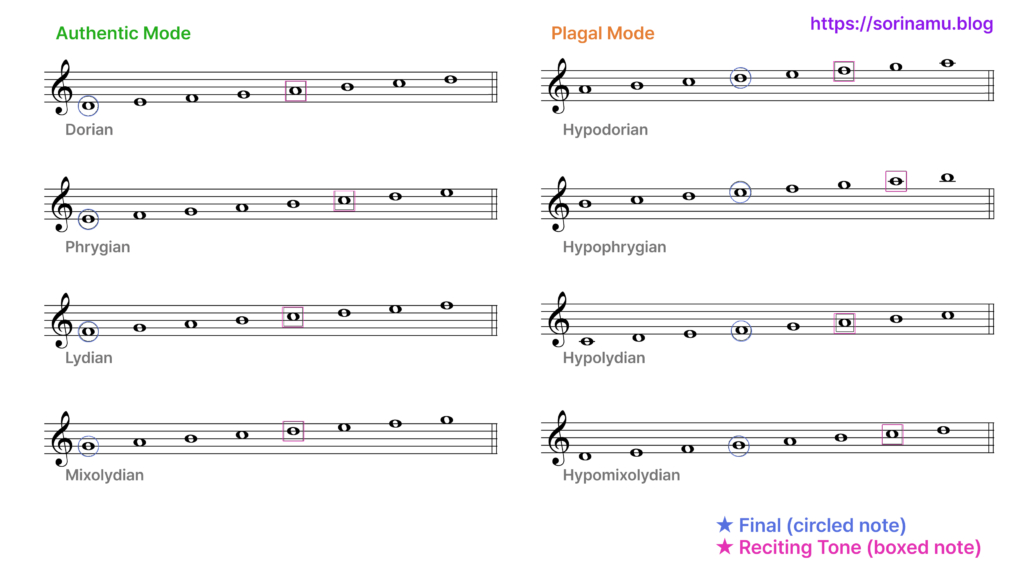
Mode I Dorian / Mode II Hypodorian

Dorian
Structure: The melody unfolds primarily in the register above the final D.
Characteristics: The Ambitus opens upward and the Tenor (A) is positioned high, creating an overall open and outward character.
Hypodorian
Structure: The melody extends evenly above and below the final D.
Characteristics: The Ambitus includes more lower-range motion and the Tenor (F) lies lower, producing a heavier and more solemn character.
Mode III Phrygian / Mode IV Hypophrygian

Phrygian
Structure: The melody unfolds primarily above the final E.
Characteristics: The semitone above the final shapes a persistent tension, and the Tenor (C) sustains long melodic arcs before the descent to the final.
Hypophrygian
Structure: The melodic range reaches further below the final E, keeping the motion closer to the center.
Characteristics: The Tenor (A) lies lower, narrowing the sense of vertical reach and emphasizing a more contained, meditative profile.
Mode V Lydian / Mode VI Hypolydian

Lydian
Structure: The Ambitus is formed primarily above the final F, keeping the melodic line consistently elevated.
Characteristics: A higher Tenor supports sustained upper motion, producing a more outward and luminous contour within the chant range.
Hypolydian
Structure: The melody incorporates pitches below the final F, distributing the range more evenly around the center.
Characteristics: With more lower-range motion, the line feels steadier and less projecting, easing into closure with softer weight.
Mode VII Mixolydian / Mode VIII Hypomixolydian

Mixolydian
Structure: The melody expands broadly above the final G, with a wide upper Ambitus.
Characteristics: A higher Tenor sustains energetic upper motion, and cadences often clarify themselves through a recognizable descent toward the final.
Hypomixolydian
Structure: The melodic range is distributed around the final G, balancing motion above and below the center.
Characteristics: With a lower Tenor, the melodic energy concentrates inward, sustaining a calmer, steadier presence before the final resolves.
Conclusion
Church modes were not scales in the modern sense, but systems grounded in permissible melodic motion. Ambitus defined the field of movement, Tenor established a center of repose, and Cadence shaped the manner of closure.
The reason Authentic mode and Plagal mode, even when sharing the same final, could be distinguished lies in these structural differences. Although the ending pitch was identical, the melodic range, the point of repose, and the manner of resolution differed fundamentally.
As these structures gradually weakened, modal thinking could no longer be maintained in the same way. Melodic ranges expanded, centers converged, and cadences acquired increasingly clear directional force. At the end of this process emerged major and minor. In the next part, we will trace this transition in detail.
Further Reading
8 Church Modes: Musical Order Before Major and Minor