

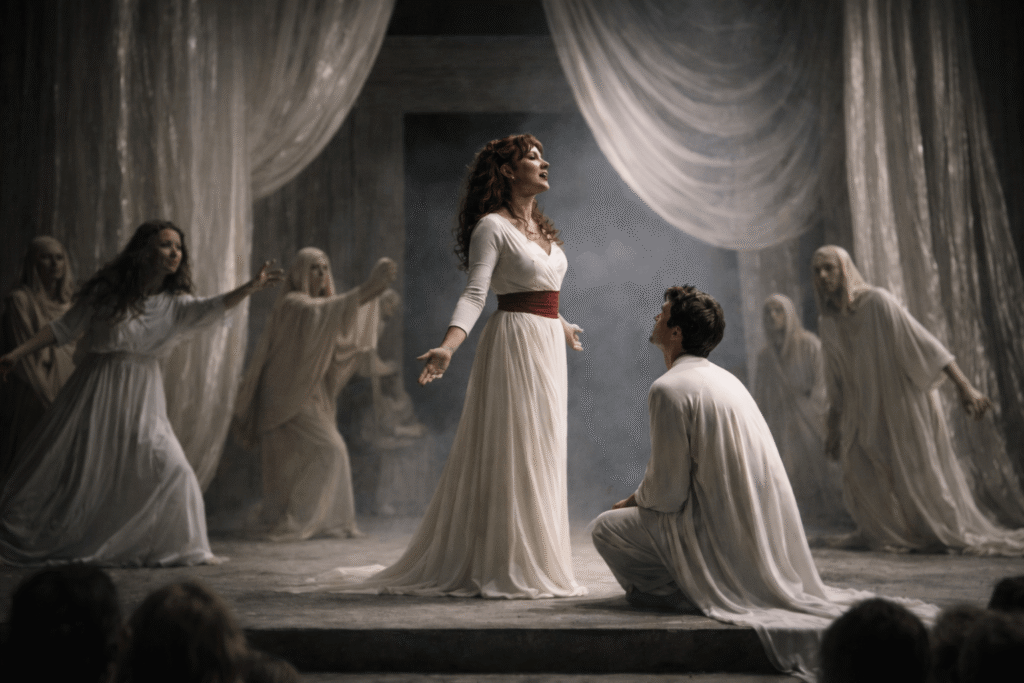
If one were to name the most overwhelming piece of mise-en-scène in the film Hannibal (2001), it would undoubtedly be the open-air concert scene in Florence. The noble soprano voice cutting through the night air, the music unfolding beneath Hannibal Lecter’s unwavering gaze as he fixes his eyes on Inspector Pazzi. The piece heard in that moment is Vide Cor Meum — Latin for “Behold my heart,” and one of the most haunting pieces of music ever composed for cinema.
Many viewers mistake it for a forgotten masterpiece from the operatic canon, but this work was not unearthed from any historical repertoire. It is a fabricated opera, created in the modern era specifically to complete the aesthetic world of Hannibal Lecter.
1. Patrick Cassidy (1966– ): A Composer Who Creates Nonexistent Classics
Patrick Cassidy is not a household name among film composers, yet he excels at constructing highly refined musical worlds for specific characters and scenes. Rather than quoting or rearranging existing operatic repertoire, he chooses to compose entirely new works that sound as though they have existed for centuries.
By reworking the language of medieval Latin chant and early Renaissance opera through a contemporary lens, Cassidy blurs the listener’s sense of historical origin. His music does not invite identification of its source; instead, it dissolves the listener’s sense of time altogether.
Vide Cor Meum is the most precise realization of this compositional approach. Although written in the 21st century, the piece is perceived not as a modern creation but as an “eternal music” that Hannibal Lecter himself might have cherished for decades.
2. The Musical Character of Vide Cor Meum
Cassidy’s music does not aim to heighten emotion directly. Instead, through sacred timbre, slow breathing, and strict formal control, it keeps emotion at a carefully measured distance.
This restrained aesthetic transforms scenes filled with murder and violence into something resembling ritual. Hannibal Lecter’s cruelty is perceived not as raw horror, but as a cold, almost reverent beauty.
Vide Cor Meum is not background music that merely decorates a scene; it functions as a musical device that allows Hannibal’s classical refinement and brutal instinct to coexist without collision.
Through this piece, Cassidy expresses — without a single word — the temperature and order of the world in which Hannibal Lecter lives.
3. Dante’s La Vita Nuova: The Vision of a Devoured Heart
The text of this piece is drawn from Chapter III of La Vita Nuova by Dante Alighieri. It records an intense and unsettling vision inspired by Dante’s first love, Beatrice.
The imagery is striking. The god of love appears and feeds Dante’s burning heart to the sleeping Beatrice. “I give my heart to the one I love” — this metaphor aligns with chilling precision to Hannibal Lecter’s identity as both a cannibal and a man who harbors a distorted love for Clarice Starling.
4. The Meaning of the Text: “Behold My Heart”
The title Vide Cor Meum is Latin for “Behold my heart.”
“Vide cor meum” (Behold my heart)
“E d’un laccio, vedi che l’amor lo stringe” (See how love binds it)
The text operates on multiple levels within the film. Hannibal is a predator targeting Pazzi’s heart, yet he is also a man whose own heart is bound to Clarice. “Behold my heart” sounds like the only confession he ever allows himself — to the world, or perhaps to Clarice alone.
5. Florence at Night and the Aestheticization of Murder
Florence, the cradle of the Renaissance, is also Hannibal’s most beloved city. As this music unfolds, he calmly recites Dante’s verses, foreshadowing Pazzi’s impending death.
Here, music elevates an act of murder into an artistic rite. Angelic voices and sacred harmonies transfigure fear into aesthetic rapture. Vide Cor Meum becomes the sonic embodiment of how Hannibal Lecter perceives the world — an aural crystallization of his twisted aesthetic philosophy.
Conclusion: The Purest Song of the Most Brutal Man
If Fauré’s Pavane represents the composed social mask Hannibal presents to the world, Vide Cor Meum reveals the fervent and unsettling truth hidden beneath it. As in Dante’s poetry, Hannibal’s love and violence converge through the single symbol of the heart.
The most sacred song heard by the most brutal man, in the most elegant of cities. Vide Cor Meum may be the most essential key to understanding the labyrinthine nature of Hannibal Lecter.
Further Reading
Gabriel Fauré’s 『Pavane, Op. 50』 | Elegance Placed on Hannibal’s Table
Gabriel Fauré’s 『Pavane, Op. 50』 | Elegance Placed on Hannibal’s Table
Madness Served on a Melody: Hannibal Lecter and Classical Music
Madness Served on a Melody: Hannibal Lecter and Classical Music