

Medieval Modal Theory Series
1. From Neumes to Mensural Notation | From Music Remembered to Music Measured in Time
2. The Birth of Solmization: Guido of Arezzo and the Beginning of Do–Re–Mi
3. 8 Church Modes: Musical Order Before Major and Minor
4. Same Final, Different Modes: Authentic and Plagal Modes in Gregorian Chant
5. Musica Ficta | The Hidden Order Beyond the Score
6. The Collapse of Modal Thinking and the Birth of Major and Minor
7. Modern Modes | A New Musical Language Chosen by Jazz and Contemporary Music
Modern Modes: Why Modes Return in Modern Music
In the previous articles, we examined the structure and character of modes that formed the backbone of medieval music. However, as the major–minor system became the central organizing force of Western music, modes gradually moved away from the practical field of composition.
The major–minor system offered a clearer sense of resolution than modal systems. Yet by the 20th century, tonal harmony could no longer function as the sole framework for organizing music. This was not because tonality itself was flawed, but because composers began to feel that the major–minor system had exhausted its capacity to produce genuinely new sounds.
Variations within a fully exploited harmonic language tended to circle back to the repetition of familiar vocabulary. To escape this limitation, composers began to cross the boundaries of tonality in search of new relationships between pitches and new qualities of sound. As a result, tonal centers gradually loosened, and music began moving toward sound worlds beyond the major–minor system.
It was at this point that modes drew renewed attention. This was not an attempt to return to older music, but rather a shift in thinking—away from the pressure imposed by harmonic progression and toward dwelling within the color of sound built around a single center.
This approach is often described as Modal Thinking. In this article, we will explore why modes were reconsidered after being pushed aside by tonality, and how they came to be used in new ways within jazz and contemporary music.
1. From Twelve Modes to the Modern Seven
Previously, we examined the eight modes used in medieval music, along with the later addition of Ionian and Aeolian during the Renaissance, forming a system of twelve modes. In modern jazz and contemporary music, however, only seven modes are commonly discussed.
In medieval music, modes were distinguished even when they shared the same pitch material. Differences in final tone (cadence), reciting tone (center), and melodic range were enough to classify them as entirely separate modes. After the emergence of the major–minor system, however, these distinctions were no longer considered necessary.
For example, when the seven pitches E–F–G–A–B–C–D are used as the basic material, older systems would divide them into multiple modes based on functional criteria. Today, these pitches are understood as sharing a single modal character and are grouped under Phrygian as one mode defined by its overall color.
The reduction from twelve names to seven reflects a fundamental shift: modes are no longer restrictive frameworks, but a palette of seven colors that modern composers can freely draw from.
2. Modern Modes and the Seven Modal Colors
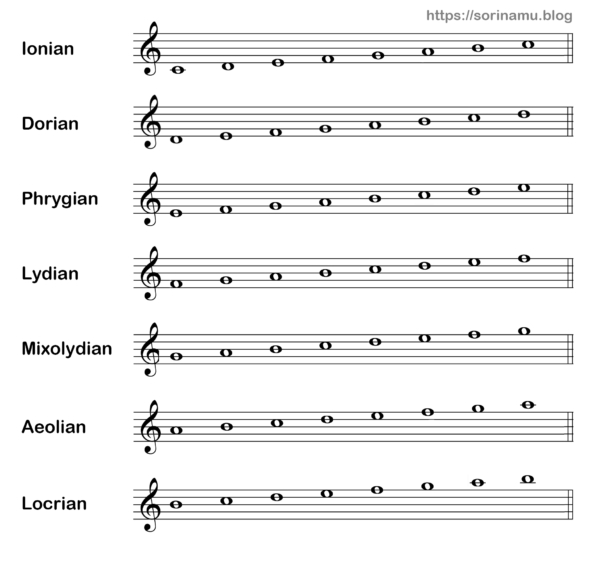
★ Ionian
– Identical in structure to the familiar major scale
– Provides a stable and clearly defined tonal center and has become the foundation of Western music
★ Dorian
– Similar to the minor scale, but without a lowered sixth degree
– Central to modal jazz, especially in the music of Bill Evans and Miles Davis, balancing restraint with sustained tension
★ Phrygian
– Characterized by a lowered second degree, creating immediate tension
– Often used in contemporary and film music to evoke unease or exotic color
★ Lydian
– Resembles the major scale, but with a raised fourth degree
– Favored for expressing openness, weightlessness, and a sense of unreality
★ Mixolydian
– Similar to the major scale, but with a lowered seventh
– Common in blues, rock, and jazz for creating relaxed, open-ended motion
★ Aeolian
– The structure of the natural minor scale
– Used to convey lyrical and traditional minor-key expression
★ Locrian
– Lacks a stable tonal foundation
– Rarely used historically, but employed in modern music to evoke instability and fragmentation
Each of the seven modes carries its own distinct weight and color. For modern musicians, modes are no longer rules to be obeyed, but materials for choosing tone color and atmosphere.
3. Where Modes Reappeared
Modes re-emerged not in medieval churches, but in mid-20th-century jazz and contemporary music.
By the time jazz passed through bebop, it had developed an extremely complex harmonic language. Rapid chord changes demanded constant attention, and improvisation increasingly focused on accurately navigating harmonic motion. While this approach produced sophisticated and high-tension music, it also left performers feeling constrained by nonstop harmonic shifts.
Some musicians began searching for alternatives. They wondered whether it was possible to stay longer within a single sound, and whether the sensation of sound itself could be extended beyond the speed of harmonic change.
This led to a renewed interest in modes. Modes were no longer seen as strict rule systems, but as ways of thinking that allowed freer melodic exploration around a central pitch.
Improvisation was no longer tied exclusively to fast-moving chord progressions. Instead, musicians could remain within the color of a mode and develop personal narratives. The focus of improvisation shifted from changing harmony to sustained melodic presence.
Meanwhile, contemporary composers turned to modes for different reasons. Rather than following rules dictating which chord must resolve to another, they concentrated on the atmosphere created by intervals themselves. Modes became tools for shaping sound character rather than enforcing movement.
Though jazz and contemporary music approached modes from different directions, both arrived at the same conclusion: modes were not a return to the past, but a choice made after fully experiencing tonal harmony and its limits.
Next, we will examine how this shift took concrete musical form in jazz—particularly why Dorian became central to modal jazz.
4. Dorian: The Starting Point of Modal Jazz
After bebop, jazz increasingly revolved around dense harmonic progressions. Improvisation focused on tracking rapidly changing chords, requiring constant reactive precision.
While this created intense musical energy, it also sparked a desire to remain longer on a single harmonic ground and focus on melodic development itself. Musicians began exploring ways to sustain improvisation with minimal harmonic change, leading them back to modal structures.
Among the available modes, Dorian was the first to be widely embraced. Retaining the darkness of minor while avoiding complete closure, its intervallic balance made it ideal for extended improvisation. Neither bright nor fully submerged, Dorian allowed long melodic arcs.
The problem facing post-bebop jazz was not a lack of sound, but too much sound moving too quickly. Dorian provided sufficient tension and color without constant chord changes, allowing musicians to concentrate on melodic shape rather than harmonic calculation.
This shift granted performers a new kind of freedom. Within a single mode, they could explore rhythm, motifs, and subtle inflections. Improvisation became less about navigating progression and more about shaping sound itself. Modal jazz thus emerged as a distinct departure from earlier jazz practices.
5. Modern Modes in Modal Jazz — Miles Davis and Bill Evans
The decisive moment when Dorian became a concrete musical language came through the collaboration between Miles Davis and Bill Evans. They did not redefine modes theoretically; they changed the way music itself was made.
Miles Davis felt that post-bebop jazz relied too heavily on dense harmonic motion. He envisioned music with minimal harmonic progression, allowing musicians to explore sound fully within a single tonal space. The result was the album Kind of Blue.
This transformation is most clearly heard in So What. Instead of complex chord sequences, the piece presents only two modes: D Dorian and E♭ Dorian. Musicians no longer had to calculate rapid harmonic shifts; they could improvise by focusing on rhythm, contour, and intervallic relationships within the mode.
The decisive color was added by Bill Evans. He stacked pitches within the Dorian mode at varying intervals to create new harmonies. The mode remained constant, but changes in chord voicing continuously altered the music’s atmosphere and tension.
Because of this approach, Dorian became more than a device for filling time. It emerged as a refined language capable of reshaping musical color in real time. Where Miles Davis opened a vast modal space, Bill Evans adjusted its internal texture, shaping the intellectual and restrained tone associated with modern jazz.
6. Beyond Dorian: Expanding the Modal Palette
If Dorian marked the starting point of modal jazz, later musicians naturally expanded toward other modes. Once sustained improvisation within a single mode proved viable, the question shifted from how long to remain, to which color to inhabit.
For example, John Coltrane moved beyond Dorian to employ stronger modes such as Phrygian and Mixolydian. Even without changing chords, his choice of mode dramatically altered musical tension and direction.
Meanwhile, Herbie Hancock and Wayne Shorter frequently used Lydian. For them, Lydian was not a variant of major, but a mode capable of sustaining openness and breadth without harmonic movement.
Modal jazz thus progressed beyond fixed experimentation. Modes became a method for selecting the desired density and texture of sound, firmly establishing themselves as expressive tools.
7. Contemporary Music: Modes as a New Canvas
If jazz adopted modes for improvisational freedom, contemporary composers used them to organize sound color and density. Seeking to escape the simplistic “major equals happy, minor equals sad” dichotomy, they focused on the unique intervallic relationships within modes.
Composers such as Béla Bartók and Maurice Ravel integrated modes drawn from folk music into modern compositional language. Their aim was not quotation, but the creation of new sonic sensibilities beyond traditional tonality.
For example, Lydian, with its raised fourth degree, became a key resource for expressing brightness and a sense of suspension in modern music.
In contemporary composition, modes are no longer rules of progression. The moment a composer chooses Lydian’s openness or Phrygian’s tension, the mode itself defines the character of the piece. Instead of pursuing functional resolution, the music centers on fully revealing the chosen mode.
Ultimately, jazz and contemporary music arrived at the same place from different paths. Modes were not revived as historical artifacts, but chosen as the next possibility after tonality reached its limits.
Conclusion
Modes began as medieval rules and acquired entirely new meanings through jazz and contemporary music. They no longer dictate where music must resolve, but help determine which sound to choose and how long to remain within it.
In jazz, modes offered an escape from rapid harmonic change; in contemporary music, they provided ways to organize sound color beyond major and minor. Though their contexts differed, the conclusion was shared: modes are not a return to the past, but a musical choice made possible only after fully experiencing tonality.
Today, modes remain not as rules, but as possibilities—asking not what must be followed, but what kind of sound we wish to inhabit.
Further Reading
8 Church Modes: Musical Order Before Major and Minor
Same Final, Different Modes: Authentic mode and Plagal mode in Gregorian Chant
Same Final, Different Modes: Authentic mode and Plagal mode in Gregorian Chant
The Collapse of Modal Thinking and the Birth of Major and Minor
The Collapse of Modal Thinking and the Birth of Major and Minor