


Medieval Modal Theory Series
1. From Neumes to Mensural Notation | From Music Remembered to Music Measured in Time
2. The Birth of Solmization: Guido of Arezzo and the Beginning of Do–Re–Mi
3. 8 Church Modes: Musical Order Before Major and Minor
4. Same Final, Different Modes: Authentic and Plagal Modes in Gregorian Chant
5. Musica Ficta | The Hidden Order Beyond the Score
6. The Collapse of Modal Thinking and the Birth of Major and Minor
7. Modern Modes | A New Musical Language Chosen by Jazz and Contemporary Music
Introduction: How Music Moved Toward Major and Minor
By the late Renaissance, the modal system that had long supported medieval music began to shift in subtle but noticeable ways. As neumes developed into more precise notation, music became something that could be recorded, repeated, and compared. Within polyphonic textures, overlapping melodies started to reveal chords as a distinct and tangible sensation. Listeners gradually came to prefer sounds that blended more clearly, and endings that felt firmly settled.
Modes were still in use, but they could no longer fully account for the character of harmony that emerged in polyphonic music, nor for the sense of resolution listeners perceived at cadences. As certain chords and endings were repeated more frequently, the ear began to recognize a center through that repetition. Over time, patterns of tension and release became familiar, moving consistently in a single direction.
Music that had once been divided among many modes slowly began to converge into two main paths. Major and Minor, which could articulate harmonic tension and resolution most clearly, came to function as practical standards through repeated performance and listening. Music was no longer guided solely by melodic flow; it increasingly followed the directional force created by harmony.
In this process, medieval modes did not disappear overnight. Instead, they were gradually pushed away from the center. What took their place was a new way of thinking: tonality. This article traces how the transition from modes to Major and Minor took shape alongside changes in harmonic perception and listening habits.
1. The Discovery of the Period: How Cadence Redrew the Musical Map
By the late Renaissance, the ending of a piece began to sound different from before. As the same pieces were performed and heard repeatedly, listeners naturally began to remember how a piece ended. The impression left by an ending became something that could be compared.
This change became even more pronounced as polyphonic music expanded. When multiple voices sounded together, the combination of tones at the very end of a piece remained clearly audible. As a result, some endings conveyed a clear sense of motion toward resolution, while others did not produce a comparable sense of closure. The ear gradually learned to distinguish these differences at the cadence.
Cadence thus ceased to be a mere point of stopping. It became a focal point where scattered sounds converged toward a single destination. Listeners began to expect a stronger pull at the end of a piece, preferring a clear and decisive close over one that faded ambiguously.
This growing auditory desire eventually led musicians to challenge the strict rules imposed by modal theory. Following the written notes precisely became less important than adjusting pitches—sometimes by very small intervals—to make an ending sound more satisfying. At this point, human auditory instinct began to take precedence over theoretical rigidity, and the modal period quietly approached its turning point.
2. The Ear That Broke the Taboo: Musica Ficta and the Birth of the Leading Tone
The desire to clarify musical endings inevitably brought theory and practice into conflict. At the time, the mode was treated as a kind of sacred order established by the Church and theorists. Notes written in the score were considered inviolable. Yet the ears of composers and performers working directly with sound began to judge differently.
A Choice Beyond the Score: Musica Ficta
Performers noticed that the note immediately preceding the final pitch often felt unsatisfying. For example, in a piece ending on C, if the preceding note was B♭ rather than B♮, the cadence lacked clarity and strength.
To address this, performers began raising certain notes by a semitone in performance, even when the score showed B♭ or no accidental at all. These unwritten but aurally motivated alterations came to be known as Musica Ficta, or “imaginary music.”
The Birth of the Leading Tone
This small adjustment produced a decisive effect. Narrowing the interval between the penultimate note and the final note to a semitone created a strong sense of attraction toward the final pitch. This sensation is what we now call the leading tone.
With the emergence of the leading tone, cadences were no longer perceived as simple points of rest. They became moments of expectation and release—events in which the ear anticipated resolution and received it unmistakably. The end of a piece was no longer a halt, but a fulfillment of direction.
The Blurring of Modal Identity
However, this clear sense of resolution came at a cost. As Musica Ficta became widespread, modes that had once possessed distinct identities began to resemble one another at their cadences.
Dorian, Mixolydian, and other modes, despite their differing colors, all came to end in similar ways once the leading tone was applied. Over time, listeners increasingly internalized only the cadential patterns associated with Major and Minor. Through repetition, these structures began to function as implicit norms.
Summary of Section 2
Musica Ficta was not an attempt to reject modal thinking. It was simply the ear’s response to a desire for clearer direction and resolution at the end of a piece. Yet as this choice was repeated, modes gradually receded from the center, and a system organized around the leading tone and the tonic took shape. At this point, music began to move away from a melody-centered order toward a new framework: tonality shaped around major and minor.
3. The Triumph of Simplicity: The Emergence of the Twelve Modes and the Survival of Major and Minor
The modal period did not end abruptly. Instead, it expanded to accommodate changing musical sensibilities, only to yield its central position to the most efficient structures—Major and Minor.
From Eight Modes to Twelve: The Official Debut of Major and Minor
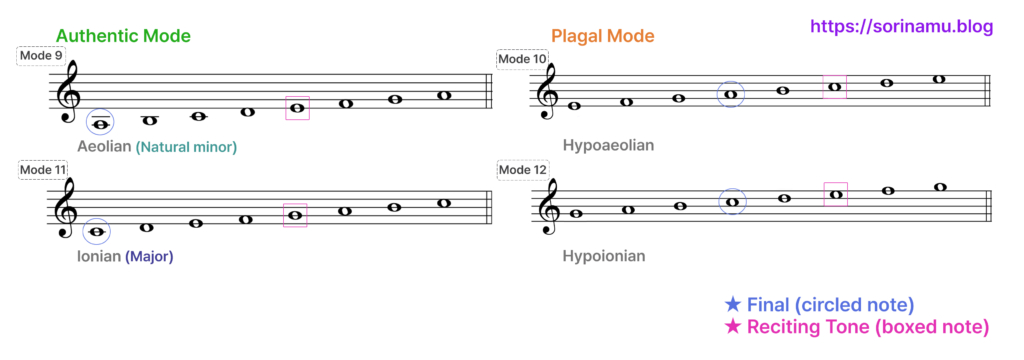
In the sixteenth century, theorist Heinrich Glarean concluded that the traditional eight-mode system could no longer explain the rich sonorities favored by contemporary musicians. He therefore proposed an expanded framework, the twelve-mode system (Dodekachordon, a theoretical treatise that formally recognized twelve modes).
Central to this expansion were Ionian, the prototype of modern major, and Aeolian, the prototype of modern minor. Including their authentic and plagal forms, four new modes were added. This marked the moment when major and minor scales—long associated with secular practice—were officially recognized within theoretical doctrine.
Why Only Two Remained
Although twelve modes were now theoretically available, performance practice quickly gravitated toward only two. Ionian and Aeolian were uniquely suited to realizing the leading tone and harmonic resolution discussed in Section 2.
Ionian (Major) naturally contained a leading tone without modification, producing a bright and decisive cadence.
Aeolian (Natural minor), while darker in character, could easily acquire comparable momentum through slight pitch alteration.
Gradually, other modes retreated from common use. Ionian and Aeolian, now understood as major and minor, became the dominant frameworks of the period.
The Completion of Vertical Order: The Primary Triads (I–IV–V)
Music now prioritized how chords were built and resolved over how melodies simply unfolded. Within this shift, three harmonic pillars—I, IV, and V—solidified the structure of tonal music.
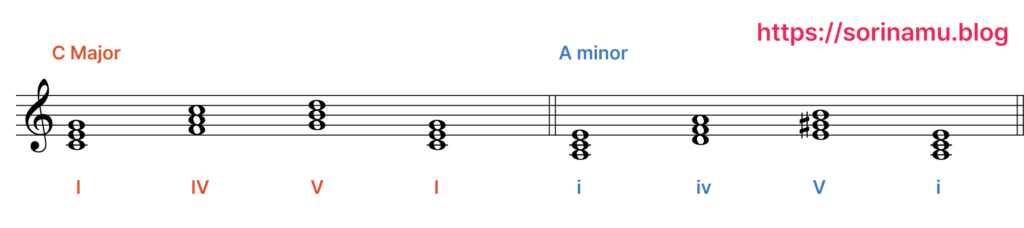
The relationship between the dominant (V) and the tonic (I) formed a powerful gravitational pull. This clear narrative of departure and return became the core of tonality as we know it.
Summary of Section 3: Modes Step Back from the Center
The establishment of Major and Minor opened a period of clarity and dramatic momentum. Thanks to this system, Western music could develop large-scale forms, from Baroque fugues to Classical symphonies.
Yet modes did not vanish. They simply withdrew beneath the dominant tonal order. Their distinctive colors lay dormant, awaiting the moment when musicians—tired of the compulsive pull of the leading tone—would seek alternative expressive paths.
Conclusion: A Shift of Order, but Not the End of the Story
In Western music history, the collapse of modal thinking and the emergence of Major and Minor represented far more than a change of system. It marked a transition from sacred regulation to human perception and harmonic logic.
As notation advanced and the ear demanded clearer cadences, the modal framework that had sustained music for centuries gradually gave way. In its place, the lucid order of Major and Minor provided powerful forward momentum. Through the harmonic drive toward the tonic, music achieved monumental forms—from Bach’s intricate fugues to Beethoven’s expansive symphonies.
Yet this efficient system did not answer every expressive need. As listeners grew accustomed to the certainty of tonal closure, the ambiguous and enigmatic colors of modes began to feel newly appealing.
Modes never disappeared. They simply remained hidden beneath the dominant tonal current. When later musicians sought freedom from the leading tone’s insistence on resolution, modal vitality resurfaced in unexpected places—most notably in the hands of modern composers and jazz musicians.
The next article explores how modal thinking survived under tonal dominance and reemerged as a new musical horizon through jazz and modal approaches.
Further Reading
8 Church Modes: Musical Order Before Major and Minor
Same Final, Different Modes: Authentic mode and Plagal mode in Gregorian Chant
Same Final, Different Modes: Authentic mode and Plagal mode in Gregorian Chant