

Medieval Modal Theory Series
1. From Neumes to Mensural Notation | From Music Remembered to Music Measured in Time
2. The Birth of Solmization: Guido of Arezzo and the Beginning of Do–Re–Mi
3. 8 Church Modes: Musical Order Before Major and Minor
4. Same Final, Different Modes: Authentic and Plagal Modes in Gregorian Chant
5. Musica Ficta | The Hidden Order Beyond the Score
6. The Collapse of Modal Thinking and the Birth of Major and Minor
7. Modern Modes | A New Musical Language Chosen by Jazz and Contemporary Music
Before Major and Minor, Music Followed a Different Order
Most of the music we hear today is understood through the two systems of major and minor. Musical emotions such as brightness and darkness, tension and resolution, are often explained within these familiar frameworks. However, this structure does not represent the beginning of Western music. Rather, it is a relatively late outcome in the long history of musical thought.
Medieval music moved according to a completely different order—neither major nor minor. At the center of this earlier system were eight organizational frameworks known as Church Modes. These were not merely collections of pitches arranged as scales. Instead, Church Modes defined where a melody should move, where it should rest, and how it should return to a point of stability.
If Guido of Arezzo fixed the position of pitches on the page through the four-line staff, Church Modes determined how those fixed pitches were connected through character, direction, and function. In other words, notation made music visible, while modes gave that music structure and orientation.
This article explores what Church Modes were in medieval music and how these eight ordered systems shaped the way Western music learned to think about sound.
Two Principles for Understanding Church Modes: Finalis and Reciting Tone
Church Modes often feel difficult because they are mistaken for simple varieties of scales. For medieval musicians, however, modes were not defined by “which notes are used,” but by where a melody begins, where it returns, and which pitch it gravitates toward. The sense of direction and stability in a chant was determined by two reference tones.
Finalis
The first reference is the Finalis, the pitch on which a chant comes to rest. While it may resemble the modern concept of a tonic, the Finalis functions less as a harmonic center and more as the melodic destination toward which the entire line resolves.
Even when the same pitches are employed, changing the Finalis completely alters the character of the music. In medieval practice, the Finalis served as the primary anchor of stability and orientation. Within Church Modes, it defined the fundamental point of return.
Reciting Tone (Repercussio)
The second reference is the Reciting Tone, also called Repercussio. This is the pitch most frequently repeated or sustained during a chant, acting as the structural axis of the melody. In psalmody and other recitation-based chants, the Reciting Tone reveals the character of a mode more clearly than any other element.
Melodies unfold by circling around this pitch, moving above and below it. Through repetition, listeners intuitively perceive the tension and atmosphere of the music.
Medieval music was organized around these two tones—where the melody ends and where it lingers. Church Modes systematized this order into eight distinct forms.
Why There Are Eight Modes: Authentic and Plagal Structures
Once Finalis and Reciting Tone were established as organizing principles, medieval theorists began to classify melodic movement more precisely. This led to the distinction between Authentic Modes and Plagal Modes. The division was not a matter of adding more notes, but of observing how melodies surround and relate to their Finalis.
Authentic Modes
In an Authentic Mode, the Finalis lies at the lowest point of the ambitus. The melody primarily expands upward from this foundation. The Finalis functions like a structural pillar, while melodic energy is directed above it.
Such melodies tend to convey a clear sense of direction, with tension and release that are readily perceptible. Medieval theorists regarded this structure as the “normal” or primary form of a mode, hence the term Authentic.
Plagal Modes
In a Plagal Mode, the position of the Finalis shifts. Rather than forming the lowest boundary, it lies near the center of the ambitus. As a result, the melody extends both below and above the Finalis, spreading more evenly across the range.
Here, the Finalis feels less like a starting point and more like a gravitational center that the melody continually embraces. Because the melodic weight is distributed on both sides, the overall impression is often softer and more stable. The prefix “Hypo-” indicates this lower-centered structure.
Through this pairing of Authentic and Plagal forms, medieval Church Modes were organized into eight systems based on four Finales. Although the number increased, the core question remained the same: where does the melody return, and how does it move around that point?
A Map of the Eight Church Modes
At first glance, Church Modes may appear complex, but their structure is relatively straightforward. The essential point is that the eight modes do not exist independently. Instead, they are arranged as four pairs, each sharing the same Finalis but differing in melodic structure.
Medieval theory organized the modes as follows:
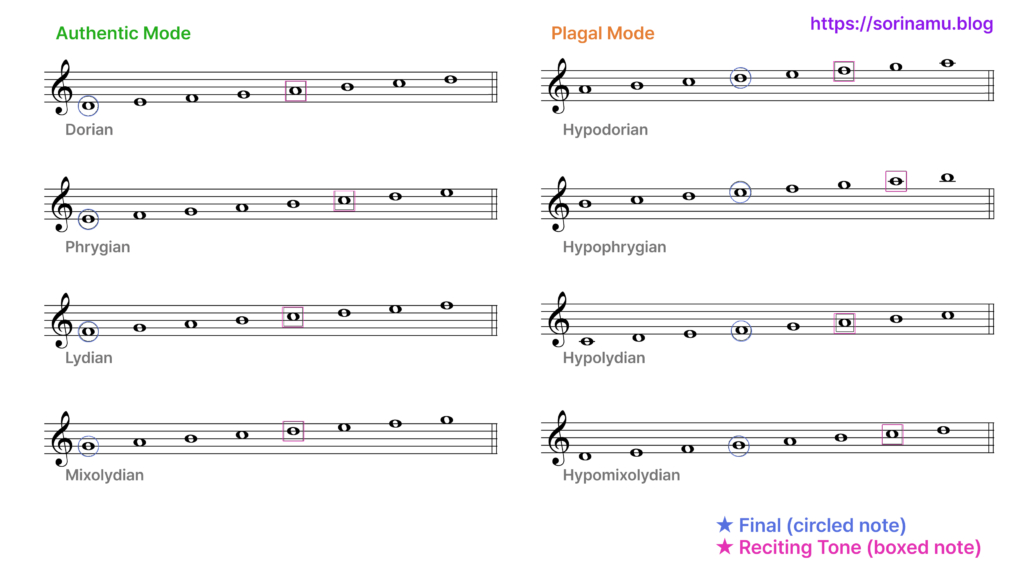
This arrangement functions less as a list to memorize and more as a map showing where melodies ultimately return. Modes that share the same Finalis may differ in ambitus and Reciting Tone, yet they resolve to the same destination. For medieval musicians, what mattered was not whether a chant was labeled “Dorian” or “Phrygian,” but how it moved toward its Finalis and how it occupied the space around it.
A common misconception arises here. Associating Dorian with sadness or Lydian with brightness oversimplifies medieval thinking. Within Church Modes, character was not a preset emotional label but the result of structure—the interaction of Finalis, Reciting Tone, and ambitus. Mood emerged from organization, not from names.
Keeping this overall map in mind allows one to read modal notation not merely as a sequence of pitches, but as a system operating within a defined order.
Guido of Arezzo and Church Modes
Theoretically refined as they were, Church Modes could not be reliably maintained through oral transmission alone. Even if musicians agreed on Finalis and Reciting Tone in principle, inconsistent pitch levels threatened to undermine the system. Without fixed pitch positions, identifying a true Finalis or Reciting Tone remained unstable.
Here, Guido of Arezzo’s notational reforms became decisive. Once pitch positions were fixed on the four-line staff, Finalis and Reciting Tone transformed from abstract ideas into points that could be visually identified and taught. Modal order was no longer perceived only by ear, but confirmed by sight.
Without stable pitch, modes easily collapse. A shifting Finalis obscures melodic resolution; a displaced Reciting Tone alters the entire character of a chant. Guido’s notation reduced this instability and allowed Church Modes to function consistently within real musical practice.
Notation and mode, therefore, were not separate inventions. They matured together. By fixing the place of sound, Guido of Arezzo enabled Church Modes to fulfill their role of assigning direction and meaning to those places. This is why pitch and mode became inseparable concerns in medieval music.
Why Church Modes Still Matter Today
Church Modes are not outdated theories confined to medieval chant. Before harmonic thinking took precedence during the Renaissance, Western music relied on modal organization for centuries. Major and minor emerged as simplified reorganizations of this modal system, while Church Modes preserve an earlier way of structuring musical meaning.
In this sense, modes offer a key to understanding how Western music historically organized emotion. Where major and minor emphasize contrast—bright versus dark—Church Modes create subtler gradations of tension and repose through the placement of Finalis, Reciting Tone, and ambitus. The unique calm or mystery of medieval chant arises directly from this modal logic.
This way of thinking did not disappear. For example, the English folk song Greensleeves is often classified as minor, yet its melodic center and cadential behavior reveal strong modal characteristics. Its ambiguous tension and archaic color cannot be fully explained by major–minor contrast alone.
From Renaissance polyphony and pre-Baroque vocal styles to modern jazz, film scores, and game music, modal thinking continues to serve as a powerful expressive tool. When composers seek atmospheres that resist simple tonal explanation, they often return to Church Modes.
Understanding these modes, then, is not about memorizing medieval rules. It is about rediscovering a long-standing way of organizing sound into order and meaning—a framework that deepens our understanding of music past and present.
Conclusion: Recording Order, Understanding Order
Before notation, music depended on memory. Neumes emerged as the first attempt to support that memory, yet directional signs alone could not ensure consistent pitch. Musical order remained unstable. Guido of Arezzo’s four-line staff addressed this problem by fixing pitch positions and enabling music to be read visually.
Church Modes formed another layer of order on top of this foundation. Once pitch was fixed, modes determined how those pitches should move, where they should settle, and which tones should carry weight. If neumes supported memory, the staff stabilized pitch, and Church Modes assigned structure and meaning to that stability.
Through the interaction of notation and mode, Western music developed into a system capable of recording, organizing, and expressing sound with coherence. Medieval music theory was not a random collection of rules, but the result of sustained reflection on how sound could be ordered and understood.
This article has outlined the broad framework of Church Modes. In the next installment, we will examine how this order functioned in actual music—how ambitus, Reciting Tone, and cadential patterns shaped the character of each individual mode.
Further Reading
The Birth of Solmization: Guido of Arezzo and the Beginning of Do–Re–Mi
The Birth of Solmization: Guido of Arezzo and the Beginning of Do–Re–Mi
From Neumes to Mensural Notation | From Music Remembered to Music Measured in Time
From Neumes to Mensural Notation | From Music Remembered to Music Measured in Time