

What completes the mise-en-scène of the drama Hannibal is the immaculate table setting, and the cold classical line that runs above it. In this series, music is not a device that heightens emotion so much as a tool that refines the character of people and spaces.
Today, I take a close look at the piece that most perfectly represents Hannibal Lecter’s social persona: Gabriel Fauré’s 『Pavane, Op. 50』. The music passes through the drama only briefly, yet that brief moment alone makes clear how Hannibal constructs himself inside society, and with what kind of composure he maintains his presence.
This essay follows, quietly and carefully, why 『Pavane』 was chosen for that scene, and which qualities of the music align so precisely with the figure of Hannibal Lecter. Tracing the work’s structure, affect, and background ultimately leads back to a single understanding: how meticulously Hannibal’s “mask” is made.
1. The Aristocrat of French Music: Gabriel Fauré (Gabriel Fauré, 1845–1924)
“A central figure of modern French music who established how emotion can be handled inside form, without display.”
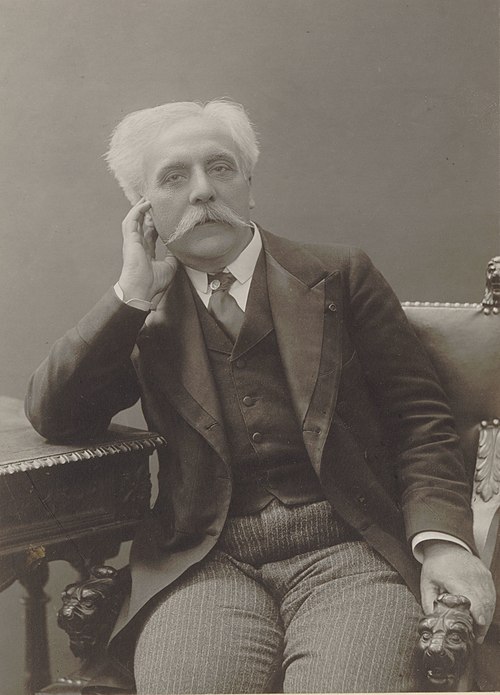
Image source: Gabriel Fauré, photographed by Eugène Pirou, 1905. Bibliothèque nationale de France, Gallica (ark:/12148/btv1b8417702r). Public domain.
Nationality: France
Activity: Late 19th to early 20th century, centered in Paris
Main genres: Songs (mélodies), chamber music, orchestral works, sacred music
Traits: Restrained emotion distinctive to France, subtle harmony, and clear melodic lines. A composer who avoided Romantic excess, holding balance at the threshold leading toward Impressionism.
Gabriel Fauré was a composer who did not readily surrender to the prevailing current of late-Romantic Europe, when musical language was increasingly drawn toward intensity and excess. As a student of Camille Saint-Saëns, he inherited a classical sense of proportion and form, and from that foundation he built a musical language in which emotion is not displayed, but polished and controlled. Even in an era dominated by post-Wagnerian scale and emotional expansion, Fauré held to French clarity and restraint to the end.
He also became an essential link in French musical history as both composer and educator. As director of the Paris Conservatoire, he stood at the institutional center of the period, and trained the next generation of composers, including Maurice Ravel. His stance—refusing to tip fully toward either Romanticism or Impressionism, and maintaining tension between emotion and form—left a deep imprint on French music thereafter.
On the surface, Fauré’s music appears calm and elegant. The lines are smooth, the harmony delicate, and the emotion restrained. Yet beneath that surface, a complex and sensitive current continues to run. Emotion is not removed; it is managed and concealed. In that sense, Fauré’s musical temperament bears an unsettling resemblance to Hannibal Lecter: a figure who wraps a monstrous interior inside the flawless exterior of a gentleman.
2. Pavane: Music for the Order of Aristocratic Society
The name “Pavane” refers to a slow dance form that originated in the Spanish court of the 16th century. It was not meant for fast rhythms or dazzling movement, but was closer to a ceremonial procession—aristocrats in splendid attire walking with measured dignity.
What mattered in this dance was not variety of gesture or personal expression, but the maintenance of order through a steady pace. The music did not so much lead the dance as support it so that the movement would not break its discipline.
Fauré borrowed this old court framework and, in 1887, composed 『Pavane, Op. 50』. Rather than depicting a particular dance scene, the work translates into sound the Pavane’s defining sense of slow tempo and refined, regulated motion.
3. The Sound of Pavane: Elegant, Yet Restrained
At the opening, a lonely yet beautiful flute solo enters first. The line can sound like longing, and at times like an emptiness—as if something has quietly slipped away.
Beneath that flute line, the piece is held by the strings’ pizzicato (a technique in which the player plucks the string with a finger). Repeated at even intervals, that sound can resemble someone stepping carefully forward, or a heartbeat continuing steadily in the midst of tension.
『Pavane』 unfolds around F♯ minor, yet the harmony often blurs the border between major and minor. That ambiguity colors the music so that it can feel comfortable and uneasy at the same time.
Because of this, Fauré was wary of performances that become overly sentimental. 『Pavane』 sustains, to the very end, “elegance without becoming absorbed in emotion.”
4. Pavane and Hannibal: The Aesthetics of the Mask
This restrained musical character overlaps naturally with the dining-table scene in Hannibal. When Hannibal Lecter invites Jack Crawford and serves an immaculate meal, 『Pavane』 does not explain the mood or amplify emotion. It simply maintains—perfectly—the condition in which nothing seems to be happening.
For Hannibal, manners and ceremony are the most powerful mask: a way to reassure others and protect himself. The strict formal beauty of the Pavane, born from courtly dance, meets his fastidious composure head-on. The music’s elegance—capable of processing even sadness inside a prescribed form—mirrors Hannibal’s gaze: a gaze that observes others’ suffering from a composed distance.
Just as 『Pavane』 preserves form without letting emotion rise to the surface, Hannibal also hides his nature inside a flawlessly ordered social posture. The reason this music functions in that dining scene without any special explanation is that the piece and the character share the same sensation: a controlled distance, and a balance that never collapses.
Elegance Left on the Mask
Fauré’s 『Pavane』 sings of a chill hidden behind meticulously calculated elegance. The music does not display feeling, does not disturb order, and keeps its expression composed to the end.
When you hear it again on Hannibal’s perfect table, you may sense anew how firm—and how beautiful—the mask he wears really is. In that moment that seems as though nothing happens, 『Pavane』 reveals him in the most precise way.
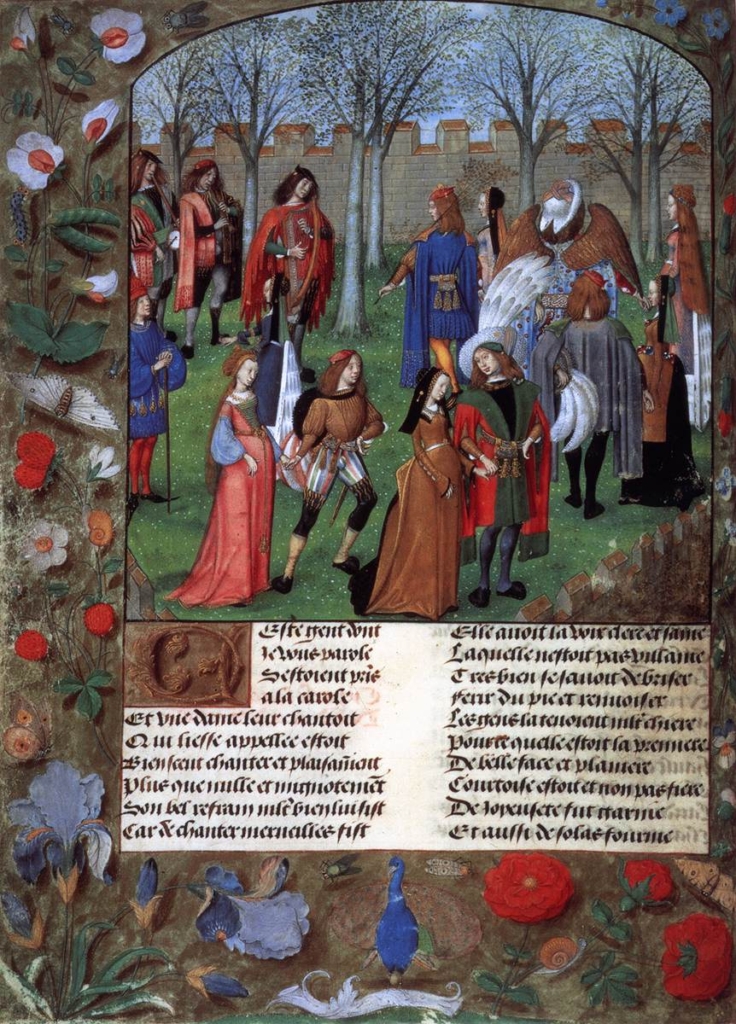
Thumbnail image: British Library, Harley MS 4425, Romance of the Rose, Flemish miniature, 1490s. Public domain.
Further Reading
Madness Served on a Melody: Hannibal Lecter and Classical Music
Madness Served on a Melody: Hannibal Lecter and Classical Music