

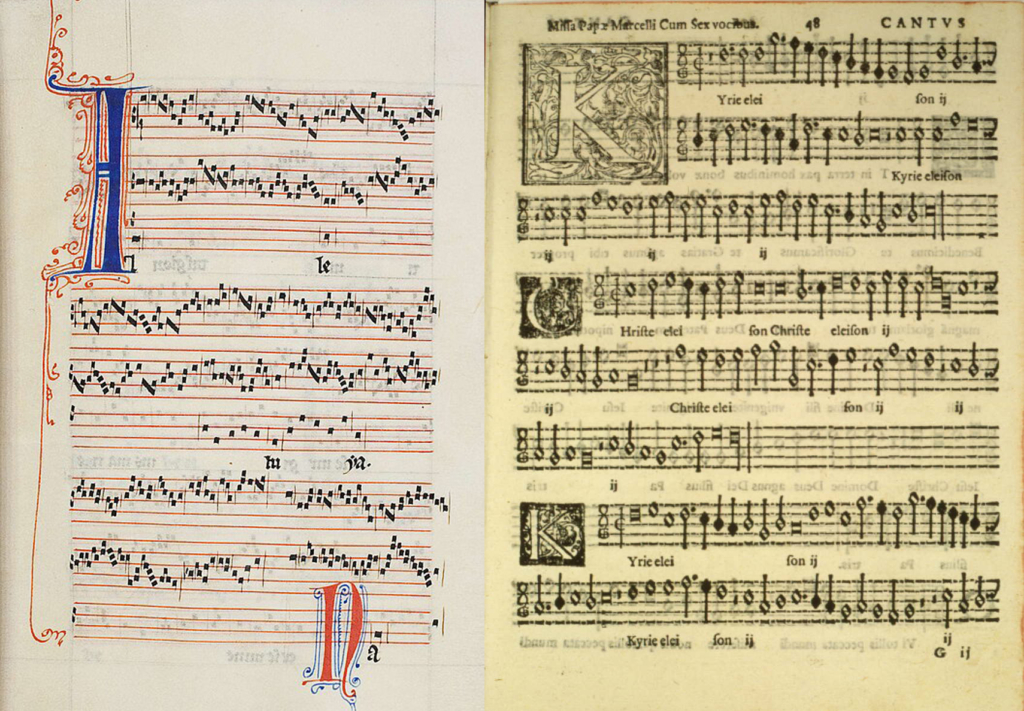
Medieval Modal Theory Series
1. From Neumes to Mensural Notation | From Music Remembered to Music Measured in Time
2. The Birth of Solmization: Guido of Arezzo and the Beginning of Do–Re–Mi
3. 8 Church Modes: Musical Order Before Major and Minor
4. Same Final, Different Modes: Authentic and Plagal Modes in Gregorian Chant
5. Musica Ficta | The Hidden Order Beyond the Score
6. The Collapse of Modal Thinking and the Birth of Major and Minor
7. Modern Modes | A New Musical Language Chosen by Jazz and Contemporary Music
Today, musical notation is often treated as the starting point of music. In the early Middle Ages, however, singing did not begin on the page. Song existed first, and people learned it by listening, remembering, and singing together. Writing was not a necessary condition for music, but something that followed later as a result.
In this period, song was closer to the body than to writing. The accent and breath of Latin texts shaped the musical flow, and there was little need to divide sound into precisely measured lengths. Chant did not unfold within a fixed beat, but moved flexibly alongside speech.
People sang together, yet there was no strong demand that every moment be aligned exactly. What mattered was knowing the same chant. How long a sound lasted, or precisely when voices should coincide, was resolved naturally through shared practice within the community. In such an environment, there was neither a clear reason nor a clear method to write a song down from beginning to end.
This situation was not limited to the Middle Ages. Even into the Renaissance, Western music remained centered on singing, and notation continued to develop primarily as a means of preserving song. This text follows how music that lived in memory gradually acquired written signs, and how those signs moved from neumes toward mensural notation.
1. Before the Score
Song as Memory, Not Record
Today it can feel as though music exists through notation. Early medieval song, however, did not originate from a score. Chant already lived within the community, and people learned it by listening, remembering, and singing together. Writing was not the starting point, but something that was not yet required.
In this period, song was not separated from speech. The accent and breath of Latin words shaped the musical flow, and there was little concern for dividing sound into regular beats or measuring exact durations. Song was understood not as a structure fixed in time, but as a stream of sound moving together with language.
People sang together, but there was no strong expectation that every tone had to align at the same instant. How long a sound continued, or where voices met and overlapped, did not need to be written down. These details were maintained naturally within communal tradition. What mattered most was simply knowing the same song.
In such an environment, there was neither a clear reason nor a clear method to record a song from beginning to end. Song lived not on parchment, but in human memory, and it was that memory which carried music forward to the next generation.
2. Why Neumes Emerged
Writing Only What Was Needed to Remember
Chant was not learned from writing in the first place. It was sung from memory, supported by repetition and shared practice within the community.
As communities grew and chants began to travel from one region to another, problems emerged. Even within the same chant, the shape of the melody or its important turning points could shift slightly. Memory alone was no longer sufficient to preserve a shared musical flow.
At the same time, there was no way to write down an entire chant. Instead of attempting to record sound itself, musicians began leaving marks that helped recall a chant already known. These marks are what we call neumes.
Early neumes did not represent individual pitches. They indicated whether the melody moved upward or downward, or whether several tones flowed together as a group. They were not meant to instruct someone to sing a chant for the first time, but functioned as signals that guided singers to recall the same melodic direction already held in the mind.
For this reason, neumes contain no information about duration or meter. That information remained tied to speech accents and communal convention. At this stage, song still resided within people, and neumes served as a minimal device to keep that memory from drifting.

Image source:
Stiftsbibliothek St. Gallen, Cod. Sang. 359 (Codex Sangallensis 359), p.148.
Monastic manuscript from St. Gallen, c. 922–926.
Provided by e-codices, Public Domain.
This image shows a representative example of early neumatic notation used by the St. Gallen tradition in the early tenth century. At this stage, staff lines were not yet firmly established. The shapes and placement of the neumes merely suggest the upward or downward movement of the melody and the grouping of tones.
Such notation functioned as a mnemonic aid for singers who already knew the chant. It was not intended to record exact pitch or duration. Rather than fixing sound precisely, neumes at this stage served as visual traces that helped recall the flow of chant already held in memory.
3. Problems That Emerge When Singing Together with Neumes
Losing a Shared Measure of Duration
Neumes were sufficient for singing monophonic chant. As long as a single melodic line moved upward or downward, singers who already knew the melody could recall it and sing together without difficulty.
The situation changed with the emergence of polyphony, where one melody was placed above another. Once two or more voices proceeded simultaneously, song could no longer be sustained as a single continuous flow. Each voice now had to align with the others, raising questions of when a part should begin and how long it should be sustained.
At this point, notation itself had not changed very much. Neumes continued to indicate melodic direction and grouping, but they still did not specify how long each sound should last. As a result, early polyphonic organum often unfolded not with strict coordination, but with voices overlapping loosely rather than fitting together precisely.
This looseness was not an aesthetic choice, but a practical consequence of the available notation. Polyphony already existed as sound, but there was still no reliable way to coordinate the length of sounds across multiple voices. Neumes were no longer able to meet the demands of polyphonic singing on their own.
![troparium cantatorium et officia adusum [...] btv1b84323046 49](https://sorinamu.blog/wp-content/uploads/2025/12/Troparium_Cantatorium_et_officia_adusum_._btv1b84323046_49.jpeg)
Image source:
Manuscript Latin 909 (11th century).
St-Martial de Limoges manuscript tradition, France.
Held by the Bibliothèque nationale de France, Département des Manuscrits.
Provided by Gallica (BnF).
This image shows an early example of polyphonic organum transmitted through the Aquitanian tradition. Two or more voices are written simultaneously using neumes or early staff notation, yet the durations of individual tones and their precise coordination in length are not specified.
The manuscript clearly reveals the limitations of notation at a time when polyphonic music was already practiced, but the means to coordinate duration had not yet been established. Rather than fixing sound precisely, the notation still relied on the performers’ shared knowledge and convention, functioning primarily as a guide for recalling music already known.
4. Changes in the Form of Neumes
Preparing to Fix Pitch and Confront the Problem of Duration
Rhythmic modes made polyphonic singing temporarily possible, but they did not resolve the problem at its core. The length of sounds was still not written into the notation, and singers had to infer duration through melodic groupings and shared convention. As chants grew longer and the number of voices increased, this method became increasingly unstable. At this point, a shift began to take place. In order to reduce the burden of interpretation, neumes themselves began to carry more information.
4–1. From Unlined Neumes to a Reference Line
Early neumes had no staff lines. They were placed above the text to indicate only whether the melody moved upward or downward, making it impossible to determine exact pitch from the notation alone. Singers had to supply this information from memory.
In monophonic chant, this posed little difficulty, since everyone shared the same melodic knowledge. With the rise of polyphonic singing, however, the limitation became clear. Without a common visual reference, singers could not be certain whether different voices were producing the same pitch, and even slight discrepancies could immediately destabilize the harmony.
To reduce this uncertainty, a reference line was introduced. This line was not designed to calculate pitch with precision, but to provide a shared point of reference for all voices. Once a reference line appeared on the page, singers no longer relied solely on memory. Multiple voices could now orient themselves around the same visual anchor while singing together.
![graduale troparium et prosarium ad [...]chapitre de btv1b10506538t](https://sorinamu.blog/wp-content/uploads/2025/12/Graduale_Troparium_et_Prosarium_ad_.Chapitre_de_btv1b10506538t.jpeg)
Image source:
Bibliothèque nationale de France (BnF), Département des Manuscrits.
Graduale, Troparium et Prosarium ad usum Sancti Aredii (Saint-Yrieix), Saint-Yrieix-la-Perche, c. 1050–1100.
Provided by Gallica, Public Domain.
This image shows an example of one-line neumatic notation used in eleventh-century chant manuscripts. Neumes are arranged around a single line, which serves as a rough reference for melodic direction. Exact pitch and duration cannot be determined from the notation alone, and the system presumes prior knowledge of the chant. At this stage, neumes still function primarily as a mnemonic aid rather than as a fully fixed representation of sound.
4–2. The Expansion of Reference Lines and the Fixing of Pitch
The reference line did not remain singular. One line alone was insufficient to distinguish pitch relationships clearly, and additional lines were gradually added. Over time, reference lines increased from one to two, and eventually to several, becoming more systematically organized.
As reference pitches such as C and F were fixed onto specific lines, pitch ceased to be a vague sense of upward or downward movement and became a defined position on the page. The same pitch was always written in the same place, and interval relationships between voices became far more stable.
This change allowed singers to verify pitch directly from the notation rather than relying entirely on memory. Even when multiple voices sang together, pitch relationships could be maintained by referring to written positions on the page. The basic conditions needed to support polyphonic singing were now beginning to take shape.
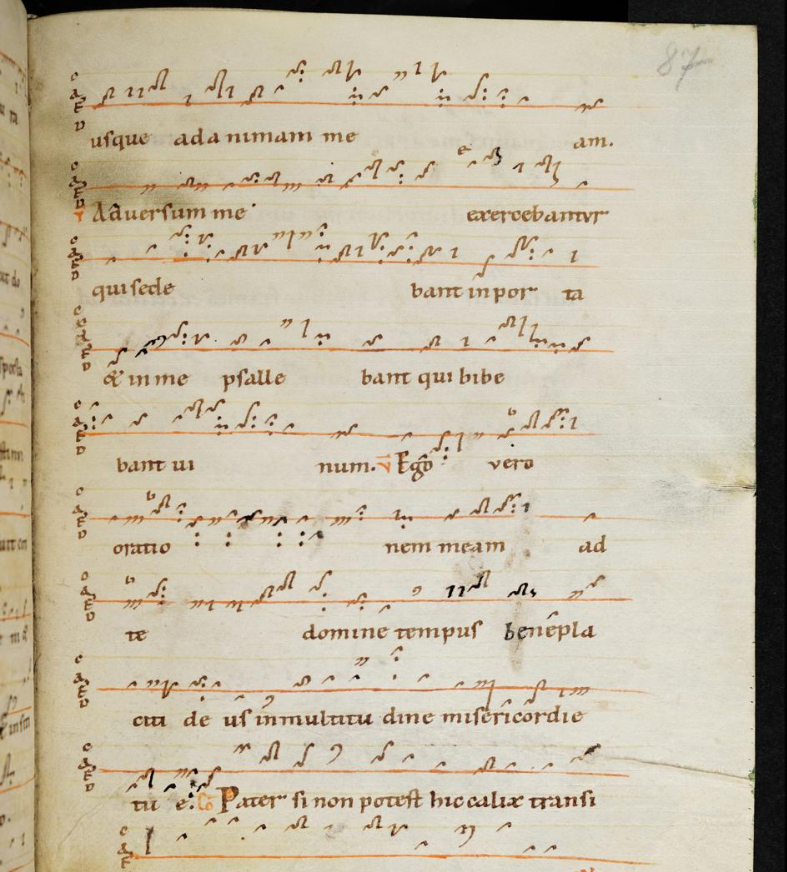
Image source:
Universitätsbibliothek Graz, Graduale cum neumis, 12th century, Ms 0807, fol. 87r.
Provided by uniPUB (University of Graz Open Access Server), Public Domain.
This image presents an example of two-line neumatic notation found in a twelfth-century chant manuscript. The red line serves as a reference for the pitch F, while the yellowish (ochre) line functions as a reference for the pitch C. With these two reference lines, pitch relationships can be perceived more clearly than in one-line neumatic notation, and neumes are placed on the lines and in the spaces between them to indicate the melodic position visually.
At this stage, however, neither meter nor the length of rhythmic values is recorded. The tempo and overall flow of the chant still relied on oral tradition. Two-line neumatic notation represents an intermediate stage in chant notation, positioned between earlier single-line systems and the later development of the four-line staff.
4–3. Neumes as a Stabilized Structure
As reference lines increased and pitch became fixed on the page, the visual form of neumes also began to settle into a more orderly state. Instead of appearing scattered or irregular, neumes started to show recurring shapes and more consistent placement. The way several notes were grouped into a single unit likewise became increasingly uniform.
At this stage, however, there was still no method for notating the length of sounds. What did become clearer was how a melody unfolded and where voices came together or separated. With the visual structure of the notation stabilized, these relationships could now be recognized by looking at the page alone.
In other words, singers no longer had to rely entirely on memory. Which notes formed a continuous flow, and at which points voices moved together, were now visible on the written page. This organized structure provided an important foundation for the later development of notation in which the length of sounds could also be written as independent symbols.
During this period, the shapes of neumes also underwent a significant transformation. Unlike earlier neumes based on dots and strokes, note signs gradually took on angular, square forms (square neumes). This change was closely related to the use of reed pens and quills on parchment, which made it easier to draw clear vertical and horizontal strokes. Over the twelfth and thirteenth centuries, these square note shapes became increasingly standardized, and by the thirteenth century the combination of a four-line staff and square neumes had become the typical format for chant manuscripts. This development reflects a broader movement toward visual clarity in pitch representation and shows how neumes settled into a more stable notational system.
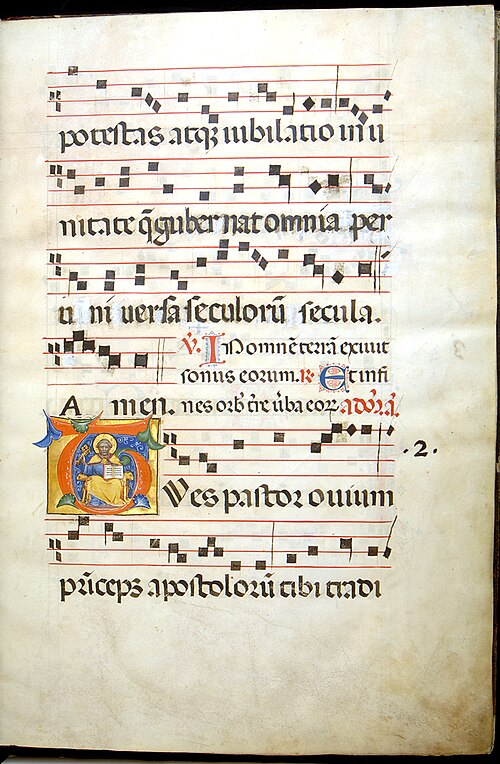
Image source:
Cenni di Francesco (c. 1380), Leaf from an Antiphonary, Florence, Italy.
Walters Art Museum, W.1533R.
Provided by Wikimedia Commons, Public Domain.
This manuscript leaf presents an example of four-line neumatic notation used in a late fourteenth-century Italian antiphonary. Pitch is securely fixed with reference to four staff lines, and neumes are clearly placed on the lines and in the spaces between them to convey relative pitch with clarity. Intended for the notation of monophonic liturgical chant, it illustrates the stage at which the four-line staff system had become established as the standard format for medieval chant notation.
5. A Provisional Solution in an Era When the Length of Sounds Could Not Be Written
Rhythmic Modes as a Temporary Device
By this stage, neumatic notation had succeeded in fixing pitch and melodic structure securely on the page. Which notes were to be sung, and where voices came together or separated, could now be understood simply by reading the notation. However, the length of each sound still could not be written into the score. Pitch had been resolved, but time remained dependent on the judgment of the singers.
As polyphonic singing grew longer and the number of voices increased, this limitation became increasingly apparent. Even when reading the same notated structure, the overall flow of a performance could differ, and there were clear limits to how precisely voices could remain together in time. In response, musicians chose not to write the length of sounds directly, but instead adopted a shared agreement to sing in the same way. This approach gave rise to what are known as rhythmic modes.

Image source:
Anonymous (Notre Dame school tradition), Pérotin, Alleluia nativitas, 13th century,
Codex Guelf. 1099 Helmst., Herzog August Bibliothek Wolfenbüttel.
Provided by Wikimedia Commons, Public Domain.
Source: https://commons.wikimedia.org/wiki/File:Perotin_-_Alleluia_nativitas.jpg
This manuscript is an example of notation used in thirteenth-century polyphonic chant of the Notre Dame school and transmits the work known as Pérotin’s Alleluia nativitas. Square neumes are placed on four staff lines, showing that pitch is securely fixed, and the structure in which multiple voices proceed simultaneously can be clearly observed.
However, the length of each sound is not recorded as separate symbols. Instead, rhythmic patterns are interpreted conventionally through the grouping and arrangement of note shapes, based on a shared understanding of rhythmic modes. Through neumatic notation, pitch had already been sufficiently stabilized, but the length of sounds could not yet be directly notated. This manuscript therefore illustrates a polyphonic musical environment immediately preceding the transition to mensural notation.
Rhythmic modes were not symbols that divided sound length in the manner of modern time signatures. Rather, they consisted of a limited number of predefined patterns that combined short and long sounds in fixed arrangements, with the expectation that all performers would interpret these patterns in the same way. By recognizing how notes were grouped, singers understood how long and short the sounds were meant to be.
This approach is especially evident in polyphonic repertories of the Notre Dame school. The upper voice often repeats relatively quick patterns, while the lower voice supports it with long, sustained sounds. Even though the length of sounds was not written in the notation, multiple voices could sing together because of a shared agreement on how the notation should be read.
In this sense, rhythmic modes functioned much like a code. Just as people familiar with Morse code can read meaning from dots and dashes alone, rhythmic modes operated only on the assumption of shared rules. The length of sounds was not written on the page, yet among singers those lengths were understood and aligned naturally.
This system, however, had clear limitations. Because rhythmic modes allowed only a small number of fixed patterns, performances became unstable whenever the music moved beyond those patterns. The same notation could yield different results depending on which rhythmic mode was applied, and the precise length of sounds could not be determined from the score alone.
Ultimately, rhythmic modes represent a transitional mechanism between neumatic notation and mensural notation. Musical practice was already demanding more precise control of sound length, but notation had not yet reached the stage where duration could be written as independent symbols.
6. Mensural Notation
Beginning to Record the Length of Sounds
The core idea of mensural notation is simple. It marks the beginning of writing directly into the score how long each sound should last. Singers no longer needed to infer rules or rely on prior agreement to align their performance. Pitch was no longer the only element fixed on the page; the length of sounds now appeared alongside it.
In this notational system, the shapes of the notes themselves distinguish duration. Even at the same pitch, whether a sound should be sung briefly or held longer becomes clear depending on the symbol used. Singing is no longer based on “a shared way of reading,” but becomes something to be reproduced according to what is written in the score.
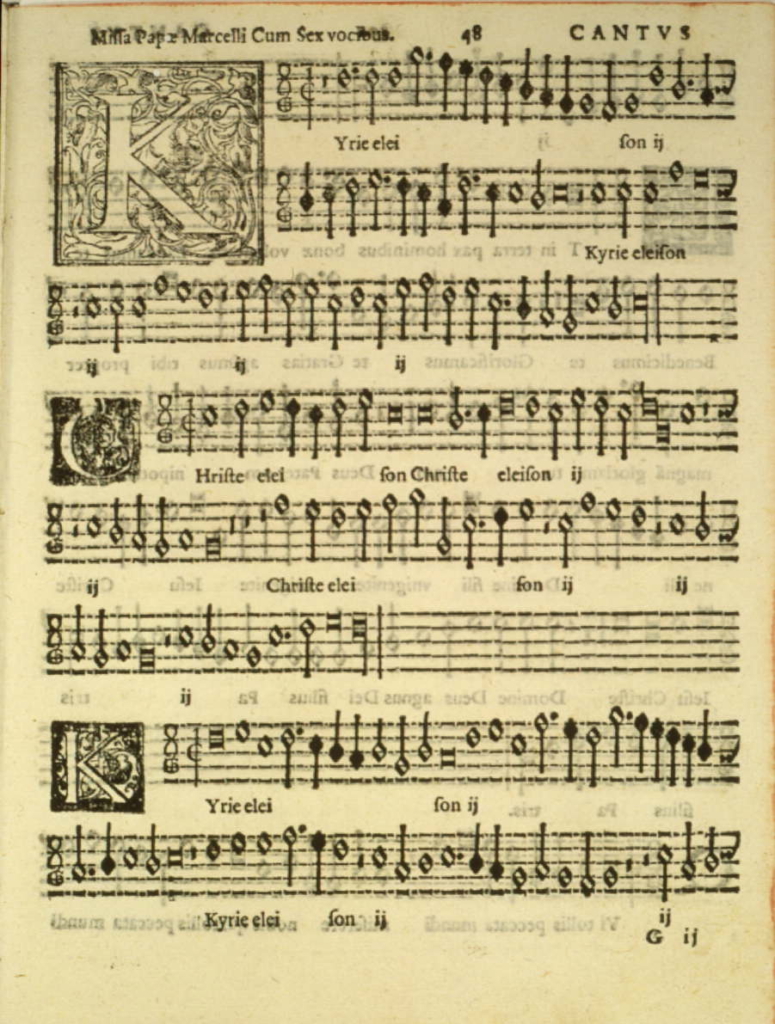
Image source:
Giovanni Pierluigi da Palestrina (c. 1562), excerpt from Missa Papae Marcelli, 16th century,
Renaissance mensural notation.
Provided by Wikimedia Commons, Public Domain.
Source: https://commons.wikimedia.org/wiki/File:Palestrina_Missa_Papae_Marcelli.jpg
This score is a typical example of Renaissance mensural notation from the sixteenth century. Each voice is placed on its own staff, and the length of sounds is clearly distinguished through the shapes of the notes. Building upon the fixed pitch established in the neumatic stage, the duration of sounds is now directly notated, allowing temporal relationships between voices to be precisely defined by the score itself. This source illustrates a mature stage of mensural notation, in which polyphonic singing can be stably reproduced through notation alone, without reliance on conventions such as rhythmic modes.
This change fundamentally alters the nature of polyphonic singing. Voices move beyond merely knowing where they meet and separate, to sharing precisely how long they should sound together. As a result, music is able to sustain far more complex and extended structures with stability.
Mensural notation does not completely reject neumes. It builds upon the pitch and structural clarity achieved through neumatic notation and adds the final element: the length of sounds. For this reason, mensural notation is not a sudden invention, but can be understood as a natural outcome that emerged in response to the limitations neumes could no longer accommodate.
From this point onward, singing no longer depends on memory alone. The score itself becomes a tool that explains the music. The transition from neumes to mensural notation marks a decisive shift from a way of singing sustained by memory to one that can be reproduced through written record.
Conclusion
The transition from neumes to mensural notation did not occur because notation suddenly became more sophisticated. It happened because the way of singing changed. As multiple voices began to sing simultaneously and longer, more complex structures had to be sustained, memory and convention alone were no longer sufficient.
Neumes were not originally created to record the length of sounds. They served as signs that recalled the direction of a melody, while choral singing continued to rely on human memory and shared agreement. However, as reference lines appeared, pitch became fixed, and the structure of notation was organized, the situation changed. Which sounds were to be sung was now clear, and the remaining question was how long each sound should last.
Mensural notation emerges precisely at this point. By beginning to divide and record the length of sounds as symbols, singing no longer needs to depend on interpretation alone. The progression from neumes to mensural notation was not a series of sudden inventions, but an accumulation of solutions to problems that had to be addressed in order to sustain singing together.
Further Reading
Bach Cello Suites (BWV 1007–1012) | Six Worlds Shaped by a Single Instrument’s Melody
Bach Cello Suites (BWV 1007–1012) | Six Worlds Shaped by a Single Instrument’s Melody