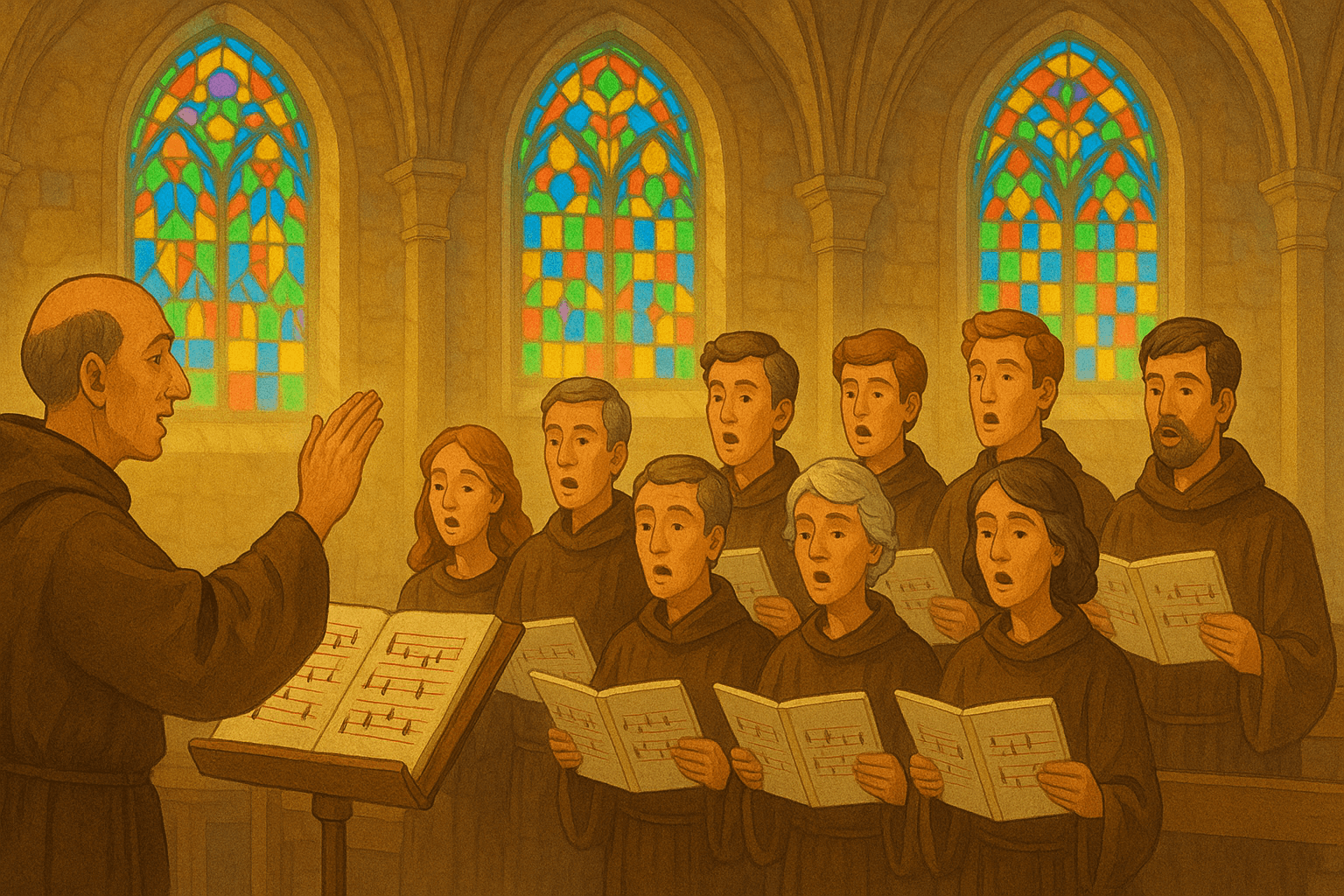
major and minor
The Collapse of Modal Thinking and the Birth of Major and Minor

major and minor

Medieval Modal Theory Series 1. From Neumes to Mensural Notation | From Music Remembered to Music Measured in Time 2. The Birth of Solmization: Guido of Arezzo and the Beginning of Do–Re–Mi 3. 8 Church Modes: Musical Order Before Major and Minor 4. Same Final, Different Modes: Authentic and Plagal Modes in Gregorian Chant 5. … Read more

Medieval parchment illustration evoking Church Modes before major and minor.
8 Church Modes: Musical Order Before Major and Minor

Medieval parchment illustration evoking Church Modes before major and minor.

Medieval Modal Theory Series 1. From Neumes to Mensural Notation | From Music Remembered to Music Measured in Time 2. The Birth of Solmization: Guido of Arezzo and the Beginning of Do–Re–Mi 3. 8 Church Modes: Musical Order Before Major and Minor 4. Same Final, Different Modes: Authentic and Plagal Modes in Gregorian Chant 5. … Read more

Guidonian Hand diagram used by Guido of Arezzo to teach solmization and pitch relationships in medieval music
The Birth of Solmization: Guido of Arezzo and the Beginning of Do–Re–Mi

Guidonian Hand diagram used by Guido of Arezzo to teach solmization and pitch relationships in medieval music

Medieval Modal Theory Series 1. From Neumes to Mensural Notation | From Music Remembered to Music Measured in Time 2. The Birth of Solmization: Guido of Arezzo and the Beginning of Do–Re–Mi 3. 8 Church Modes: Musical Order Before Major and Minor 4. Same Final, Different Modes: Authentic and Plagal Modes in Gregorian Chant 5. … Read more

neume&mensural notation
From Neumes to Mensural Notation | From Music Remembered to Music Measured in Time

neume&mensural notation

Medieval Modal Theory Series 1. From Neumes to Mensural Notation | From Music Remembered to Music Measured in Time 2. The Birth of Solmization: Guido of Arezzo and the Beginning of Do–Re–Mi 3. 8 Church Modes: Musical Order Before Major and Minor 4. Same Final, Different Modes: Authentic and Plagal Modes in Gregorian Chant 5. … Read more

String Quartet History - Baroque trio sonata ensemble with two violins, cello, and harpsichord performing together.
String Quartet History | From the Trio Sonata to a Free Language of Expression

String Quartet History - Baroque trio sonata ensemble with two violins, cello, and harpsichord performing together.

The string quartet is a representative chamber-music form consisting of two violins, a viola, and a cello. This genre is characterized by a conversational musical flow among four performers, emphasizing cooperation, balance, and subtle expression. This article offers a concise overview of String Quartet History, tracing how the ensemble developed from the Baroque trio sonata … Read more

baroque music s
Western Music History ④ Baroque Music (1600–1750) | The Establishment of Tonality and the Peak of Splendor

baroque music s

Baroque Music takes its name from the Portuguese word for a “misshapen pearl.” The term was first used to describe an artistic style that seemed exaggerated and irregular compared to the balance and order pursued in Renaissance art. Yet this very sense of irregularity and splendor became the core of the Baroque aesthetic. Music, too, … Read more

renaissance music s
Western Music History ③ Renaissance Music (1400–1600) | The Music of Human Emotion

renaissance music s

Renaissance Music The Renaissance, meaning “rebirth,” was a sweeping cultural movement that spread across Europe from the 15th to the 16th century. Moving away from the religious-centered worldview of the Middle Ages, this era rediscovered the value of human emotion and intellect. Music, too, evolved beyond being a mere vessel for divine expression, becoming an … Read more

Medieval music
Western Music History ② Medieval Music (500–1400) | From chant to polyphony, when the foundations of music were laid

Medieval music

Medieval music opens the first chapter of Western music history. Starting from simple Gregorian chant, it began to record sound through musical notation and expanded into polyphony, laying the groundwork for all later music. At the center of Christian faith, music became the language of worship and, under the authority of the Church, developed into … Read more

error: This content is protected. Copying or selection is disabled.