

The string quartet is a small ensemble of four players — two violins, a viola, and a cello — each voice carrying its own melodic line while blending into a single, carefully woven texture. The sound is not large, but the music within is remarkably dense, delicate, and introspective.
Because of this inward quality, the string quartet is often described as the “most intimate musical form.” It speaks quietly but deeply, like a private reflection shared in sound. As musical periods shifted, composers interpreted this form in new ways, allowing us to trace the evolution of musical thought through the centuries.
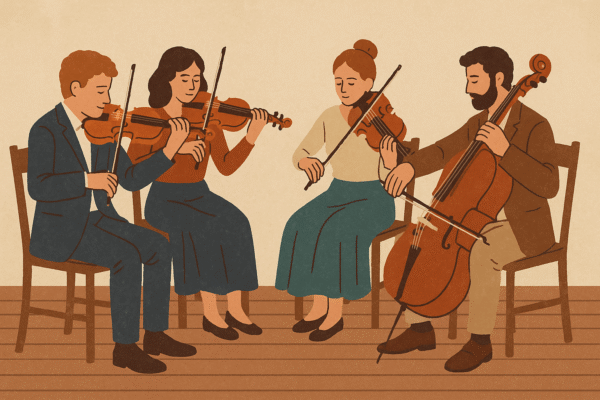
Instrumentation of the string quartet – first violin, second violin, viola, cello
1. Classical Period – Instruments Begin to Converse
In the mid-18th century, Joseph Haydn shaped the string quartet into its modern form. He structured it so that each instrument held an essential role, and he established the four-movement layout — fast, slow, dance, fast. It was no longer simple accompaniment; it became a musical conversation between four independent voices.
Mozart then added lyricism and emotional warmth. His “Six Quartets Dedicated to Haydn” expanded the expressive depth of the genre. During this period, the quartet became a central voice of Classical chamber music — balanced, articulate, and clear in formal design.
2. Beethoven – Deeper, Broader, More Complex
Beethoven transformed the string quartet into a profound arena of musical thought. His early quartets followed Haydn and Mozart, but he soon stretched the form — expanding structures, intensifying emotions, and exploring bold harmonic paths. The late quartets, especially, are demanding yet deeply rewarding.
Their movements can be free in order and form, and the music often unfolds with a sense of inner reflection rather than outward display. What seems difficult at first reveals a universe of quiet emotion and intricate design.
3. Romantic Period – Emotion and Narrative
In the 19th century, composers sought more direct emotional expression. Mendelssohn, Brahms, and Dvořák infused the quartet with personal stories, lyrical themes, and national color. Forms became more flexible, melodies grew broader, and textures more openly expressive.
Mendelssohn brought bright lyricism, Brahms contributed dense, reflective architecture, and Dvořák added folk-inspired warmth and rhythmic vitality. The string quartet became a space where personal narrative and the spirit of the age could be heard in an intimate scale.
4. 20th Century – More Experimental, More Whispered
In the 20th century, the string quartet became a space for experimentation. Bartók incorporated folk rhythms and new pitch languages, while Shostakovich wrote quartets that often concealed private messages beneath public silence.
Rhythms grow irregular, harmonies unfamiliar, and textures stripped back — yet within these sounds lie deep narratives, quiet resistance, and personal confession. The quartet turns into a medium for coded expression, where every gesture feels deliberate and exposed.
Conclusion – Four Voices, One Truthful Space
The string quartet is small in size, but never in meaning. Across eras, it has offered composers a uniquely private space — a place to reflect, confess, and experiment. Its four voices weave together without excess, allowing emotion and structure to appear in their most concentrated form.
In this quiet ensemble, instruments speak without words, revealing stories that resonate long after the final note fades. That is why the string quartet remains one of the most intimate spaces in chamber music — four voices, constantly rediscovering what it means to listen and to answer.
Further Reading
String Quartet | How Four Instruments Shape a Musical Conversation
Haydn’s “Emperor” Quartet | A Melody for a Nation, a Sentiment Beyond Time (Coming soon)