

Bach Fugue Structure is often discussed as a model of musical logic and balance, but behind this architectural clarity stands a very human story. Most people know Johann Sebastian Bach as one of the foundational figures of Western music, yet few realize he was also a devoted father of twenty children. Beyond his stern portrait lies the story of a man who struggled to provide the best musical education for his large family. This personal mission ultimately led to the creation of one of the most important works in history: The Well-Tempered Clavier (WTC).
1. A Father’s Heart in Köthen (1722)
In 1722, Bach was serving as a Kapellmeister in Köthen. This was a golden era in his life, filled with creative energy. Having lost his first wife, Maria Barbara, he found new happiness with Anna Magdalena, a gifted singer. Together, they raised a house full of children.
Bach was deeply invested in his children’s future. He wanted to create a comprehensive “textbook” that would teach them not only how to play the keyboard but also how to understand the very language of music. This was the birth of the WTC Book I.
2. The Truth About “Equal Temperament”: Bach as a Pioneer, Not an Inventor
There is a common misconception that Bach invented the system of Equal Temperament. However, historical records show that the mathematical concept of dividing an octave into twelve equal parts existed long before him. Scholars in China (Zhu Zaiyu) and Europe (Simon Stevin) had already calculated the theory as early as the late 16th century.
The problem was that, at the time, many musicians and theorists felt that mathematically equal intervals sounded cold or even “out of tune” compared to the pure, natural intervals of the past.
This is where Bach’s genius truly shines. He wasn’t the scientist who calculated the ratios; he was the artist who proved its musicality. By composing a Prelude and Fugue in all 24 keys, Bach demonstrated to the world that this new tuning system didn’t just “work”—it allowed for a richer, more emotional, and infinitely more flexible musical language. He turned a dry mathematical theory into a living, breathing masterpiece.
3. Anatomy of the Bach Fugue Structure: BWV 847
Before we dive into the analysis, it’s important to note that each piece in the WTC consists of a ‘Prelude’ and a ‘Fugue.’ While the Prelude serves as a free-flowing introduction to set the mood, the Fugue is the intellectual and artistic core of the collection—a masterpiece of strict logic and dialogue. At its heart, Bach Fugue Structure is not merely a compositional technique, but a carefully balanced system of musical conversation, where each voice carries equal responsibility.
Let’s look at the blueprint of Fugue No. 2 in C Minor (BWV 847) to understand the core Bach Fugue Structure:
By examining this example closely, we can see how Bach Fugue Structure transforms abstract counterpoint into a living, dramatic process.
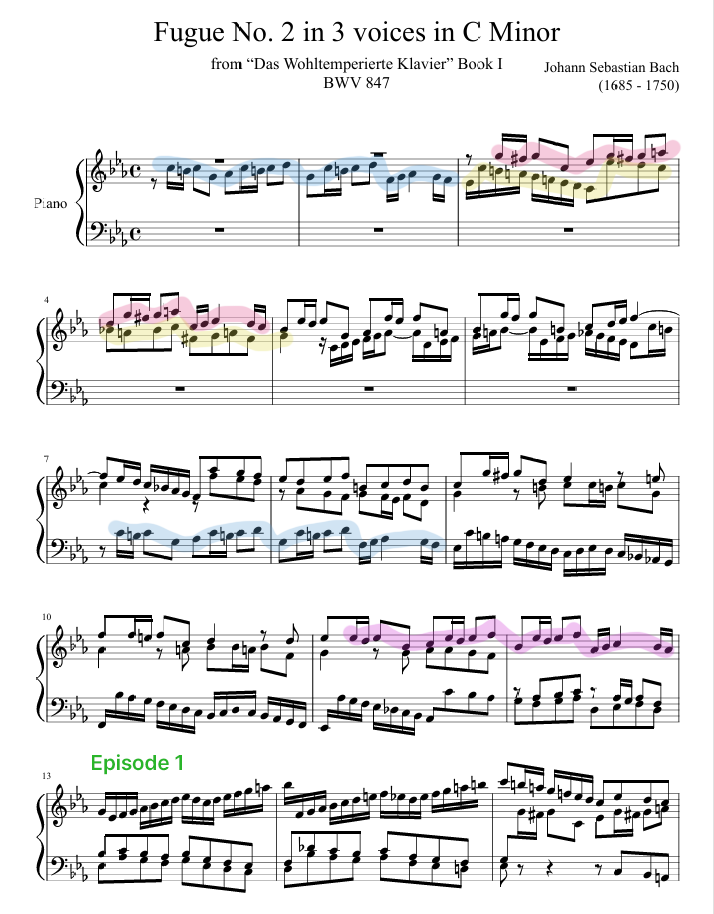
- The Subject (mm. 1-2) [Blue]: The main theme starts in the Alto voice. This rhythmic, energetic melody is the DNA of the entire piece.
- The Answer (mm. 3-4) [Blue]: The Soprano voice takes over the theme (the Answer), expanding the conversation.
- Countersubject 1 (mm. 3-4) [Pink]: While the Soprano sings the answer, the Alto follows with a fixed companion melody.
- Subject Entrance (mm. 7-8) [Blue]: Finally, the Bass voice makes its grand entrance with the subject.
- Countersubject 2 (mm. 7-8) [Yellow]: As the Bass takes the lead, the Alto adds a second supporting melody, enriching the harmony.
- Episode 1 (m. 13~) [Green Label]: After all voices have entered, Bach introduces a brief “scene change” to transition into a new key.
4. A Personal Reflection: The “Fugue Struggle”
Looking at this perfect Bach Fugue Structure reminds me of a fugue I composed 20 years ago as a music student. Comparing my work to Bach’s makes his genius even more apparent—even placing my work alongside his only highlights the distance between student craftsmanship and true mastery, but it’s a good way to see what makes his so special.
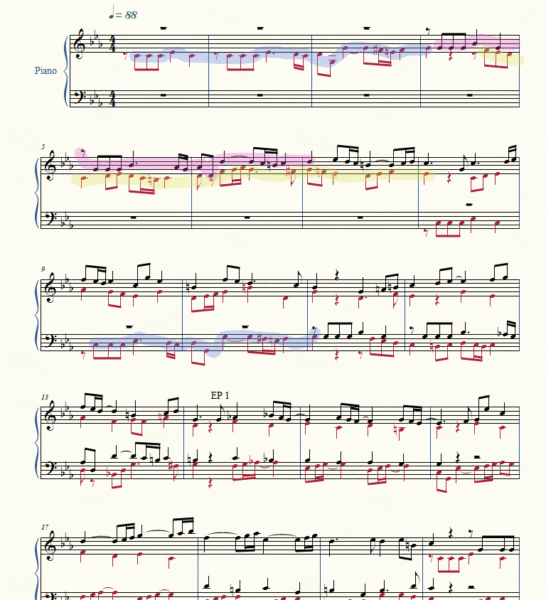
In my old score, the Subject (Blue) and the first Countersubject (Pink)—which starts exactly a fifth above—look quite promising. However, the struggle began with the yellow markings. Unlike Bach’s fixed identities, my third voice drifted into “Free Counterpoint” just to avoid harmonic clashes.
While I followed the academic rules and received a good grade, the result lacks the effortless flow of Bach, revealing the clumsy and awkward touch of a student. This contrast makes Bach’s mastery all the more striking.
Conclusion: A Legacy for All
What started as a father’s educational tool for his children became the “Old Testament” of piano music. When you listen to or play these pieces, you aren’t just hearing old music; you are experiencing Bach’s love for his family and his visionary dream of musical freedom. This Bach Fugue Structure remains his greatest gift to the musical world.
Further Reading
Why is the Clarinet a Transposing Instrument? Its Evolution and Modern Standard
Why is the Clarinet a Transposing Instrument? Its Evolution and Modern Standards
Why Are Catalogue Numbers in Classical Music So Diverse?