

Prologue – Rediscovering the chopin new waltz after Two Centuries
In 2024, the Morgan Library & Museum in New York revealed a previously unknown waltz in A minor, believed to have been written by Frédéric Chopin (1810–1849). This small manuscript, consisting of 24 measures with a repeat sign and lasting about 80 seconds, may be the shortest waltz attributed to Chopin. As the first newly identified Chopin piece since the 1930s, the chopin new waltz immediately drew the attention of both performance and research circles.
1. Discovery in New York – How the chopin new waltz Was Found
The manuscript of the chopin new waltz was identified by Robinson McClellan, a composer and curator at the Morgan Library. While cataloging the Arthur Satz Collection donated in 2019, he discovered a card labeled “Valse” and “Chopin.” Realizing it did not match any known waltz, he sent it to Jeffrey Kallberg for analysis. Following confirmation, the Morgan Library officially announced the discovery, and The New York Times reported it in October 2024.
This event marked the first time in decades that a potentially new Chopin autograph had surfaced, reigniting public fascination with the composer’s creative world.
2. The Morgan Library – Provenance of the chopin new waltz
The Morgan Library & Museum, founded by J. P. Morgan, houses autograph manuscripts by Beethoven, Mozart, and Chopin. The waltz manuscript entered the library in 2019 through the bequest of Arthur Satz and had previously belonged to Augustus Sherrill Whiton, an amateur pianist and collector. This clear chain of ownership strengthens the authenticity of the chopin new waltz and distinguishes it from anonymous manuscripts of uncertain origin.
3. Physical Features – The Compact Beauty of the chopin new waltz
The manuscript measures approximately 13×10 cm and is written in brown ink. It contains 24 measures with a repeat sign, giving a total of 48 measures. Dynamic markings and fingering indicate it was meant for performance, not merely as a draft. Such small autograph pieces were typical of Chopin’s personal dedications or album leaves.
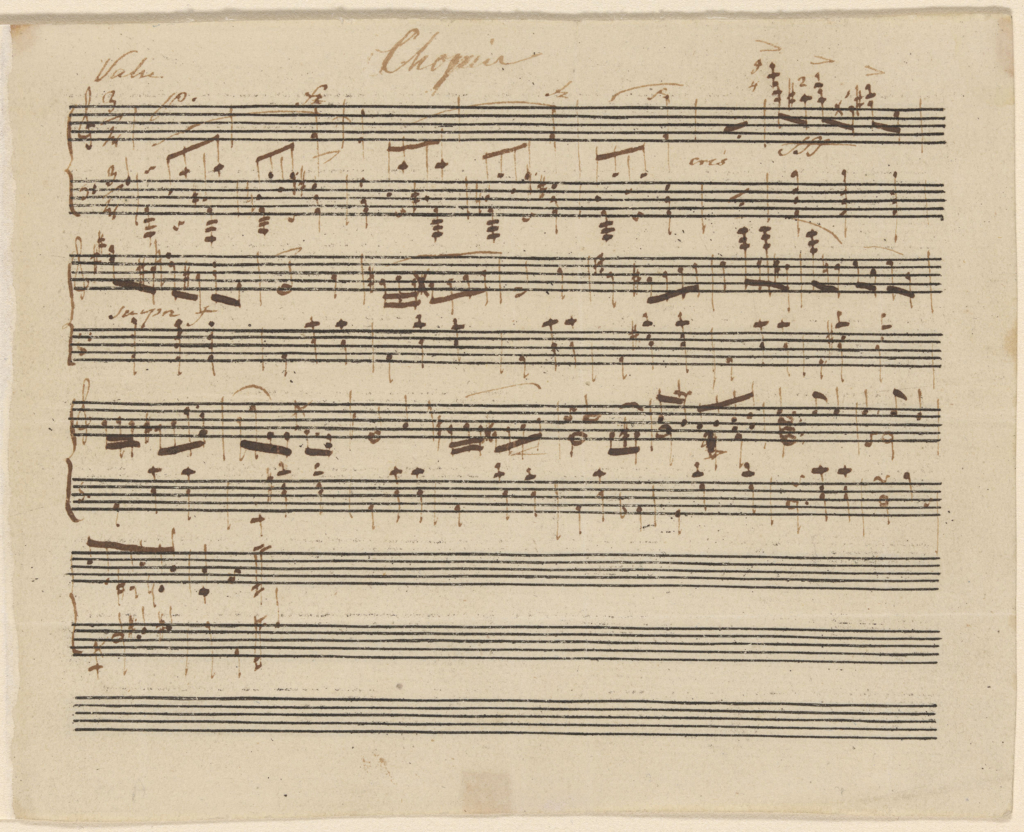
Image source: Waltz for piano (album leaf), attributed to Frédéric Chopin – autograph manuscript. Bequest of Arthur Satz, 2019. The Morgan Library & Museum, Satz 1.10.
4. Authenticity – Evaluating the chopin new waltz
Scholars at the Morgan analyzed the paper, ink, and handwriting, particularly Chopin’s characteristic bass-clef form, and concluded that the manuscript is most likely his autograph. The title “Valse” matches Chopin’s hand, while the word “Chopin” at the top right was written later by another person for identification. This added label does not invalidate the authenticity.
The Fryderyk Chopin Institute and other researchers recognize the document as an authentic trace of Chopin’s work but remain cautious about assigning it an official opus number. Its brevity, uneven notations, and lack of publication intent make the chopin new waltz a credible autograph rather than a finished cataloged work.
5. Dating the chopin new waltz – Early Paris Years (1830–1835)
Many scholars place the chopin new waltz between 1830 and 1835, during his early Paris period. The manuscript’s materials align with that era, and musically it shows a blend of Polish rhythm and Brilliant style typical of Chopin’s youthful works such as the Grande Valse Brillante Op.18 and Nocturne in E-flat Major Op.9 No.2.
This style features elegant ornamentation and expressive virtuosity. Within the short A minor waltz, the arpeggiated bass, ornamented melody, and tension–release motion reveal a vivid emotional core. It belongs to the time when Chopin, newly exiled from Poland, sought to define his musical identity in a foreign city.
6. Form and Character – How the chopin new waltz Defies Tradition
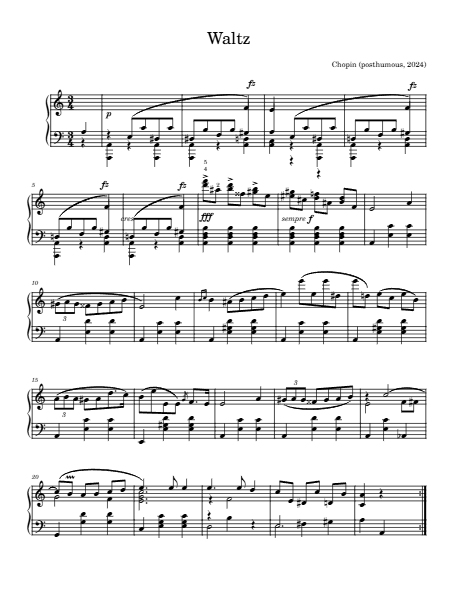
The chopin new waltz is written in triple meter yet opens with an unexpected intensity. The first eight bars, marked fff, are unusually bold for Chopin, resembling a scherzo or polonaise more than a salon waltz. Some scholars propose it might have served as a prelude or a fragment meant for a specific event.
After the thunderous beginning, the rhythm softens into a lyrical waltz. The descending bass from the introduction returns later as chromatic motion in the treble, creating a mirror-like structure. A short modulation to C major near the end adds a fleeting brightness. Despite its brevity, the chopin new waltz contains strong contrasts and symmetry, offering a complete miniature experience.
7. Tonality and Expression – The Emotional Core of the chopin new waltz
The piece is set in A minor. Its compressed harmonies, chromatic lines, and early cadences echo Chopin’s youthful idiom. A sudden modulation to C major near the end gives a brief glimpse of light, a hallmark of Chopin’s expressive design. Within just eighty seconds, the chopin new waltz conveys both tension and serenity—an introspective world reduced to miniature scale.
8. Listening Guide – Hearing the chopin new waltz Today
Epilogue – The Lasting Significance of the chopin new waltz
The chopin new waltz has not been officially numbered, and debates on its status continue. Yet its existence illuminates Chopin’s early compositional practice and poetic approach to miniature form. The uncertainty surrounding it—part complete, part fragment—only enhances its fascination. This rediscovered waltz reminds us that even a single page of music can reopen history and renew our sense of artistic wonder.
Further Reading
Debussy Arabesque No.1 | Music Between Silence and Light