
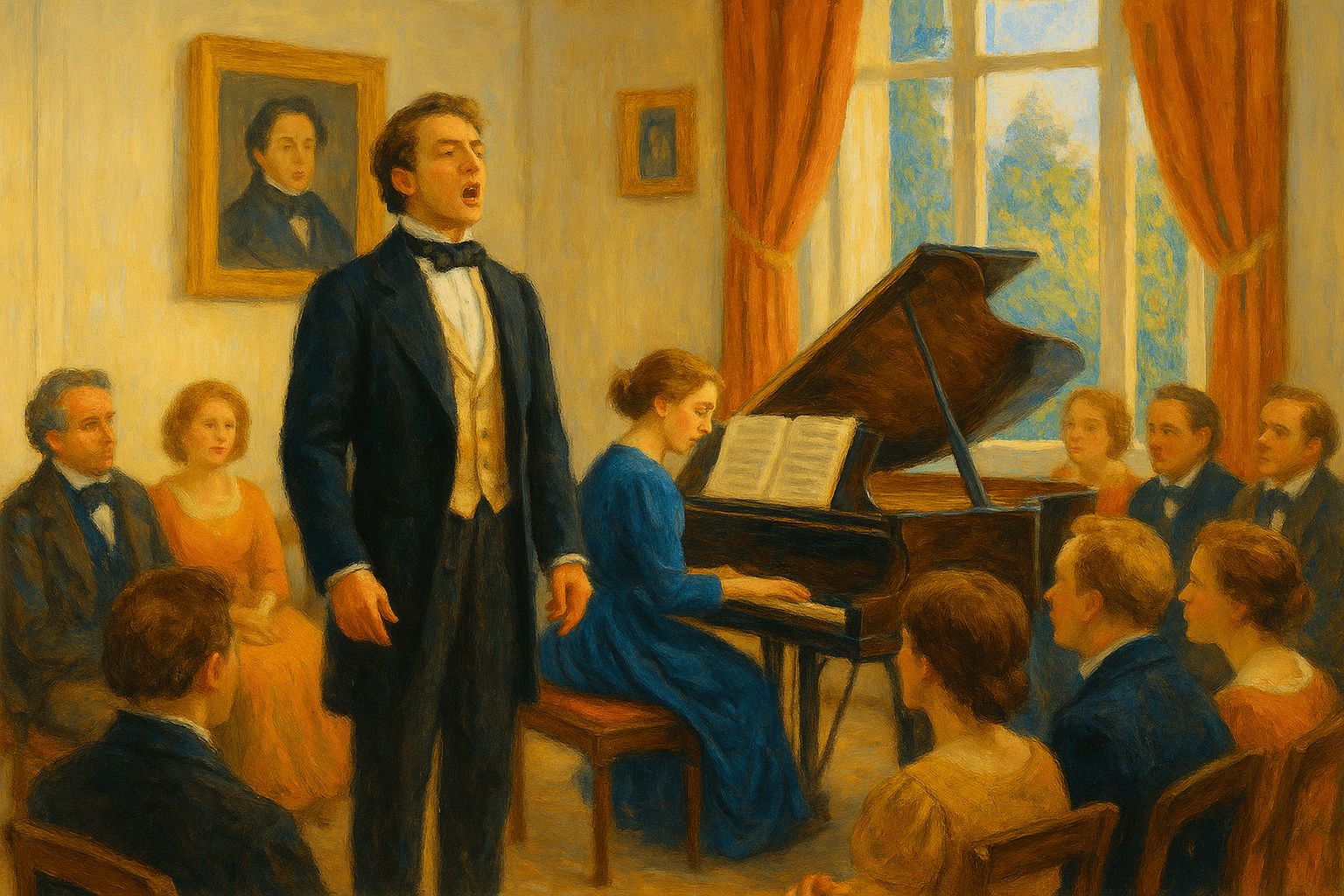
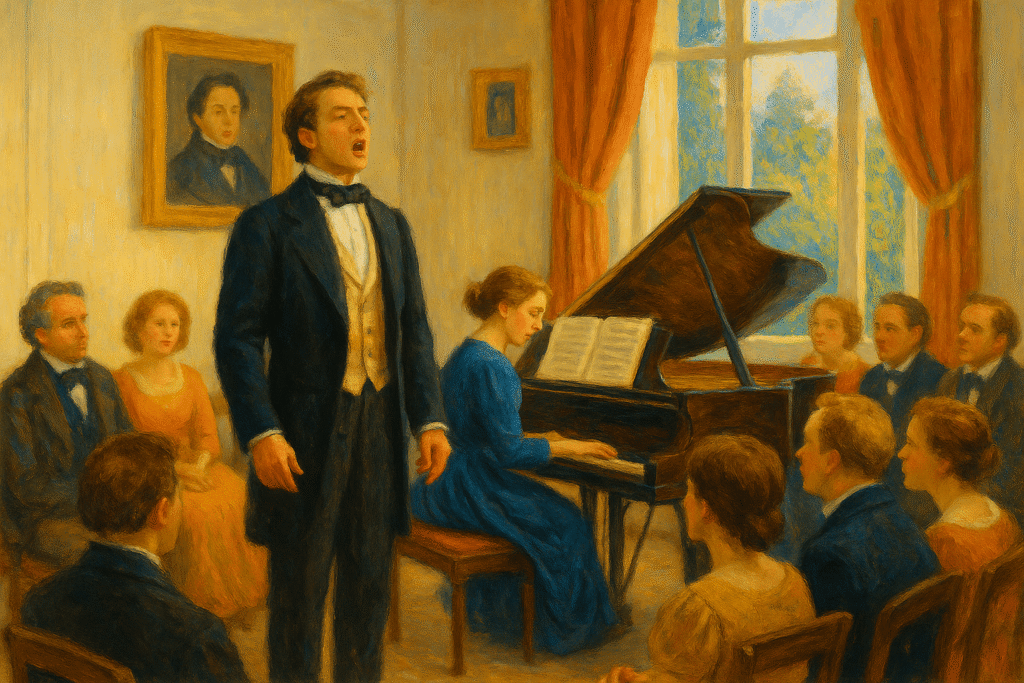
The Early Romantic period built upon the order and formal structures that Classicism had refined — and within that framework, composers began to express personal emotion and imagination with a new kind of freedom.
As the Industrial Revolution expanded the urban middle class, music moved beyond the courts and churches into public concert halls, private homes, and salons. The growth of music printing and distribution brought composers into contact with far wider audiences, while the Romantic movement in literature and the visual arts gave music a new infusion of poetic sensibility and personal expression.
In this environment, the art song (Lied) and the piano miniature became the defining genres of the period. Songs grounded in poetry captured emotion at its most subtle, and the piano evolved from a simple accompanying instrument into a second voice — one that shared equally in the emotional life of the music.
The orchestra, too, was expanding. The woodwind family grew in both directions, reaching higher and lower than before, and valve mechanisms transformed the brass. Meanwhile, advances in instrument-making gave the piano and harp a considerably wider expressive range.
Above all, the music of this period moved toward honest, direct expression of the composer’s inner world. The expressive intensity of Beethoven’s late works gave the next generation its point of departure, and Schubert, Mendelssohn, Chopin, and Schumann each found a different answer to the defining question of Early Romantic Music: how do you put a feeling into sound?
1. The Social Background That Shaped Early Romantic Music
(1) The Industrial Revolution and the Rise of the Middle Class
In the early 19th century, the Industrial Revolution swept through European society at remarkable speed. As mechanization and urbanization took hold, a new bourgeois class emerged and gradually became the primary audience for culture and the arts. Music was no longer the exclusive preserve of the aristocracy — it became an art form that ordinary citizens could enjoy and engage with on their own terms. This shift created the conditions for art to develop in the direction of expressing personal emotion and individual experience.
(2) Music Publishing and the Spread of Notation
At the same time, advances in printing technology transformed how music reached its audience. As sheet music began to be published in large quantities, composers could promote their works and earn a living from them, while audiences could easily purchase scores and perform music at home. The wider circulation of printed music brought music into everyday life and closed the distance between composer and listener.
(3) Salon Culture and New Performance Spaces
During this period, performance thrived not only in large concert halls but in homes and private salons. The salon was a social space where literature, visual art, and music came together — a new kind of stage where artists and audiences could meet and exchange ideas freely. In these intimate settings, small-scale, nuanced works were preferred over large-scale symphonies, and it was within this environment that genres such as the art song (Lied) and the piano miniature flourished, shaped by and shaping the Romantic sensibility.
2. The Musical Language of Early Romantic Music
Beethoven’s late works maintained the formal balance that Classicism had built — while pushing against it from within, forcing emotional intensity into structures that were never quite designed to contain it. The composers who followed took that tension further. For them, music was no longer a matter of rational architecture; it was a language for expressing exactly what a person feels.
(1) Harmony — From Functional Logic to Expressive Color
Classical harmony revolved around a clear tonal center, with the relationship between tonic and dominant providing structure and stability. Within any given piece, the harmony moved purposefully toward resolution, giving the music its sense of order and balance.
Romantic composers began to pull away from this. Rather than following harmonic logic, they chose chords for their emotional color and atmosphere. Schubert moved freely between major and minor to trace shifts in feeling — in his song Der Lindenbaum from Winterreise, the warmth of the major key gives way to minor at the exact moment a cold wind enters the text. The harmony doesn’t just support the words; it becomes the temperature of the scene.
Chopin went further, allowing dissonances to linger without resolution — treating harmonic tension not as a problem to solve but as an atmosphere to inhabit. Tonality remained, but in Early Romantic Music the gravitational pull toward resolution grew more elastic, more personal.
(2) Melody and Rhythm — From Fixed Meter to the Performer’s Breath
Classical melody was built on symmetry: regular phrases, clear periodicity, steady rhythm. As music moved into the Romantic period, these constraints loosened considerably. Composers began to stretch and compress the beat to match the emotional shape of a phrase — prioritizing feeling over strict metrical regularity. This expressive flexibility became known as rubato, and it became one of the defining characteristics of Early Romantic Music.
Chopin’s Nocturne in E-flat major, Op.9 No.2 is the clearest illustration of this shift. The left hand holds a steady pulse beneath the music, while the right-hand melody moves freely above it — breathing, pausing, surging forward — as if thinking out loud. The rhythm follows the heart, not the clock.
Schumann’s Kinderszenen works in a similar way — each piece unfolds like a spoken sentence, pausing and continuing according to its own inner rhythm. The performer’s interpretation became as much a part of the music as the notes on the page.
(3) Form and Structure — Shaped by Emotion, Not Convention
Classical form followed a clear architecture: introduce a theme, develop it through contrast, return to the opening, and close. Romantic composers kept this framework in mind but allowed emotional direction to take precedence over formal convention.
Mendelssohn’s Songs Without Words let short melodies carry feeling in place of words. Each piece flows naturally like a vocal phrase — complete in itself, shaped more by mood than by any fixed structural plan.
Schumann’s Symphonic Études takes the variation form but abandons the idea of logical thematic development. Each variation has its own distinct character and emotional register — the listener follows a psychological journey rather than a formal argument.
Chopin’s Ballade No.1, Op.23 makes this most explicit. It follows no standard sonata plan, yet moves with complete inevitability: a quiet opening theme gathers intensity, meets a contrasting idea, builds tension over a long arc, and finally releases everything at once. The structure is the emotional journey — nothing more, nothing less.
For these composers, form was not a mold to be filled but a shape that emotion itself created as it moved through time.
3. Major Genres
(1) The Art Song (Lied) — Where Poetry and Music Became One
At the heart of Early Romantic Music was the art song, or Lied. Composers of this period sought to carry the language and emotion of poetry directly into music — and in doing so, elevated the vocal song from simple entertainment into a fully realized art form.
Schubert brought this genre to its peak. Setting texts by Goethe, Müller, and other poets, he shaped melody and accompaniment to follow the structure and natural rhythm of the words themselves. His song cycles Die schöne Müllerin (D.795) and Winterreise (D.911) trace the inner life and journey of a single figure — charting psychological depth with a precision that made them the starting point for Romantic emotional expression.
Schumann carried this tradition forward with a more inward, literary sensibility. In Dichterliebe (Op.48) and Frauenliebe und -leben (Op.42), poetry and music interlock so tightly that voice and piano together express what neither could convey alone. The art song of this period became the genre that most purely embodied the Romantic spirit — the place where literature and music met most completely.
(2) Piano Music — Where Technical Mastery Met Personal Expression
In the Early Romantic period, the piano moved from accompanying instrument to the center of musical life. The introduction of the iron frame and improvements to the action dramatically expanded its dynamic range and expressive capacity — composers could now conjure something approaching orchestral color from a single instrument.
Rather than large formal structures, the music of this period concentrated on capturing a single moment or emotion within a compact form. Small in scale but wide in expressive range, the piano miniature became one of the defining achievements of the age.
Chopin wrote everything for the piano and pushed the instrument to its limits. His Études (Op.10, Op.25) are not merely technical exercises — they are works of art in which virtuosity becomes a vehicle for emotional expression. In the Revolutionary Étude (Op.10 No.12), the relentless motion of the left hand carries with it a sense of desperation and struggle that goes far beyond the technical.
Schumann approached the piano through literary imagination. Works like Kinderszenen (Op.15) and Fantasiestücke (Op.12) explore the subtle movements of inner feeling rather than pianistic display — and in doing so, established the Romantic tradition of the character piece: music defined not by formal structure but by psychological character.
(3) Symphony and Concerto — Landscape and Emotion in the Orchestra
The Romantic symphony inherited the Classical framework but filled it with something new: personal feeling, natural imagery, and the suggestion of narrative. Music became a means of painting inner scenes rather than constructing abstract architecture.
Schubert’s Symphony No.8 in B minor (“Unfinished”) demonstrates this clearly. Only two movements survive, yet the work feels complete — its lyrical, warm themes wrap around the whole and give it a sense of resolution that has nothing to do with formal closure. Emotional flow, not traditional development, is what holds it together.
Mendelssohn’s Italian Symphony translates the experience of travel into orchestral sound — not description, but the emotional impression left by a journey: brightness, vitality, the particular feeling of being somewhere alive and new.
The concerto, too, reflected this shift. Chopin’s Piano Concerto No.1 places less emphasis on virtuosic display and more on the lyrical voice of the piano — soloist and orchestra less in opposition than in conversation, exchanging feeling rather than competing for dominance. Mendelssohn’s Violin Concerto in E minor (Op.64), with its seamless balance of lyricism and formal grace, remains one of the best-loved concertos in the repertoire.
4. Key Instruments of Early Romantic Music
Image Sources
All instrument images used in this section are sourced from public domain or open access collections held by museums and libraries.
Strings
Bow (Violoncello) — Made by François Tourte, France, c. 1800. Picryl Image Archive (Public Domain).
Woodwinds
Piccolo — Germany, c. 1878–1880. Smithsonian National Museum of American History (Object No. MI.055631).
English Horn — Made by Andrea Fornari, Venice, Italy, 1832. The Metropolitan Museum of Art (Object No. 89.4.889).
Bass Clarinet — Made by Giacinto Riva, Italy, mid-19th century. The Metropolitan Museum of Art (Object No. 89.4.3124).
Contrabassoon — Made by Johann Tobias Ullmann, Germany, c. 1825–1833. The Metropolitan Museum of Art (Object No. 89.4.1736).
Brass
Valve Trumpet — Made by Elbridge G. Wright, Boston, USA, c. 1845. The Metropolitan Museum of Art (Object No. 2002.388a–j).
Valve Horn (Cor solo) — Made by Jean Louis Antoine, Paris, France, c. 1850–1855. The Metropolitan Museum of Art (Object No. 1999.304a–h).
Ophicleide — France, c. 1835–1840. National Music Museum, University of South Dakota (Object No. 02414).
Cornet (B-flat) — Made by Courtois frères, Paris, France, 1833. The Metropolitan Museum of Art (Object No. 2002.190a–n).
Piano and Harp
Grand Pianoforte — Made by Sébastien Érard, London, England, c. 1840. The Metropolitan Museum of Art (Object No. 59.76).
Double-action Pedal Harp — Made by Sébastien Érard, London, England, 1831. National Music Museum, University of South Dakota (Object No. 01218).
(1) Strings — Greater Power, Greater Flexibility
The string section gained no new instruments in the Early Romantic period, but developments in materials and construction significantly expanded its expressive range. The shift from gut to steel strings increased tension and projection, producing a brighter, more penetrating tone that could fill the larger concert halls of the 19th century. The overall sound of the orchestra grew richer and more powerful as a result.
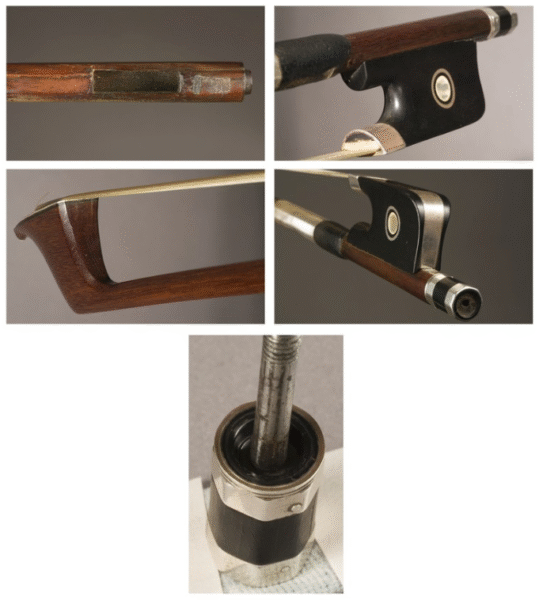
Library of Congress – Cello Bow
The more far-reaching development was the Tourte bow, perfected by French bow-maker François Tourte. Three changes defined it:
First, Tourte used Pernambuco wood from Brazil, which gave the bow exceptional elasticity and allowed players to control pressure and speed across its full length with far greater sensitivity than before. Second, a redesigned camber shifted the balance point toward the hand, making the bow’s movement smoother and more stable — essential for the long, singing phrases that Romantic string writing demanded. Third, a metal screw mechanism at the heel allowed players to adjust the tension of the horsehair precisely, giving immediate control over tone weight and dynamic range.
Together, these changes made possible the sustained lyrical lines and wide dynamic contrasts that define the Romantic orchestral sound. The expressive depth of Romantic string writing rests, in no small part, on the development of this bow.
(2) Woodwinds — Deeper Range, Richer Color
The Classical woodwind section — flute, oboe, clarinet, bassoon — remained the foundation, but the Early Romantic orchestra added four new instruments that extended the family’s range in both directions: the piccolo, the English horn, the bass clarinet, and the contrabassoon.
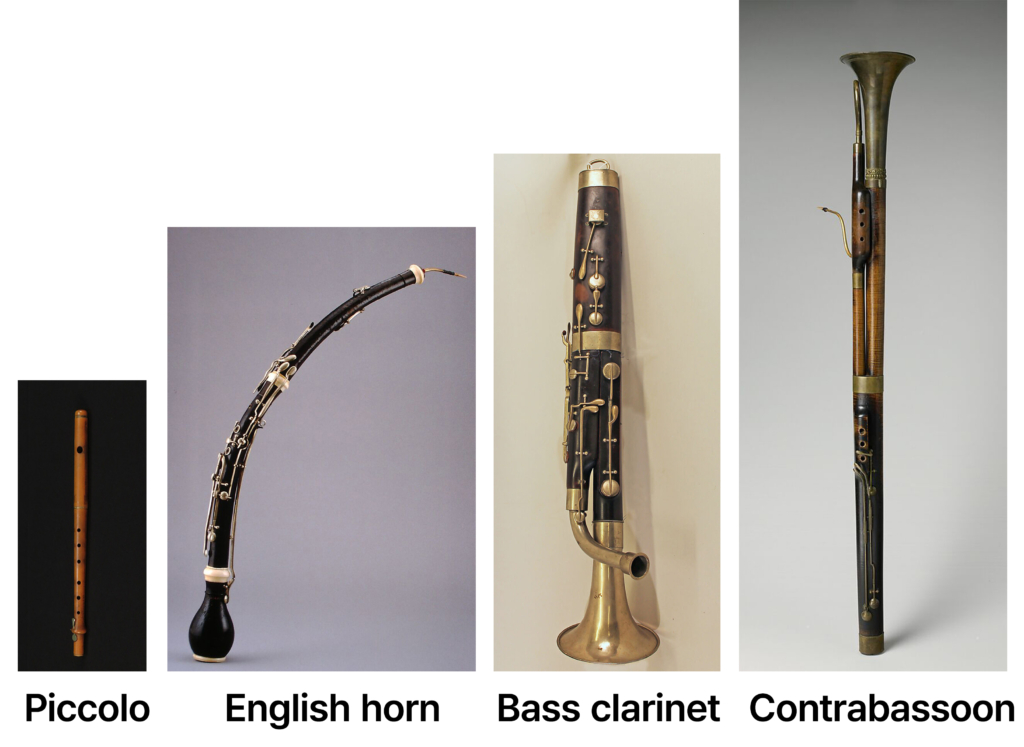
The piccolo (an octave above the flute) brought a bright, penetrating upper register. The English horn (a perfect fifth below the oboe) added a warm, lyrical voice well suited to expressive solos. The bass clarinet extended the clarinet’s range downward with a dark, resonant tone, while the contrabassoon anchored the woodwind section with its lowest pitches.
These additions were more than a matter of range. Composers began using woodwind instruments as carriers of specific emotional character — the English horn for longing and nostalgia, the bass clarinet for unease and shadow. Each instrument brought its own distinct personality to the orchestral palette.
(3) Brass — The Valve Revolution
The single most transformative development in Early Romantic instrumentation was the invention of the valve system for brass instruments. Before valves, horns and trumpets were limited to the pitches of the natural harmonic series — determined by the fixed length of the tube. Players could alter pitch by inserting detachable crooks or by hand-stopping the bell, but chromatic playing remained cumbersome and tonally inconsistent.
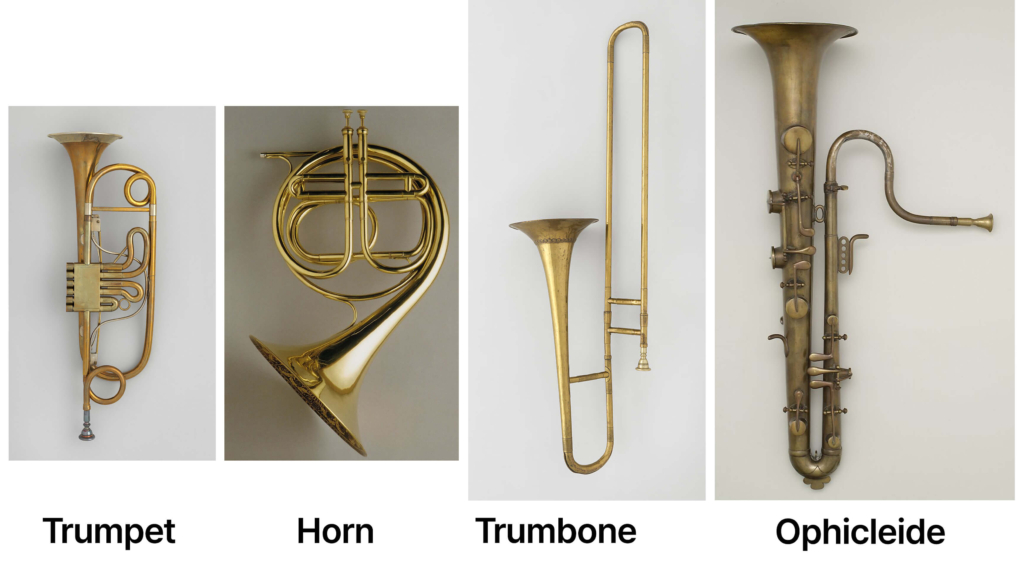
The introduction of rotary and piston valves in the early 19th century changed this entirely. Valves allowed players to redirect airflow through additional tubing instantly, making the full chromatic scale available with the same ease as any other instrument. The horn, once confined to fanfares and hunting calls, could now carry lyrical melodies; the trumpet could move through any key with fluency. This was not merely a technical advance — it opened the door for brass instruments to express the full emotional range of Romantic music.
This period also saw the brief prominence of the ophicleide, a keyed bass brass instrument that succeeded the serpent and provided a more focused, resonant low-brass sound. As valve technology spread, it was gradually displaced by the tuba, whose valve mechanism offered greater range and consistency. The line from serpent to ophicleide to tuba traces the steady deepening of the orchestra’s bass foundation across the 19th century.
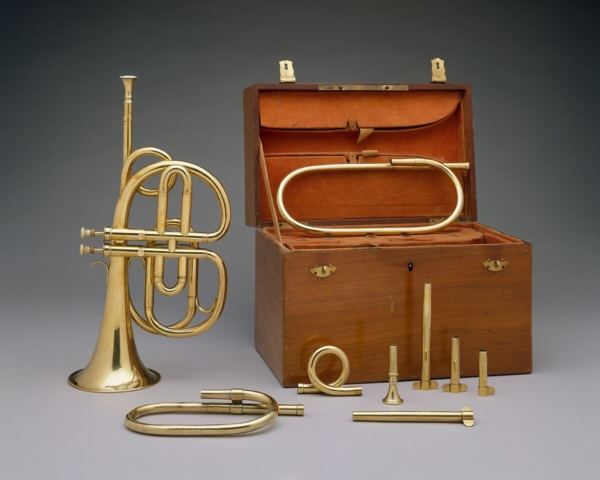
The cornet also enjoyed a period of popularity, particularly in orchestras and military bands. Shorter than the trumpet and softer in tone, it was used by Mendelssohn and Berlioz for passages requiring lyrical flexibility. As trumpet technique advanced, the cornet gradually withdrew from the orchestra — today it lives on mainly in brass bands and wind ensembles.
(4) Percussion — From Timekeeping to Dramatic Expression
The timpani remained the center of the Early Romantic percussion section, but its role expanded. Improved tuning mechanisms made pitch changes more precise, and composers began writing timpani parts that contributed to harmonic color and dramatic tension rather than simply marking the beat.
New metal percussion instruments — cymbals, triangle, and tam-tam — entered the orchestra during this period, used primarily for scene-painting and climactic emphasis. Berlioz deployed them in the Symphonie fantastique to evoke madness; Tchaikovsky used cannon fire and bells in the 1812 Overture to recreate the atmosphere of battle. Percussion was no longer just rhythm — it had become atmosphere, color, and drama.
The percussion section of the Early Romantic orchestra was still relatively modest. The far larger and more varied ensembles of the mid and late Romantic periods lie ahead — and will be explored in the next installment of this series.
(5) Piano and Harp — The Voice of Intimate Expression
No instrument defined Early Romantic Music more completely than the piano. In the early 19th century, the shift from wooden to iron frames dramatically increased string tension and projection. The introduction of double escapement made rapid, repeated notes and subtle gradations of touch possible in ways earlier instruments could not achieve. The piano became capable of sustaining a singing tone, producing near-orchestral density, and responding to the finest nuances of a performer’s touch — transforming from an accompanying instrument into a personal voice for the composer’s innermost thoughts.
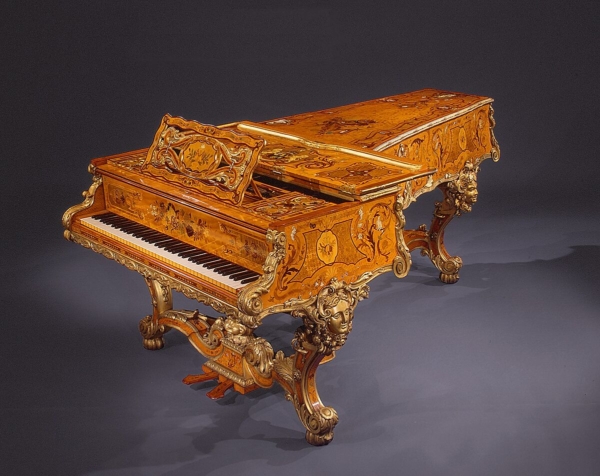
Chopin sang of love, solitude, longing, and passion through the piano alone — earning him the title “Poet of the Piano.” Schumann used it to hold the worlds of memory and imagination found in works like Kinderszenen. Together, they showed that a single instrument could carry the full weight of Romantic expression.
♣ What is Double Escapement?
Early pianos — including the fortepiano of Mozart’s era — required the key to return almost fully to its resting position before the hammer could strike again. This made rapid repeated notes, trills, and delicate arpeggios difficult to execute cleanly.
In the early 1810s, French instrument maker Sébastien Érard addressed this with the double escapement mechanism. The new design allowed the hammer to reset at a halfway position — without the key needing to return all the way up — so the string could be struck again almost immediately. The result was a piano that responded to the lightest, fastest touch with complete precision.
This single mechanical innovation made possible the rapid figurations of Chopin’s études, the delicate voicing of Schumann’s character pieces, and the sustained singing tone that Romantic composers required. The piano of 1840 was, in terms of expressive capacity, a fundamentally different instrument from the piano of 1800.
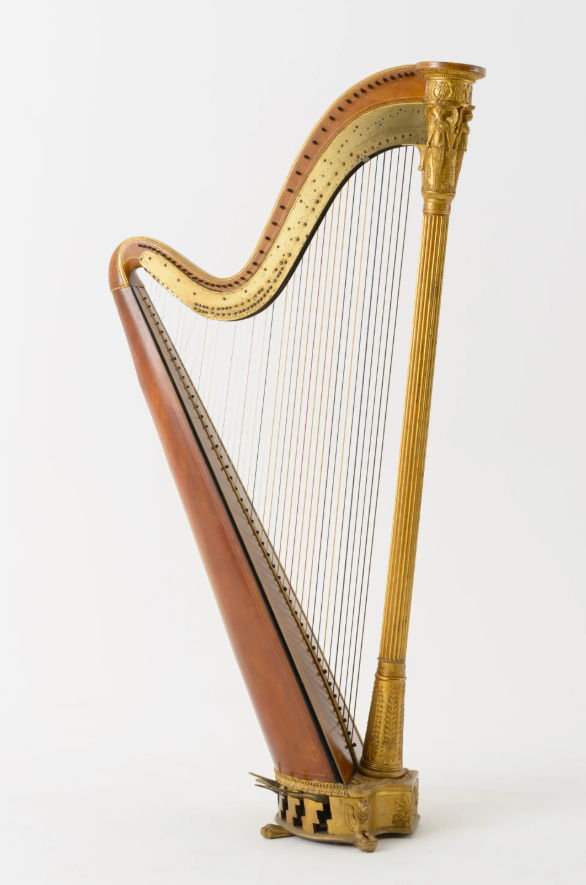
The harp underwent a comparable transformation through Érard’s double-action pedal system, completed in 1810. Before this innovation, the harp was effectively limited to a single key per performance. Érard’s system allowed each pedal to be set in three positions, raising or lowering the corresponding strings by a semitone or a whole tone — giving the instrument full chromatic freedom for the first time. The harp moved from a decorative fixture of the aristocratic salon into a genuine expressive presence in the orchestra and chamber ensemble. Its characteristic shimmer — strings resonating together, each slightly different in color — became one of the most distinctive sounds of the Romantic age.
5. Major Composers of Early Romantic Music
(1) Franz Schubert (1797–1828)
“The composer who dissolved the boundary between poetry and music, and opened a new world of song”
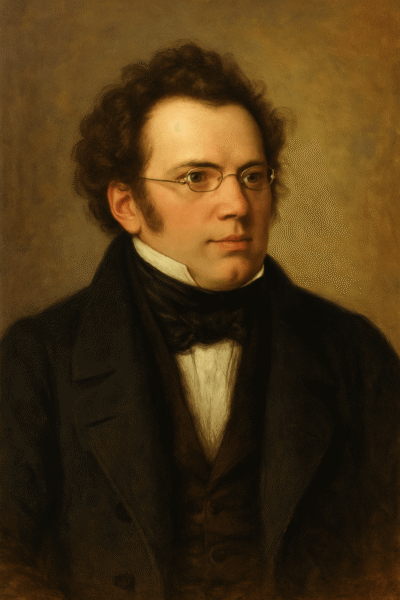
Nationality: Austrian
Active: Vienna; a pioneer of Romanticism who was largely overlooked in his lifetime and reassessed after his death
Key genres: Art song (Lied), symphony, chamber music, piano music
Schubert lived and worked in Vienna, but remained largely unknown during his lifetime. He supported himself as a schoolteacher while composing with extraordinary productivity, and shared his music mainly through private gatherings known as Schubertiades — informal evenings among friends that served as the primary venue for his work. Despite the quietness of his life, the creative output he left behind was remarkable in both quantity and density for someone who died at thirty-one.
What distinguished Schubert was his ability to connect human emotion and poetic language directly through music. He translated the atmosphere and natural inflection of a text into melody and accompaniment that seemed to think alongside each other — voice and piano in genuine dialogue. His song cycles and instrumental works alike carry a world where light and shadow coexist, and that world continues to resonate deeply today.
(2) Felix Mendelssohn (1809–1847)
“A Classicist within Romanticism — conductor, administrator, and composer of cultivated elegance”
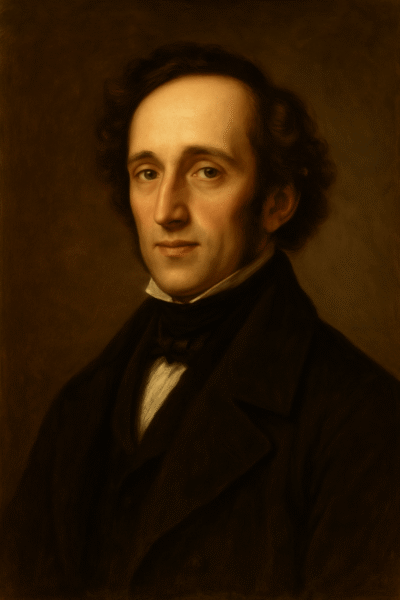
Nationality: German
Active: Composer, conductor, pianist, music administrator
Key genres: Symphony, concerto, overture, chamber music, choral music
Mendelssohn grew up in a wealthy Jewish family with broad intellectual horizons — literature, philosophy, and the visual arts were as much a part of his education as music. He showed prodigious talent from childhood, completing the Overture to A Midsummer Night’s Dream at seventeen. The security and refinement of his upbringing left a lasting imprint on his music: it tends toward restrained beauty and Classical balance, favoring clarity and lyrical grace over emotional extremes.
He was more than a composer. As a conductor, his revival of Bach’s St. Matthew Passion in 1829 is considered a turning point in music history — the spark that launched the modern Bach renaissance. His music occupies a distinctive place in the Romantic canon: deeply Romantic in feeling, yet Classical in proportion and finish.
(3) Frédéric Chopin (1810–1849)
“The poet who painted human emotion through the piano”
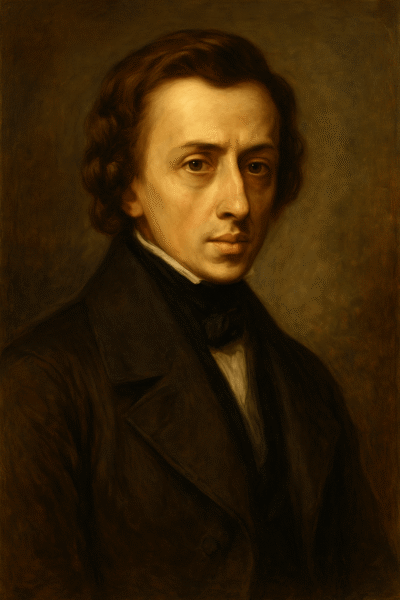
Nationality: Polish
Active: Composer and pianist, based in Paris
Key genres: Piano solo, concerto, waltz, mazurka, polonaise, ballade, nocturne
Chopin grew up in Poland, where he showed both compositional sensibility and pianistic talent from an early age. Studies in Warsaw and his first European concert tours gradually built his reputation, and he eventually settled in Paris — moving in artistic circles while establishing the finely nuanced expressive world that was entirely his own. His playing shone more in the intimacy of the salon than on the concert stage, and through the keyboard he captured the subtlest tremors of feeling, earning him naturally the title “Poet of the Piano.”
Chopin’s world is essentially an interior language realized through the piano. By combining folk rhythms with lyrical melody he opened new emotional territory, and his works stand apart for the way they dissolve virtuosic technique into the delicate flow of feeling. The poetic sensibility running through his ballades, mazurkas, and nocturnes continues to inspire pianists to this day.
(4) Robert Schumann (1810–1856)
“The Romantic poet who wove literature and music into one”
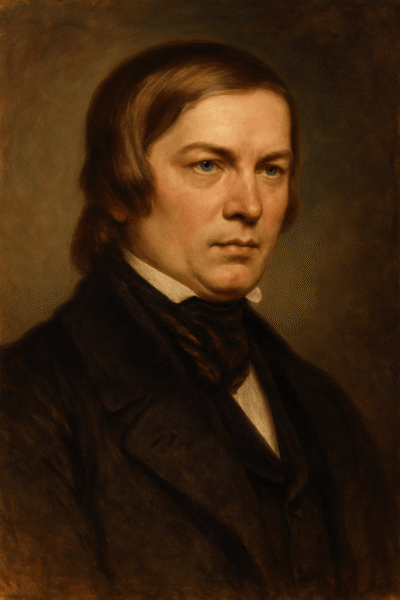
Nationality: German
Active: Composer, music critic, conductor
Key genres: Piano music, art song (Lied), symphony, concerto, chamber music
Early Romantic Period — Emotion Sung Through Piano and Song
The young Schumann was deeply absorbed in bringing literature and music together. His dream of becoming a concert pianist ended with a hand injury, but that experience turned him decisively toward composition. In short piano pieces he distilled inner feeling and imagination with extraordinary precision, building a poetic architecture all his own.
The major works of this period — Davidsbündlertänze, Kinderszenen, Dichterliebe — all draw their breath from literary sources. Each individual piece stands complete, like a poem, while the whole forms a single continuous narrative.
For Schumann, love was the source of art. His relationship with the brilliant pianist Clara Wieck was a constant creative force, and his feeling for her runs through countless piano works. His music moves not through passion but through a deep, thoughtful emotional current — the defining inner voice of early Romanticism.
Middle Romantic Period — Expanding into the Symphonic World
After his marriage, Schumann moved beyond piano and song into symphonies and concertos. Symphony No.1 “Spring” carries the hope and energy of a new season; Symphony No.3 “Rhenish” shapes the grandeur of the Rhine into music. The Piano Concerto in A minor, dedicated to Clara, became a new model for the Romantic concerto.
During these years Schumann remained active as a critic, founding the Neue Zeitschrift für Musik and introducing young composers to the world — most famously presenting Johannes Brahms to his readership. But his mental health declined in later life, and he died in an asylum in 1856. His music, however, continues to shine with human warmth and sincerity.
Conclusion — The Age When Feeling Became the Language of Music
Early Romantic Music placed human emotion and experience at the very center of musical life. The wider audiences that industrialization created, the advances in instrument-making and music publishing, and the exchange with literature and the visual arts all drove music toward becoming a more personal, more direct language. Composers worked within the order of the Classical tradition while pursuing a new approach — one that followed emotional flow over formal convention — and in doing so, the Lied, the piano miniature, and the symphony each found their own way of holding the inner world.
The works of Schubert, Mendelssohn, Chopin, and Schumann are different answers born from the same era, and their music continues to carry toward us the emotional temperature and breath of 19th-century life. To look closely at Early Romantic Music is to follow a journey through the air of a changing time — tracing how music came to hold both the individual heart and the feeling of an age.
Further Reading
Western Music History ⑤ Classical Music (1750–1820) | Balance, Clarity, and the Logic of Form
Western Music History ⑤ Classical Music (1750–1820) | Balance, Clarity, and the Logic of Form
Oboe vs English Horn | Understanding Their Voices and Roles in the Orchestra
Oboe vs English Horn | Understanding Their Voices and Roles in the Orchestra