


Women Behind the Score Series
1. Mel Bonis (1858–1937) | A Forgotten French Female Composer and the Music Hidden Behind a Name
2. Mel Bonis and Fauré | A 50-Year Musical Friendship Born in Room 7 of the Paris Conservatoire
3. Cécile Chaminade (1857–1944) & Augusta Holmès (1847–1903) | Two Forgotten Voices of Paris
In our last piece, we followed the remarkable friendship between Mel Bonis and Fauré — two musicians who shared a classroom in Paris yet were handed entirely different lives by the same era. We promised to travel next to Vienna and London, where other women were hiding behind names or having their names taken from them altogether. But before we leave Paris, there is one more story that demands to be told here. In the very city where Mel Bonis lived, two other women were losing their names in ways that were entirely their own. Cécile Chaminade (1857–1944) and Augusta Holmès (1847–1903). One kept her name but watched it be stamped with the label of “salon music.” The other had to replace her name with a man’s from the very beginning. Where Mel Bonis hid behind the mask of “Mel,” these two women each wore a different kind of mask — and Paris let them disappear just the same.
1. Cécile Chaminade — The Stigma of “Salon Music”
Cécile Chaminade (Cécile Louise Stéphanie Chaminade, 1857–1944)
“A French composer of over 400 works, whose legacy was buried beneath the label of salon music”
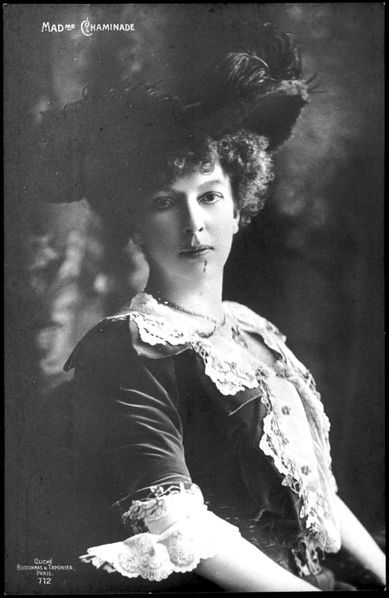
Image source: Portrait photograph of Cécile Chaminade — Reutlinger & Savonnier photography studio, Paris. Held by IMSLP (File: ChaminadeCecile.jpg). Public domain.
Nationality: French
Active: Late 19th–early 20th century, France · United Kingdom · United States
Primary genres: Piano works, symphonic poem, ballet, opéra comique
Characteristics: Wide-ranging output spanning salon miniatures and large-scale orchestral works; victim of a double standard that dismissed her work in both directions
Bizet’s “Mon Petit Mozart” — Turned Away at the Door
Where Mel Bonis was pushed through the doors of the Paris Conservatoire by César Franck’s personal intervention, Chaminade never made it through those doors at all. The composer Georges Bizet, who lived nearby, heard the eight-year-old Chaminade play and called her “mon petit Mozart” — urging her parents to enroll her at the Conservatoire without delay. Her father refused. In his view, daughters of the bourgeoisie were born to become wives and mothers, not students at a public institution. The door closed, and Chaminade was left to study privately with members of the Conservatoire faculty — a distinction that would later be turned against her.
The “Salon Music” Label — A Double Standard with No Exit
Despite that, she never stopped composing. She left behind more than 400 works, ranging from concerto-style piano pieces to symphonic poems, ballets, and opéra comique — a far wider range than the “salon composer” label would ever suggest. But the critics refused to look at the full picture. They fixed their attention on her piano miniatures, attached the label of “salon music,” and let it do its work. By the twentieth century, the term had hardened into something dismissive — trivial, sentimental, music made for the idle entertainment of women — and under that weight, her name began to sink.
What made the stigma particularly cruel was its double standard. Write something small and intimate, and it was “too feminine.” Move toward the orchestra and larger forms, and the criticism reversed itself entirely. There was no direction she could write in that did not invite some version of the same dismissal. The rules had been written in advance, and she had not been consulted.
The irony is that her music found its warmest reception not in Paris, but across the Atlantic. More than 200 “Chaminade Clubs” formed across the United States, where amateur musicians gathered specifically to perform her work. In 1913, she became the first female composer to be awarded the Légion d’honneur. And yet none of it secured her a place at the center of Parisian musical life. She died in Monaco in 1944, and for the better part of a generation afterward, she was treated as a relic of the Victorian era. It was not until the late 1970s that serious musicians began recording her major works — and the reassessment, long overdue, finally began.
2. Augusta Holmès — The Mask of “Hermann Zenta”
Augusta Holmès (Augusta Mary Anne Holmès, 1847–1903)
“An Irish-French composer who wrote large-scale orchestral works from behind a male pseudonym”
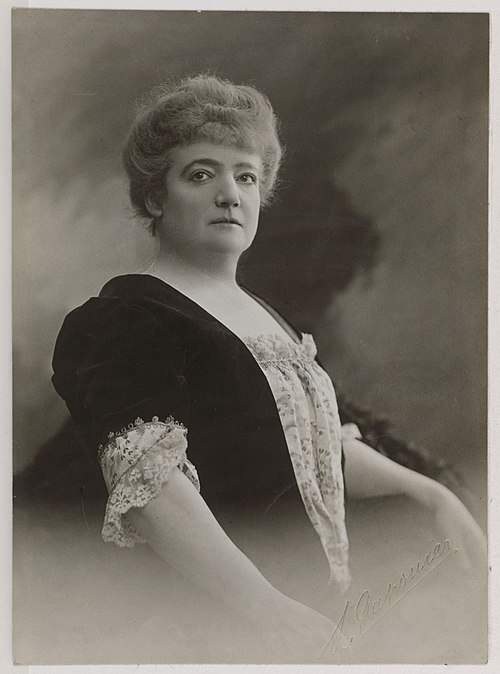
Image source: Portrait photograph of Augusta Holmès — photographed by L. Taponier, between 1880 and 1887. Held by Bibliothèques spécialisées de Paris. Wikimedia Commons. Public domain.
Nationality: French (of Irish descent)
Active: Late 19th century, based in Paris
Primary genres: Symphonic poem, cantata, opera
Characteristics: Post-Wagnerian large-scale orchestration, student of César Franck, use of male pseudonym
“Hermann Zenta” — A Woman Who Chose a Man’s Name
Where Chaminade fought under her own name, Holmès decided from the beginning that her own name was not safe to use. Her early works were published under the male pseudonym “Hermann Zenta” — a calculated move to bypass the prejudice that would have greeted a woman’s name on a score. Where Mel Bonis chose the gender-neutral “Mel,” Holmès went a step further and chose a man entirely.
In 1875, on the recommendation of Saint-Saëns, she entered the studio of César Franck — the same master whose influence shaped Mel Bonis’s structural rigor. But where Bonis channeled Franck’s teaching into architectural density and formal precision, Holmès moved in a completely different direction. She had no interest in the salon miniatures expected of women composers. Instead, she turned toward symphonic poems, cantatas, and large-scale orchestral works, drawing on the rich brass writing of the post-Wagnerian tradition. She was not interested in meeting expectations. She wanted to exceed them.
Music for 1,200 Performers — And Still “An Extremist”
The peak of that ambition came in 1889, when she was commissioned to write a work for the Paris Universal Exposition — the world’s fair celebrating the centenary of the French Revolution. The result, Ode triomphale, called for 1,200 performers. It was an audacious statement, and Paris noticed. But notice was not the same as acceptance. In the journal Harmonie et Mélodie, Saint-Saëns wrote: “Women have no sense of obstacles, and their willpower breaks through every barrier. Mademoiselle Holmès is a woman, and an extremist.” Write small, and you were trivial. Write large, and you were an extremist. Holmès, like Chaminade, found that no answer was ever going to be the right one.
She died in 1903, at the age of fifty-five. Her operas had been staged in Paris, Covent Garden, and the Metropolitan Opera. But after her death, the silence came quickly. Like Mel Bonis, who was rediscovered only decades after her death, her name is only now being slowly reclaimed.
3. Three Names, Three Kinds of Erasure
Mel Bonis, Cécile Chaminade, Augusta Holmès. Three women, the same city, the same era. Bonis erased her name. Holmès replaced hers with a man’s. Chaminade kept hers and watched it be buried under a label. Three strategies. One verdict from Paris.
What differed was only the shape of the forgetting. Bonis’s name was removed from her own work. Holmès’s short life meant the silence came fast. Chaminade’s name survived, but pinned beneath “salon music,” it could barely breathe. Whether a name is hidden, replaced, or stigmatized, the destination turns out to be the same.
Conclusion: The Names Paris Erased Are Being Heard Again
Cécile Chaminade’s music began to return in the late 1970s, when scholars and performers started pulling her scores back into the light. Holmès’s symphonic works remain rarely performed, with many scores still unpublished and effectively unreachable. The mask Mel Bonis wore was the name “Mel.” The mask Chaminade wore was the label “salon.” The mask Holmès wore was the name “Hermann Zenta.” Three masks, three silences — all for the same reason.
Next, we leave Paris. In Vienna, in the shadow of a collapsing empire and two world wars, two more women composers lost their names in ways that were entirely different — and entirely familiar.
Further Reading – Women Behind the Score Series
Mel Bonis (1858–1937) | A Forgotten French Female Composer and the Music Hidden Behind a Name
Mel Bonis (1858–1937) | A Forgotten French Female Composer and the Music Hidden Behind a Name
Mel Bonis and Fauré | A 50-Year Musical Friendship Born in Room 7 of the Paris Conservatoire
Mel Bonis and Fauré | A 50-Year Musical Friendship Born in Room 7 of the Paris Conservatoire