
Women Behind the Score Series
1. Mel Bonis (1858–1937) | A Forgotten French Female Composer and the Music Hidden Behind a Name
2. Mel Bonis and Fauré | A 50-Year Musical Friendship Born in Room 7 of the Paris Conservatoire
3. Coming Soon
In the history of French music, the name Mel Bonis (1858–1937) long remained a “hidden gem.” The reason why her works have recently been actively reexamined goes beyond simply restoring a female composer; it lies in the fact that the harmonic boldness and structural completeness she demonstrated place her in a distinctive position even when compared with the leading male composers of her time. As a contemporary of Claude Debussy at the Paris Conservatoire, she experienced both the birth of Impressionism and the twilight of late Romanticism, and built her own unique musical language between them.
Her life was also a record of a fierce struggle between her artistic identity, which had to be hidden behind the neutral pen name “Mel”, and the oppression of a conservative Catholic family. By tracing her vast body of more than 300 works according to the stages of her life, we aim to examine in depth what musical value her delicate yet strong melodies convey to us today.
Mel Bonis (Mélanie Hélène Bonis, 1858–1937)
“A French composer who built an independent musical language between late Romanticism and Impressionism.”
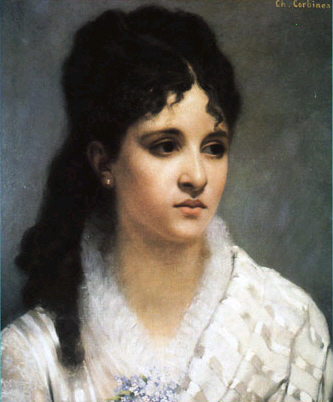
Thumbnail Source: Portrait of Mel Bonis (Mélanie Hélène “Mel” Bonis, 1858–1937) – 1877, painted in France by Charles-Auguste Corbineau. Used as a cover image for a published music score. Public domain.
Nationality: France
Activity: Late 19th century – early 20th century, mainly in France
Main genres: Chamber music, piano works, sacred music
Characteristics: Structural precision and harmonic boldness, with harmonic changes and cyclic influence from the middle period onward
1. Early Period (1870s–1880s): The Paris Conservatoire and the Influence of César Franck
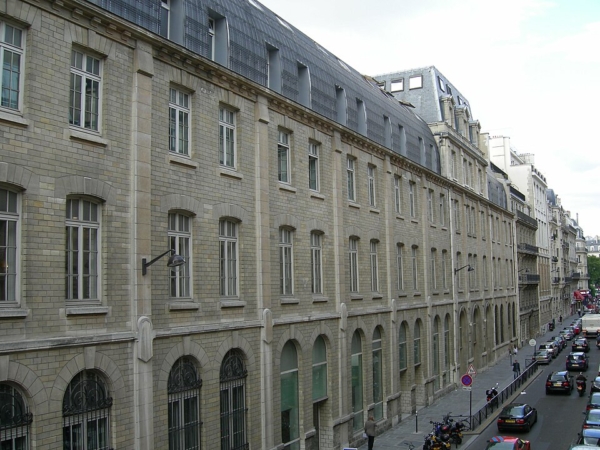
Image Source: Conservatory of Paris (14 rue de Madrid, 75008 Paris, France) – Photograph by Chi Hyowon, Summer 2007. Public domain.
Mélanie Hélène Bonis’s music did not begin in an open environment. Raised in a strict Catholic family with no musical background, she approached music by learning the piano on her own despite her parents’ opposition. This experience is not simply a starting point, but is also connected to the tendency of her music to rely more on internal structure rather than external expression.
The turning point was her encounter with César Franck. Franck confirmed in her performance and early works not just simple talent, but a compositional sense that already understood form and structure. He persuaded her parents and had her admitted to the Paris Conservatoire in 1876, and this became the decisive moment that transformed her music from a personal hobby into composition.
At the Conservatoire, she studied alongside Claude Debussy and Gabriel Pierné and quickly distinguished herself. Under Ernest Guiraud and Auguste Bazille, she won first prizes in harmony, counterpoint, and organ performance, and through this process, her music began to be organized around structure rather than sensation. The evaluation of “structural drive and refined logic” mentioned by the faculty at the time is more than just praise; it is a clue to the direction in which her music was forming.
Works from this period are based on clear tonality, but do not simply repeat the same form. Under the influence of cyclic form inherited from Franck, themes return through transformation rather than repetition, and melodies continue to move within the structure. While maintaining the framework of classical form, internal change begins to appear.
These characteristics are confirmed clearly in 『Sevillana, Op.125』. While the Spanish-style rhythm repeats over a bright major tonality, the same pattern does not remain static but continues through subtle variations. The surface may sound light, but internally, the rhythm and melody are meticulously woven with rigorous logic.
2. Middle Period (1890s–1910s): The Birth of “Mel” and Artistic Expansion
What had seemed to continue as a stable musical path reached a sudden turning point through her relationship with Amédée Hettich. Her family, who strongly opposed her marriage to a poor musician, forced her to leave the Conservatoire, and this ultimately led to her marriage to a businessman twenty-five years older than she was. During this period, her life moved away from her time as a composer, and for about ten years, her music appeared, from the outside, to have come to a halt.
Yet within that silence, another story was unfolding — one invisible from the outside. Mélanie secretly reunited with Hettich, her childhood love, and the two had a daughter together, Madeleine. Madeleine grew up in the care of a former housemaid, never knowing who her real mother was, and Mélanie spent a lifetime keeping that secret. The truth only came to light years later, when Madeleine fell in love with Hettich’s son — her own half-brother — leaving Mélanie no choice but to finally reveal what she had hidden for so long. Hiding her name was not something that happened only on the page. Her entire life was one long secret.
Yet this rupture was not simply an absence — it was the time that would transform the nature of her music. When she took up her pen again in the early 1890s, her works began to reveal a harmonic density and sense of direction unlike anything that had come before. The name she chose at this point was “Mel Bonis” — a name adopted to ensure her music would be judged on its own terms, free from the prejudice that followed a woman’s name. The deeper her life was suppressed, the bolder and more richly textured her music became. From this period onward, her works returned to the world in a steady stream.
In this period, her music maintains tonality, but as non-harmonic tones and chromatic motion increase, it moves away from traditional functional harmonic progressions, allowing chords to connect more freely. While this change shows a similar flow to the Impressionist music represented by Debussy and Fauré, it differs in that structural frameworks such as sonata form and cyclic form are preserved. Melody does not remain as a separate line, but moves within harmony, and as multiple voices overlap, the overall sound becomes more dense.
These musical characteristics are confirmed clearly in 『Sevillana, Op.125』. Written during her years at the Paris Conservatoire, this work shows an early style centered on major tonality and Spanish rhythms. While the harmonic expansion or complex structure of later works is not yet prominent, the method of shaping the piece through the repetition and transformation of a single core motive is already clearly present. This clearly shows her early approach of maintaining flow even within short connected sections.
In the same period, 『Flute Sonata in C-sharp minor, Op.64』 presents these characteristics in a more structured form. Centered in C-sharp minor, a darker harmonic palette and chromatic motion appear frequently. The flute and piano engage in a sophisticated dialogue as equal partners, transcending the traditional roles of soloist and accompanist. Although rooted in sonata form, the movements are so organically linked that the entire work unfolds as a seamless, continuous flow.
3. Late Period (1920s–1937): Inward Immersion and Spiritual Sublimation
After World War I, the music of Mel Bonis turned away from outward brilliance and toward an exploration of inward, contemplative depth. Her attempt to sublimate personal twists and the tragedies of her age through faith appears in leaner melodic lines and lucid instrumental clarity. In particular, her sacred works and organ pieces composed while deeply immersed in Catholic spirituality were her earnest artistic response to searching for peace beyond painful reality.
At the same time, while preserving a Brahmsian classical framework, she filled its interior with writing that was far bolder and more modern. This was not simply remaining in the past of Romanticism, but an original achievement in which sorrow and serenity coexist with great precision inside a stable structure. Bonis’s late style reveals another intellectual height that French music at the turn of the 20th century was capable of reaching.
Conclusion: Mel Bonis – The Return of a Name
Mel Bonis (1858–1937) is not simply a composer of “beautiful melodies.” She preserved the genius her era did not permit under the name “Mel,” leaving behind over 300 works. Even through the long years in which her name was erased, the music itself never ceased its internal progress.
Her life carries a weight that goes beyond biography. She left works behind even under conditions in which she had to hide her name, and that music was rediscovered only much later. What we hear today in Mel Bonis is not value newly created, but value that had always been there, only revealed late.
The structural precision and harmonic transformation from early to late works clearly show the place she ought to have occupied in musical history. Choosing Mel Bonis for this 50th post is a quiet way of turning our gaze toward a name that is finally finding its rightful place.
Further Reading
Chopin and George Sand | A Cruel Exile Called Sanctuary
Ravel, Piano Concerto for the Left Hand | A Sublime Design Drawn from the Abyss of Loss
Ravel, Piano Concerto for the Left Hand | A Sublime Design Drawn from the Abyss of Loss