

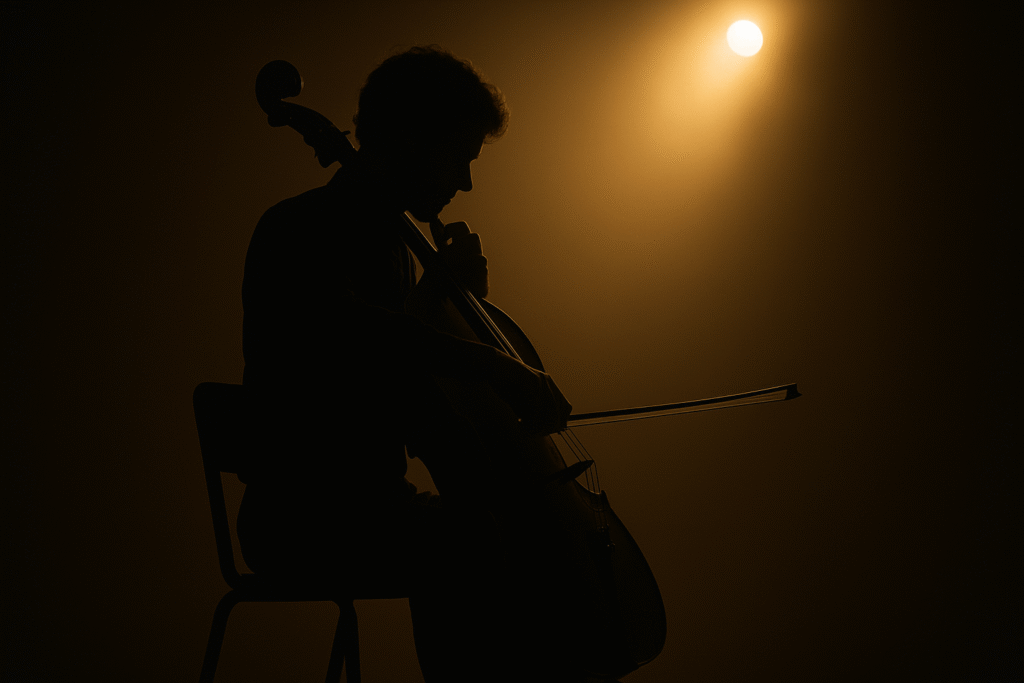
The Bach Cello Suites (BWV 1007–1012) demonstrate how a single instrument can create depth and structural clarity through its own timbre alone. The melodic line moves quietly, yet the placement of each note and the length of the surrounding silence naturally reveal the center of each suite, allowing the cello’s resonance to shape a distinct texture in every work. Although the six suites stand apart, they leave the impression of unfolding within one continuous arc.
This article considers the six suites within their overall structure, focusing on how each key forms a particular atmosphere and how Bach’s choices of register and movement shape the character of each work. A representative movement from each suite is also highlighted to show how the instrument’s resonance shifts from piece to piece.
1. Johann Sebastian Bach (1685–1750)
“A composer who decisively organized the language of Baroque music based on the order of counterpoint and tonality.”

Nationality: Germany
Activity: Organist (Arnstadt · Mühlhausen), Court Musician (Weimar), Kapellmeister (Köthen), Thomaskantor (Leipzig)
Main genres: Organ works, keyboard works, suites and concertos, cantatas, masses and passions, contrapuntal instrumental works
Bach was born into a Thuringian family in Germany that produced musicians over several generations. From childhood he learned various instruments and built a solid foundation, and even after losing both parents he continued his musical studies. When he found an interesting score, he stayed up late copying and analyzing it, and in his youth he even walked a long distance to hear the great North German master Dieterich Buxtehude perform in person. These experiences became an important foundation for Bach’s musical language, which embraced diverse styles and tonal possibilities.
The period in which he worked was strongly rooted in vocal traditions, and instrumental performance took place under limited tuning conditions. Bach sought to move beyond these constraints by conducting keyboard experiments that used various keys, continuing this work steadily as part of his children’s musical education, and organizing pedagogical keyboard pieces such as the Inventions and Sinfonias to systematize musical fundamentals. This process led to the Well-Tempered Clavier, which served as a turning point by demonstrating that all major and minor keys could function within actual music, significantly expanding the tonal awareness of the time.
As an adult, Bach worked as a church organist and court Kapellmeister, leaving a wide range of keyboard, organ, and instrumental compositions. During his Köthen period he focused on secular instrumental music and completed the Cello Suites, the Sonatas and Partitas for Solo Violin, and the Brandenburg Concertos. Later in Leipzig, as Thomaskantor, he drew on the chorale tradition to compose cantatas, passions, and masses, greatly expanding sacred music.
In his later years, Bach distilled his contrapuntal thinking further in The Art of Fugue and Musical Offering, clarifying his musical world. Although his works were forgotten for some time after his death, their status became firmly reestablished after Mendelssohn’s revival in the 19th century. Today Bach’s music is valued for its structural precision and inner depth, and the Cello Suites in particular are widely loved as works that redefined the possibilities of a solo instrument.
2. Background of Composition – A Period Focused on Instrumental Music at the Köthen Court
The period in which Johann Sebastian Bach composed the Cello Suites coincides with his tenure as Kapellmeister at the Köthen court. Because this environment emphasized instrumental rather than liturgical music, Bach gained the natural opportunity to explore instrumental possibilities in fine detail apart from vocal works. Although the court orchestra was not large, its performance quality was high, and Bach worked closely with the musicians, observing each instrument’s timbre and structural potential.
During the Köthen period, Bach’s interest lay in revealing the distinct character of each instrument. At the time, the cello often played continuo or accompanimental roles, but Bach gradually became convinced that a single melodic line could support the entire musical structure. This exploration led to the six Cello Suites, marking an important moment in expressing the autonomy of instrumental music and the independence of melody.
There is no definitive record indicating whether the works were written for a specific performer. However, Bach clearly understood the skills and personalities of the musicians at the court, and it is likely that he shaped the character of each suite with their playing styles and timbres in mind. The Köthen period was a time when Bach reconsidered the role of instruments and quietly explored the forms and movements a single instrument could create, and the Cello Suites can be understood as works born from that process.
3. Rediscovery and First Performances – A Return After Long Silence
The Cello Suites were not widely known at the time of their composition. Instrumental suites themselves were closely tied to court culture, and works written for a single instrument were often regarded as practical music rather than major artistic statements. Even after Bach’s death, the pieces were seldom performed and were transmitted quietly through manuscript copies.
The suites were substantially rediscovered only in the 20th century. Pablo Casals, as a young man, found a copy of the manuscript by chance in a bookstore and spent years studying the works before performing them publicly. His performances became a turning point that revealed the true value of the suites, providing a foundation for later cellists to explore their significance.
It is difficult to determine a precise “premiere” date, but many of the performances and recordings of the 20th century can be viewed as a kind of rebirth. Music that had remained largely outside public attention came alive again and rose to the center of the standard repertoire, demonstrating the enduring vitality and inner strength of these suites.
4. Bach Cello Suites – Overview and Suite-by-Suite Commentary
The six suites share the same basic form: each begins with a Prelude and ends with a Gigue, with movements such as Allemande, Courante, and Sarabande placed between. Bach varies the flow and character of each suite within this fixed framework, expanding what the cello can express.
The length and placement of each note, together with recurring patterns, allow harmony to emerge naturally, while the alternation of low, middle, and upper registers creates the effect of several voices moving within one continuous line. Despite their shared form, the suites differ markedly in atmosphere and tension, creating a sense of unity across contrasting landscapes.
Suite No. 1 in G major — Key Movement: Prelude
Suite No. 1 is a work in which the bright sonority of G major sets the overall atmosphere. The Prelude continues with a single arpeggiated pattern, and as this pattern moves slightly across different registers, it naturally develops the musical flow. The Allemande and Courante unfold with neat rhythms and concise melodic lines, maintaining the suite’s bright and orderly character.
The center of this suite is the Prelude, where the repeated figures create a stable sonority and clearly reveal the structure of the piece. The Sarabande lowers the mood with a simple melody, and the Gigue proceeds with a lighter rhythm, bringing the work to a close while keeping its overall brightness.
Suite No. 2 in D minor — Key Movement: Sarabande
Suite No. 2 is a work in which the color of D minor lowers the overall atmosphere. In the Prelude, short figures are repeated and connected; as these figures move slightly across registers, they naturally lead the flow of the piece. The Allemande and Courante are developed with almost no ornamentation and with steady rhythms, preserving the calm character of the suite.
The center of this suite is the Sarabande, where a simple structure made from a single melodic line determines the emotion of the piece. The length and spacing of each note are laid bare, so the quiet, weighty color unique to D minor clearly emerges, and the final Gigue increases the amount of motion somewhat, bringing the flow to a close.
Suite No. 3 in C major — Key Movement: Gigue
Suite No. 3 is marked by the open resonance of C major, and melodies that make use of open strings create a broad sonority. The Prelude links repeated patterns that shift slightly in register, opening up the flow of the piece, while the Allemande and Courante proceed neatly over steady rhythms, keeping the overall atmosphere stable.
The center of this suite is the Gigue, where a clear rhythm and wide register changes define the character of the movement. The motion becomes more pronounced as it unfolds, but it is not excessively showy, so the suite’s orderly character is preserved while the preceding movements are brought together naturally.
Suite No. 4 in E-flat major — Key Movement: Prelude
Suite No. 4 forms a deep and broad sonority characteristic of E-flat major, and this is most clearly revealed in the Prelude. In the Prelude, arpeggios and leaps appear together, and as these patterns move through different registers, they create an expanded feeling across the whole piece. The Allemande and Courante carry this expanded sonority into a more orderly flow, forming an overall stable structure.
The center of this suite is the Prelude, where motion that makes wide use of the register defines the character of the piece. After this, the Sarabande briefly calms the flow with a concise structure, and the Gigue, with its relatively quick progress, brings the suite to a conclusion while still retaining the broad and gentle quality of the sound.
Suite No. 5 in C minor — Key Movement: Sarabande
Suite No. 5 is a work that, through scordatura (lowering one string and retuning the instrument), gives a dark and concentrated impression of tone. In the Prelude, repeated patterns appear while shifting slightly in register, and this motion shapes the overall sense of tension. The Allemande and Courante develop with few ornaments and with tidy, melody-centered lines, preserving the restrained atmosphere of the suite.
The center of this suite is the Sarabande, whose simple structure, built from a single melodic line, determines the character of the piece. The length and spacing of each note are exposed exactly as they are, so the quiet and deep emotion of C minor is clearly conveyed, and although the final Gigue contains somewhat more movement, it still maintains the dark mood of the suite as it brings the work to an end.
Suite No. 6 in D major — Key Movement: Prelude
Suite No. 6 was originally written for a five-string cello, and is characterized by melodic writing that makes wide use of the instrument’s register. In the Prelude, repeated patterns develop while expanding into the higher range, and this structure clearly reveals the character of the movement. The Allemande and Courante link the expanded register into a stable flow, forming an overall bright and firm sonority.
The center of this suite is the Prelude, where a wide register and long-breathed melodic lines determine the direction of the work. Afterward, the Sarabande briefly calms the mood by organizing the structure in a simpler way, and the Gigue, with various changes of register, brings the piece to a close while maintaining its bright character.
Conclusion – What the Bach Cello Suites Leave Us With
Although the six suites share the same structural outline, each presents a distinct musical character. Bach shaped the mood of each work through his choices of melodic contour and register, naturally broadening the expressive range of the entire collection.
Since the twentieth century, a wide range of performances has prevented the suites from settling into a single interpretive approach. Changes in phrasing, tempo, and tone color shift the emphasis within the music, and each suite reveals a different character depending on these choices.
Ultimately, the suites show how far a single instrument can extend its structural and tonal possibilities. By following each suite calmly, one can sense how Bach’s sense of order and movement connects one movement to another.
Further Reading
Oboe vs English Horn | Understanding Their Voices and Roles in the Orchestra
Oboe vs English Horn | Understanding Their Voices and Roles in the Orchestra