

Renaissance Music
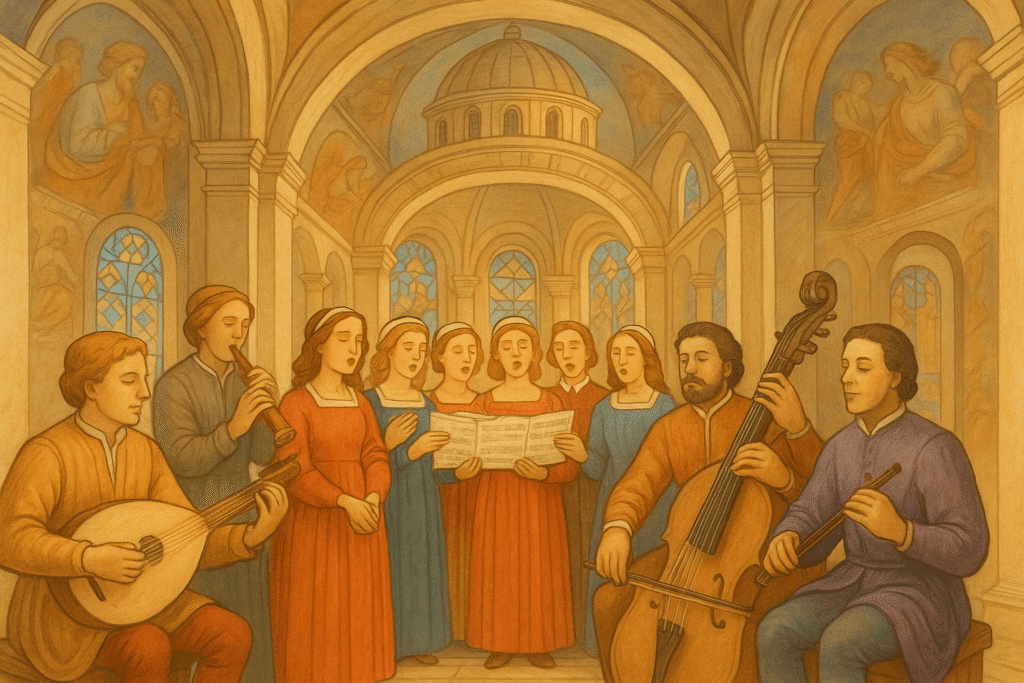
The Renaissance, meaning “rebirth,” was a sweeping cultural movement that spread across Europe from the 15th to the 16th century. Moving away from the religious-centered worldview of the Middle Ages, this era rediscovered the value of human emotion and intellect. Music, too, evolved beyond being a mere vessel for divine expression, becoming an art that reflected the heart and life of humanity.
Whereas medieval music emphasized order and devotion to God, Renaissance music embraced the richness of the human voice and emotion. Just as painting advanced through perspective and realism and architecture sought balance and proportion, music pursued a balance of harmony and expression. The interweaving of multiple independent voices—polyphony—became the defining musical language of the period.
1. The Character and Features of Renaissance Music
(1) The Maturity of Polyphony and the Birth of Harmonic Thinking
The seeds of polyphonic music that sprouted in the late Middle Ages came to full bloom in the Renaissance. Each voice carried its own distinct melody, yet together they formed a unified and harmonious sound. This was not merely the stacking of melodies; it reflected a conscious awareness of vertical harmony, shaping a new mode of musical thinking that would influence later Western composition.
(2) Human-Centered Expression of Emotion
Music was no longer confined to being a tool of faith. Personal emotions—joy and sorrow, love and longing—began to find expression through melody. This mirrored developments in visual art, where painters sought to portray the human face and feeling with realism. Music thus became a mirror of the inner self, a language of emotion that gave voice to the human experience.
(3) The Balance Between Sacred and Secular Music
Although sacred music such as the Mass and Motet remained central, secular music flourished as well. The Italian madrigal and French chanson celebrated love and everyday sentiment, spreading throughout courts and cities. While choirs filled cathedrals with sacred sound, gatherings of nobles and citizens alike enjoyed secular songs and instrumental dances. These two realms—sacred and secular—developed side by side in harmonious coexistence.
(4) The Printing Press and the Dissemination of Music
Around 1450, Johannes Gutenberg’s invention of the printing press transformed the course of musical history. Once limited to hand-copied manuscripts, musical scores could now be mass-produced and distributed across Europe. Composers’ works transcended borders, and people from many walks of life could obtain sheet music to sing or play themselves. Music was no longer the privilege of a select few but began to flourish as a shared cultural art accessible to all.
(5) The Franco-Flemish School – The Heart of Polyphony Across Europe
The Franco-Flemish School stood at the center of Renaissance polyphony. The region known as Flanders—covering today’s Belgium, the Netherlands, and northern France—was one of Europe’s most important cultural hubs after the Middle Ages. Situated at the crossroads of French-, German-, and Latin-speaking worlds, it became a fertile ground where diverse musical traditions blended to give birth to new art.
Composers from this region traveled widely through Italy, Germany, and France, spreading their music to churches and royal courts. With the rise of music printing, their works could be easily reproduced in many cities, allowing their style to circulate rapidly throughout Europe.
Their creative activity played a major role in uniting local traditions. The Masses, motets, chansons, and madrigals composed by the Franco-Flemish masters transcended national styles, linking different cultures and languages to form a shared musical language of the Renaissance. Thus, music became not just an art of one region but a universal art embraced by all of Europe.
The lineage of the Franco-Flemish School stretches from Guillaume Dufay and Johannes Ockeghem to Josquin des Prez, Jacob Obrecht, Nicolas Gombert, Adrian Willaert, and Orlando di Lasso. With each generation, polyphonic style grew more refined—featuring intricate imitation among voices, a greater balance of harmony, and more delicate expression that illuminated the meaning of the text.
Through their work, these composers organically advanced the music of each region and brought the humanistic spirit of the Renaissance to its fullest realization in sound. Their art transcended cultural boundaries, weaving Europe into one vast musical network.
2. The Reformation and Music
(1) Martin Luther and the Birth of the Chorale
In the early 16th century, Martin Luther’s Reformation brought a profound change to the course of church music. Instead of hymns sung only in Latin, new vernacular hymns emerged that ordinary worshippers could understand and sing themselves. Luther paired simple melodies with easy-to-remember lyrics, allowing the congregation to participate directly in worship. This form became known as the Chorale, a defining element of Protestant music.
The Chorale was more than just a musical innovation; it became a means of uniting believers within a shared faith community. This movement marked a pivotal musical transformation in the late Renaissance, eventually reaching its most radiant expression in the Baroque period through the works of Johann Sebastian Bach.
(2) The Catholic Response – The Role of Palestrina
The Reformation posed a serious challenge to the Catholic Church, prompting introspection and reform within its musical practice. During the Council of Trent (1545–1563), critics argued that church music had grown overly complex, obscuring the sacred words and diminishing the sense of devotion. In response, the Church called for music that was simpler, clearer, and more spiritually focused, allowing the text to be heard distinctly within polyphonic settings.
Amid this movement, the Italian composer Giovanni Pierluigi da Palestrina (c.1525–1594) emerged as a central figure. His Mass settings exemplified balance and clarity—retaining the beauty of polyphony while ensuring that the sacred text remained intelligible. Palestrina’s work embodied the Church’s ideal of sacred purity, earning him the lasting title of the “model of church music” and securing his place as one of the greatest composers of the Renaissance.
3. Notation and Performance Culture in the Renaissance
(1) The Refinement of Musical Notation
The system of musical notation in the Renaissance period became highly organized, allowing composers to record polyphonic music with precision. While neumatic notation in the Middle Ages only indicated approximate pitch direction, the mensural notation developed in the late 13th century made it possible to write exact note lengths and rhythmic values. This system became fully established during the Renaissance, providing the essential technical foundation for the flourishing of multi-voiced music.
When we look at the Renaissance score of Palestrina’s 『Missa Papae Marcelli』 (Pope Marcellus Mass), we can already recognize the familiar five-line staff, note shapes, and voice layout that closely resemble modern notation. Thanks to this advancement, contrapuntal music with multiple simultaneous vocal lines could be written and performed with stability and clarity. (You can listen to this piece in the composer section below.)

Image Source: Mensural notation manuscript from 『Missa Papae Marcelli』 by Giovanni Pierluigi da Palestrina – fragment of a late 16th-century score. Provided by Wikimedia Commons.
(2) The Vocal Tradition
During this period, vocal music remained the central form of expression. The human voice was considered the most perfect instrument, and choral singing played a vital role both in religious ceremonies and in secular gatherings.
Instrumental music mainly served as accompaniment for vocal or dance performances, yet it gradually began to establish an independent identity. This evolving performance culture laid the groundwork for the later Baroque period, when instrumental music would expand into a dominant artistic force.
4. Instruments of the Renaissance
Although vocal music remained central during the Renaissance, a wide variety of instruments were used to accompany the voice or perform independently, gradually taking on more significant roles. Among them, the viol, lute, and recorder are considered the representative instruments of the period.
Image Source Note:
All instrument images included in this section are from public domain or open-access museum collections.
Viola da gamba – made by Richard Meares around 1680 in London, England. The Metropolitan Museum of Art, New York (Object No. 1982.324)
Renaissance Lute – made by Sixtus Rauchwolff in 1596, Augsburg, Germany. The Metropolitan Museum of Art, New York (Object No. 89.2.157)
Tenor Krummhorn in D – made in 16th-century Germany. Musikinstrumenten-Museum Berlin. (Wikimedia Commons, CC BY-SA 4.0)
Tenor Recorder – made by the Bassano family around 1600 in Venice, Italy. The Metropolitan Museum of Art, New York (Object No. 506723)
Alto Recorder in F – made by Johann Benedikt Gahn around 1700 in Nuremberg, Germany. The Metropolitan Museum of Art, New York (Object No. 501520)
Cornetto in A – made around 1575 in Nuremberg, Germany. The Metropolitan Museum of Art, New York (Object No. 52.96.1)
Sackbut (Alto in F, reconstructed instrument) – made by Helmut Finke in 1968 in Herford, Germany, modeled after a late 16th-century sackbut. National Music Museum, South Dakota (Object No. 6162)
String Instruments
Viola da gamba (Viol / Viola da gamba)

The viola da gamba was widely used throughout the Renaissance and Baroque periods. Held between the knees while playing, it featured a flat back, frets, and six or seven strings. Its tone was warm and gentle, more delicate than that of the modern cello.
This instrument was used for both solo performances and ensemble playing, especially in chamber music settings among the nobility. It often accompanied songs or was used in instrumental consorts, becoming a symbol of refined culture.
In a broader cultural sense, the viola da gamba represented aristocratic sophistication. Although it was eventually replaced by the cello, it remains an essential key to understanding the musical sensibilities and social life of Renaissance Europe.
Lute

The lute was the most beloved plucked string instrument of the Renaissance. With its rounded resonating body and short neck, it had multiple strings that were plucked by hand. It served many roles—accompanying songs, performing solos, and participating in ensemble music. Its ability to produce rich harmonies contributed significantly to the development of harmonic thinking in this period.
Lute music was written in a special notation system called tablature, which indicated the strings and finger positions instead of pitches on a staff. This made the music accessible to performers and allowed greater freedom of interpretation. The widespread use of tablature was one of the reasons lute music spread so rapidly across Europe.

Image Source: Lute tablature manuscript – printed lute notation from Renaissance Europe. Provided by Needpix (Public Domain).
In Renaissance art and literature, the lute often symbolized poetry, love, and philosophy. It was regarded as a hallmark of cultivated society and later became the direct ancestor of the modern guitar.
Woodwind Instruments
Krummhorn (Tenor Krummhorn)

The krummhorn (meaning “curved horn” in German) was a distinctive double-reed woodwind instrument of the Renaissance. Its body was curved, producing a nasal yet charming tone. Though not very loud, its unique timbre added vivid color to ensemble music.
It was especially popular in dances and secular pieces, often playing alongside other instruments to create a lively texture. In ensemble settings, it provided rhythmic emphasis and ornamental effects.
Culturally, the krummhorn enlivened courtly entertainment, banquets, and civic celebrations, bringing humor and vitality to Renaissance music.
Recorder

The recorder was one of the most widely used wind instruments of both the Renaissance and Baroque periods. With its simple structure and various sizes—soprano, alto, tenor, and bass—it could cover a wide pitch range. Its tone was clear and sweet, and its simplicity made it easy to learn.
The instrument was used for solo playing, ensemble performance, and vocal accompaniment. The alto recorder was prized for solo work, while the tenor recorder provided lower, fuller tones that supported the ensemble’s bass line.
Culturally, the recorder was loved not only by the nobility but also by the emerging middle class. It became the direct ancestor of the modern school recorder used in music education today.
Cornett (Cornetto)

The cornett (or cornetto in Italian) was a wind instrument combining features of both brass and woodwinds. It produced sound through lip vibration like a brass instrument but was made of wood and had finger holes like a recorder. Thus, it is often classified as a wooden brass instrument.
Its tone was softer than the trumpet and remarkably similar to the human voice, making it popular in choral and sacred music from the 16th to the early 17th century. Composers such as Palestrina, Giovanni Gabrieli, and Claudio Monteverdi frequently used it in church works, early oratorios, and Venetian cathedral music.
The cornett was valued for its delicate expressiveness rather than brilliance, earning the nickname “the instrument that imitates the human voice.” Although it later disappeared with the rise of the trumpet and oboe, it was revived in the 20th-century early music movement and can still be heard in historically informed performances today.
Brass Instruments
Sackbut

The sackbut, predecessor of the modern trombone, was used throughout the Renaissance and Baroque periods. It already featured a slide mechanism for changing pitch, but its narrower tubing and smaller bell produced a softer, darker sound compared to the modern trombone.
In the Renaissance, it was often used in church music and large choral works, blending with woodwinds to create rich yet restrained resonance. As music moved into the Baroque period, the term “trombone” gradually replaced “sackbut,” and by the 18th century, its shape and power evolved into the modern brass instrument we know today.
In modern historically informed performances, reconstructed sackbuts are used to revive the mellow metallic tone and noble resonance characteristic of the 16th and 17th centuries.
5. Major Musical Genres
Renaissance music continued the religious traditions of the Middle Ages while developing new genres that expressed secular emotions. These works reflected both faith and human life, spreading across Europe in diverse forms.
(1) Mass and Motet
The Mass and the Motet, central to Catholic liturgy, remained the most important sacred genres of the Renaissance period. The style of polyphonic music—in which multiple voices intertwine—became firmly established, pursuing both reverence and harmonic balance. The Mass settings of Palestrina represent the ideal of this spiritual and musical equilibrium.
(2) Madrigal
The madrigal was the central genre of secular music during the Renaissance. It often explored themes of love and human emotion, translating poetic sentiment into refined musical expression. In its early form, composers such as Philippe Verdelot and Jacques Arcadelt established its foundation, while in the late Renaissance, Luca Marenzio and Carlo Gesualdo expanded its emotional and harmonic range with daring chromaticism and dramatic intensity.
Carlo Gesualdo (1566–1613) was an Italian nobleman and composer who created a unique world of sound through his radical use of dissonance and emotional intensity. His late madrigals opened a new path of personal expression in Renaissance music.
(3) Chanson and Secular Songs
The chanson, developed primarily in France, expressed everyday life and nature with bright and lively melodies. The works of Clément Janequin stand out for their vivid imitation of environmental sounds—birdsong, battle cries, and city noises—showcasing the imaginative freedom of secular Renaissance music.
Clément Janequin (c.1485–1558) was a leading French composer of the Renaissance chanson. He masterfully transformed natural and daily sounds into music, and his “Song of the Birds” exemplifies the lighthearted and imaginative character of Renaissance secular art.
(4) Instrumental Dance Music
Dance played an essential role in both courtly and civic life during the Renaissance. Instrumental dance forms such as the pavane and the galliard were central to festivities and gatherings. These genres also helped instrumental music grow beyond its earlier role as accompaniment, setting the stage for its independence in later centuries.
6. Representative Composers and Works
Guillaume Dufay (1397–1474)
“A bridge between the Middle Ages and the Renaissance, a master of early polyphony”
Nationality: Flemish region (then part of the Burgundian Duchy, now northern France and Belgium)
Activity: Served as a composer and choir singer at the Burgundian court, the Papal Chapel, and in several European cities
Main genres: Mass, Motet, Secular Chanson
Achievement: Guillaume Dufay was a pioneering composer of the Franco-Flemish School and one of the first international musicians active across Europe during the early Renaissance. Starting from France and Burgundy, he later worked at the Papal Chapel in Italy and at various royal courts, absorbing the diverse musical languages of each region and shaping a distinctive personal style. For this reason, he is often called “the first international master of Renaissance music.”
Dufay inherited the medieval motet tradition while introducing the harmonic sensibility of the Renaissance, opening a new chapter in music history. He built sophisticated polyphonic textures over chant melodies, emphasizing unity and balance in his Masses, and displayed refined elegance in his secular chansons. His work bridged sacred devotion and courtly artistry, making him a central figure in both church and secular music.
Among his representative works, Missa Se la face ay pale is one of the earliest Masses constructed around a secular melody, while the motet Nuper rosarum flores, composed for the 1436 consecration of Florence Cathedral, combines architectural proportion with musical structure—a symbol of Renaissance thought. In his chansons, simple melodies are enriched with polyphony, conveying refined and worldly emotions.
Josquin des Prez (1450/55–1521)
“The heart of the Renaissance, who gave human emotion a musical voice.”

Image Source: Portrait of Josquin des Prez – woodcut published in 1611. Provided by Wikimedia Commons.
Nationality: Flemish region (then part of the Burgundian Duchy, now northern France and Belgium)
Activity: Active throughout Italy and France in both church and court settings
Main genres: Mass, Motet, Madrigal
Achievement: Josquin des Prez was the leading figure of the Franco-Flemish School who brought Renaissance polyphony to its artistic peak. He embodied the humanistic ideals of the era, profoundly influencing both his contemporaries and later generations. Closely joining melody and text, he expressed human emotion through music, and with his intricate use of imitation achieved a perfect equilibrium among voices. For this reason, he has often been called “the Bach of the Renaissance”—if Bach perfected counterpoint, Josquin presented its archetype.
Josquin excelled not only in sacred music but also in secular compositions. His Masses and motets serve as representative examples of how humanistic ideals were realized in music, uniting expressive emotion with structural perfection. In particular, his sensitivity to the meaning of the text shaped a model that became foundational for later Renaissance composers.
His motet Ave Maria… Virgo serena demonstrates the essence of Renaissance counterpoint—each voice enters in gentle imitation within clear, solemn harmony—earning its place as one of the masterpieces of Renaissance polyphony.
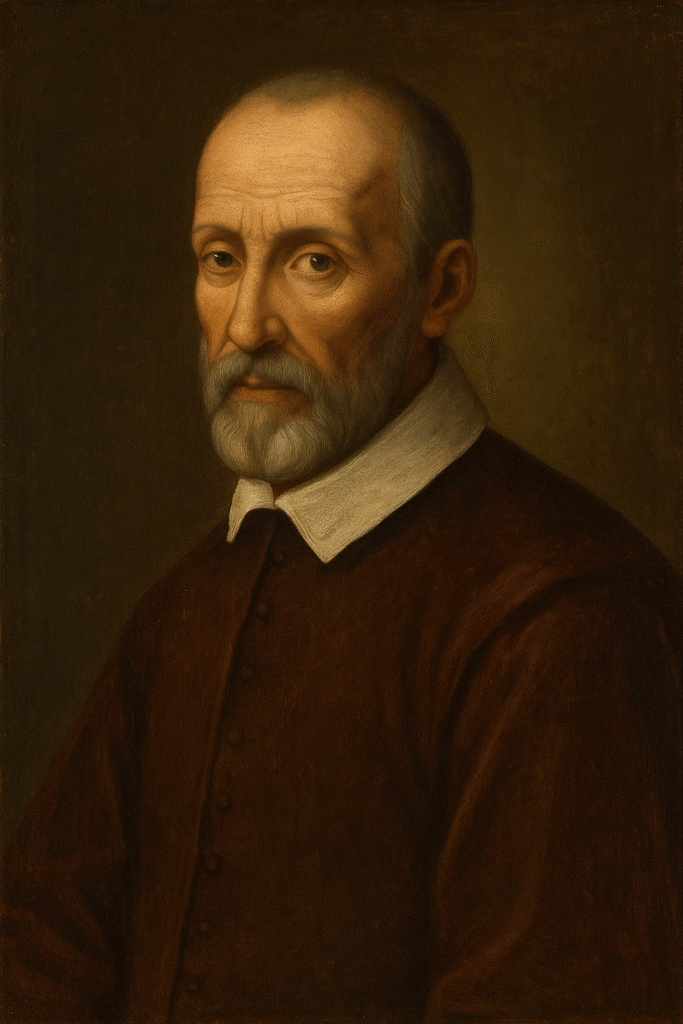
Giovanni Pierluigi da Palestrina (1525–1594)
“The ideal of church music, the consummator of Renaissance polyphony.”
Nationality: Italian
Activity: Papal chapel, major Roman churches
Main genres: Mass, motet
Achievement: Palestrina fulfilled the Catholic Church’s demand—after the Council of Trent—for clarity of text and devotional atmosphere. His music balanced complex polyphony with transparent harmony, ensuring that the words remained intelligible. His works epitomize the ideal of Renaissance sacred music, earning him the title “model of church composition.”
While preserving tradition, Palestrina infused his music with luminous harmony, letting each voice move naturally within a perfectly balanced whole. His 『Missa Papae Marcelli』 (Pope Marcellus Mass) responded to the Church’s call for intelligibility, standing as one of the most exemplary works of late Renaissance polyphony.
Orlando di Lasso (Orlande de Lassus, 1532–1594)
“A comprehensive Renaissance artist who united Europe as one”

Image source: Portrait of Orlando di Lasso, attributed to a 16th-century Flemish painter. Provided by Wikimedia Commons.
Nationality: Flemish region (modern Belgium and northern France)
Activity: Active across Italy, France, and Germany; long-serving Kapellmeister at the Bavarian Court in Munich
Main genres: Mass, Motet, Madrigal, Chanson, Latin Hymn
Achievement: Orlando di Lasso represented the final generation of the Franco-Flemish School and completed the art of Renaissance polyphony. Freely moving among Europe’s musical traditions, he created an extensive body of work that transcended the boundaries between sacred and secular music. His art united Italian warmth, French refinement, and German spirituality, forming the true synthesis of the Renaissance spirit.
Lasso’s works span a remarkable range of languages and styles. His Latin Masses and motets reveal reverence and balance, while his madrigals and chansons vividly portray human emotion and humor. Even within complex polyphony, he maintained clarity of text and meaning, showing music’s power to unite language and feeling. For this reason, later generations called him “the humanist who spoke through music.”
His motet Tristis est anima mea depicts Christ’s suffering through low, meditative voices and restrained harmony, conveying deep devotional emotion. Performed by the Regensburger Boys’ Choir at the 99th Catholic Day in Regensburg Cathedral, this work captures the serene gravity of Christ’s Passion through its calm, reverent tone.
Thomas Tallis (1505–1585)
“Master of English polyphony, who composed across the tides of the Reformation.”

Image Source: Portrait of Thomas Tallis – engraving by Niccolò Haym after an original by Gerard van der Gucht. Provided by Wikimedia Commons.
Nationality: English
Activity: Courts of Henry 8, Edward 6, Mary 1, and Elizabeth 1
Main genres: Anthem, motet, Mass
Achievement: Thomas Tallis was a towering figure in English Renaissance music, active through the turbulent years of the Reformation. He composed in both Latin and English, excelling across a wide spectrum—from simple harmonies to elaborate polyphony—laying the foundation for English sacred music.
His monumental motet 『Spem in alium』 for forty independent voices is one of the most awe-inspiring achievements in Renaissance polyphony. Meanwhile, works such as 『If Ye Love Me』 reveal his lyrical simplicity and warmth, remaining beloved in choral repertoire today.
Conclusion
The music of the Renaissance transcended the devotional restraint of the Middle Ages, embracing the emotion and intellect of humanity. Polyphonic textures intertwined like conversations between voices, achieving harmony and balance. Sacred and secular worlds flourished side by side, each reflecting different facets of the human spirit.
Advances in notation and instrument development allowed music to be recorded and shared more precisely and widely. Genres such as the Mass, motet, madrigal, chanson, and dance revealed music as a mirror of both faith and daily life.
Through the line of Dufay, Josquin, and Palestrina, Renaissance music came to embody the spirit of humanism and established itself at the heart of European culture—laying the foundation for the new musical era that would blossom in the Baroque period.
Further Reading