
Women Behind the Score Series
1. Mel Bonis (1858–1937) | A Forgotten French Female Composer and the Music Hidden Behind a Name
2. Mel Bonis and Fauré | A 50-Year Musical Friendship Born in Room 7 of the Paris Conservatoire
3. Cécile Chaminade (1857–1944) & Augusta Holmès (1847–1903) | Two Forgotten Voices of Paris
4. Johanna Müller-Hermann (1868–1941) & Dora Pejačević (1885–1923) | Two Forgotten Voices of Vienna
In our last piece, we left Paris behind — or so we promised. Now it’s time to make good on that promise. We’re heading to Vienna. But the way these two women were forgotten is nothing like what we saw in Paris. Cécile Chaminade was erased by a label. Augusta Holmès faded quickly alongside a short life. Johanna Müller-Hermann (1868–1941) and Dora Pejačević (1885–1923) were different. What erased them was not prejudice, and not stigma. It was history itself. Nazism, two world wars, and an early death. External forces did what no label ever could — they removed these women from the record entirely.
1. Johanna Müller-Hermann — The Golden Age of Vienna That Nazism Erased
Johanna Müller-Hermann (Johanna Josefine Friederike Hermann, 1868–1941)
“An Austrian composer at the heart of Vienna’s golden age, erased wholesale by Nazism and the destruction of war”
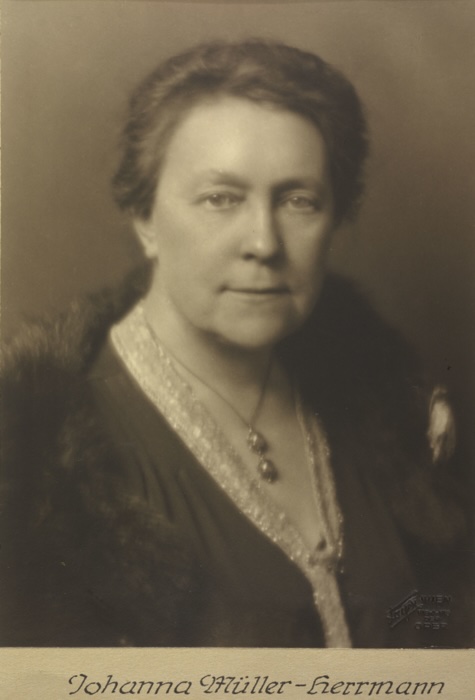
Image source: Portrait photograph of Johanna Müller-Hermann — photographed by Georg Fayer (1892–1950), 1927. Published in Bildnisalbum zur Beethoven-Zentenarfeier (1927). Held by Österreichische Nationalbibliothek (Austrian National Library). Wikimedia Commons. Public domain.
Nationality: Austrian
Active: Late 19th–early 20th century, based in Vienna
Primary genres: Lieder, chamber music, large-scale orchestral and choral works
Characteristics: Late Romantic foundation, influences of Wagner, Strauss, and Zemlinsky, extended tonality and expressive harmonies
A Door Opened by Marriage — Into the Heart of Vienna’s Golden Age
Müller-Hermann was born in Vienna in 1868, but she did not begin as a composer. Her father held a senior position in the Austrian Ministry of Culture and Education, and in keeping with the expectations placed on middle-class women of the time, she trained as a teacher and spent several years at a Viennese primary school. Music remained on the margins of her life — until her marriage in 1893 freed her from the obligation to work, and she turned her full attention to composition.
The teachers she studied with speak to the world she had entered. She studied composition under Alexander Zemlinsky — the same teacher who had taught Schoenberg. It was within this same Viennese circle that Alma Mahler had been introduced to Zemlinsky not long before. Her music reflects that influence: the expressive harmonies of Wagner, enriched by Richard Strauss and Zemlinsky, and laced with a lyrical gift that calls to mind the French song tradition of Duparc and Fauré.
That work found its way to the most prestigious stages in Vienna. Her compositions were performed at the Musikverein and published by Universal Edition — the same house that published Mahler, Schoenberg, and Berg. In 1918, she succeeded her teacher Foerster as professor of music theory at the Neues Wiener Konservatorium. Wilhelm Furtwängler was among those who campaigned to preserve her work after her death. By any measure, her place in Viennese musical life was secure.
1938 — The Year Nazism Swallowed Vienna
So why does almost no one know her name today? The answer lies in 1938. When the Nazis annexed Austria, Müller-Hermann — though not Jewish — found herself in direct conflict with the Nazi doctrine of Kinder, Kirche, Küche: that women belonged in the home and the church, not in the concert hall or the classroom. The Neues Konservatorium, where she had taught for nearly 25 years, was shut down and never reopened.
When the war finally ended, her music faced a double disadvantage. As a woman, her contribution to “Vienna’s Golden Autumn” did not fit the prevailing narrative of young men in revolt against their conventional fathers — the story that dominated the literature. And as a tonal composer, she was dismissed as irrelevant to the great modernist project launched by Schoenberg’s atonal and serial techniques. It was not Müller-Hermann alone who was forgotten. An entire generation of Viennese women composers was erased from the historical record at once.
2. Dora Pejačević — A Life Shaped by War, Cut Short by Childbirth
Dora Pejačević (Countess Maria Theodora Paulina Pejačević, 1885–1923)
“A Croatian composer of Austro-Hungarian noble birth, forgotten through war and an early death”
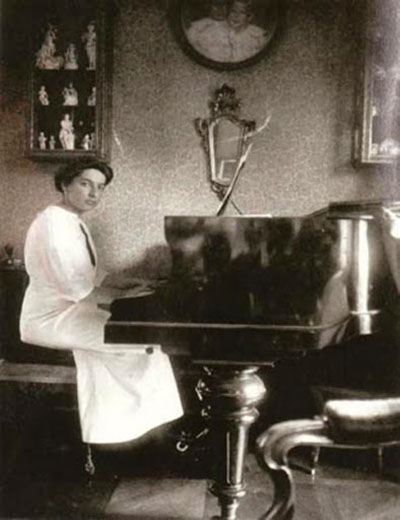
Image source: Photograph of Dora Pejačević at the piano — photographer unknown, before 1923. Wikimedia Commons (File: Dora-Pejačević-za-klavirom.jpg). Public domain.
Nationality: Croatian (Austro-Hungarian Empire)
Active: Early 20th century, Našice · Vienna · Munich · Dresden
Primary genres: Piano works, chamber music, symphony, concerto
Characteristics: Late Romantic foundation with Impressionist harmonies, traces of Slavic folk melody, expressionist tendencies after the war
A Nobleman’s Daughter Who Found Music on Her Own Terms
Born in Budapest in 1885 to a Croatian aristocratic family, Dora Pejačević grew up in a world where music was never far away. Her mother was a pianist and singer, and the salons of Našice Castle rang with music throughout her childhood. She began composing at the age of twelve, and though she studied briefly in Dresden and Munich, she was for the most part self-taught — working through exercises in harmony and counterpoint on her own, driven by an intellectual hunger that extended well beyond music.
Her friendships reflected that breadth. She moved in the circles of Rainer Maria Rilke and Karl Kraus, absorbing the ideas of the leading thinkers of her time. Born into privilege, she grew increasingly aware of — and repelled by — the social inequalities that privilege concealed. In 1913, she completed her Piano Concerto in G minor: the first concerto ever written by a Croatian composer. She was twenty-eight years old.
The Symphony a Nurse Wrote in Wartime
That moral awareness was sharpened into something more urgent by World War I. Despite her aristocratic background, Pejačević volunteered as a nurse, caring for wounded soldiers in her hometown of Našice. What she witnessed there cemented her rejection of aristocratic life and drove her deeper into composition. She kept writing through it all — as a way of processing what she had seen, as an escape, and as a form of protest.
The work that emerged from those years is her Symphony in F-sharp minor, Op.41 — widely regarded as the first modern symphony by a Croatian composer. Composed between 1916 and 1917, it is a large-scale work of nearly fifty minutes, holding traditional four-movement form together with Impressionist harmonies and a deep expressionist tension beneath the surface. It is the sound of someone trying to make sense of the senseless.
She married in 1921 and moved to Munich. In 1923, she gave birth to her first child and died shortly afterward from puerperal sepsis. She was 37 years old. Her son, Theodor, survived. The 58 opus numbers and 106 compositions she left behind were largely unperformed for decades, until the Croatian musicologist Koraljka Kos began the work of rediscovery in the 1980s.
3. Two Kinds of Violence, One Silence
What erased Mel Bonis was her family. What erased Chaminade was a label. But what erased Müller-Hermann and Pejačević was history itself. Nazism deleted an entire generation of Viennese women composers. A world war cut one remarkable life short at thirty-seven. These were not acts of prejudice. They were acts of force.
Müller-Hermann’s name was taken by ideology. Pejačević’s name was taken by an early death. But in both cases, what the violence could not touch was the music. It was still there — waiting, as it turned out, for someone to find it again.
Conclusion: The Names History Erased Are Being Heard Again
Müller-Hermann’s music began reappearing on recordings in the 1990s. In 2023, BBC Radio 3 named her Composer of the Week and produced a new series of recordings — bringing her music to a wider audience for the first time in decades. Pejačević’s centenary was marked that same year at the BBC Proms, where her symphony was performed to a new generation of listeners.
What erased Mel Bonis was her family. What erased Chaminade was the word “salon.” What erased Holmès was the name “Hermann Zenta.” And what erased Müller-Hermann and Pejačević was history. The methods were different. The silence was always the same.
Next, we cross the Atlantic. In England and America, two more women composers lost their names — in ways that were entirely different, and entirely familiar.
Further Reading – Women Behind the Score Series
Mel Bonis (1858–1937) | A Forgotten French Female Composer and the Music Hidden Behind a Name
Mel Bonis (1858–1937) | A Forgotten French Female Composer and the Music Hidden Behind a Name
Mel Bonis and Fauré | A 50-Year Musical Friendship Born in Room 7 of the Paris Conservatoire
Mel Bonis and Fauré | A 50-Year Musical Friendship Born in Room 7 of the Paris Conservatoire
Cécile Chaminade (1857–1944) & Augusta Holmès (1847–1903) | Two Forgotten Voices of Paris
Cécile Chaminade (1857–1944) & Augusta Holmès (1847–1903) | Two Forgotten Voices of Paris