


There are moments when a casual violin line suddenly holds the heart, and when the resonance of brass stirs the chest from within. When many different instruments gather to create one vast soundscape, we call that an orchestra — a living frame through which we glimpse the History of the Orchestra.
In Western music, the orchestra has never been merely a performing group. It has been a structure of sound that embodies the aesthetics and philosophies of its time. From Baroque intricacy to modern experiments with acoustics and timbre, how has the orchestra changed — an arc we recognize as the History of the Orchestra?
This article traces how orchestral instrumentation evolved across centuries: which instruments were added and when, why certain periods could achieve so much with small forces, and how today’s orchestras still carry layered stories within their sound. The thread is simple: sound shifts as the world shifts.
Baroque Period — The Beginning of the History of the Orchestra
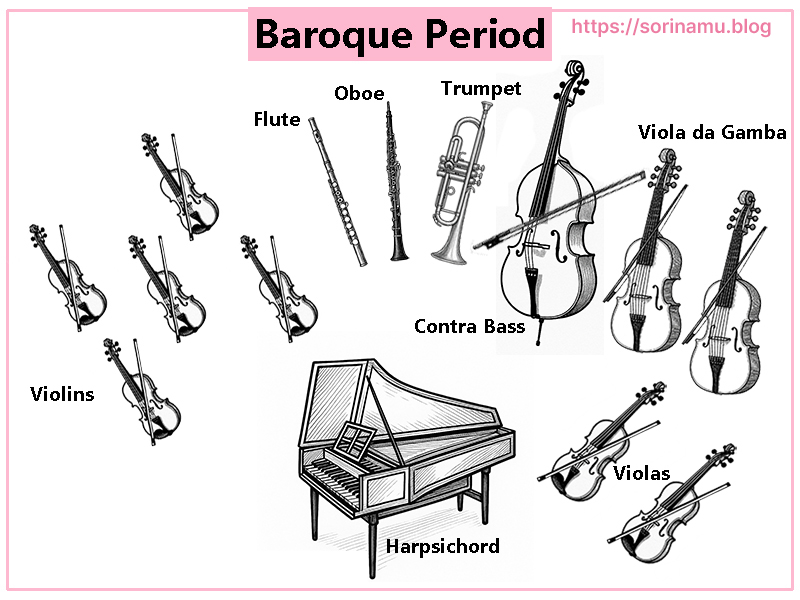
In the early 17th century, alongside the birth of opera, the Baroque period emphasized dramatic expression and delicate ornamentation. Orchestras were smaller and simpler than those of today, yet their inner design highlighted refined structure and the balance of musical lines.
The core was a string-centered ensemble supported by the basso continuo. Low strings such as the cello or viola da gamba sustained the bass, while harpsichord or organ provided harmonic foundation. There was no separate conductor; the harpsichordist led the entire ensemble from the keyboard.
Woodwinds — flute, oboe, and bassoon — were employed in limited roles, while trumpet and timpani appeared mainly for courtly or sacred occasions. Systematic ideas such as a “two-woodwind” setup had not yet formed. A typical Baroque orchestra numbered about fifteen players: modest in size, exquisitely blended in color.
Summary: Baroque Orchestra
Instrumentation:
- String-centered: consisting mainly of 1st and 2nd violins, viola, and cello forming the core of the ensemble.
- Basso continuo: built from harpsichord or organ together with low strings, providing harmonic foundation and rhythmic stability.
- No separate conductor: the harpsichordist led the ensemble, guiding tempo and balance from within.
- Small woodwind group: limited use of flute, oboe, bassoon, and other winds, often for color or special effects.
- No formal woodwind formation: terms like “two-woodwind” or “three-woodwind” did not yet exist and appeared later in the Classical period.
- Typical size: about 15 players on average; large ensembles were rare exceptions.
Classical Period — The Aesthetics of Balance and Form
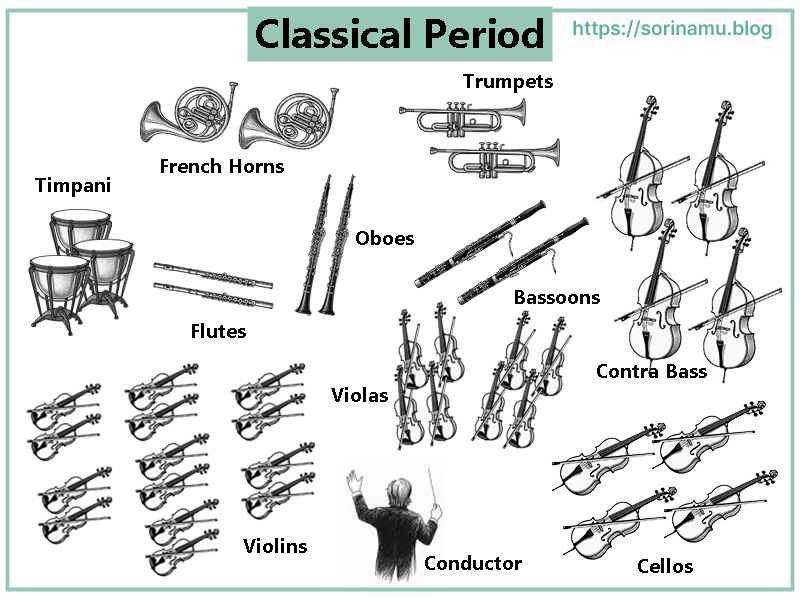
Beginning in the mid-18th century, balance and proportion defined musical beauty. As sonata form crystallized and the symphony and concerto matured, orchestras acquired a more systematic structure — a decisive step in the broader History of the Orchestra.
Haydn, Mozart, and early Beethoven favored a two-woodwind formation: two flutes, two oboes, two clarinets, and two bassoons alongside the strings. Horns and trumpets strengthened the brass; timpani became standard. The harpsichord disappeared, and leadership passed to the conductor or concertmaster.
Average size expanded to roughly 30–40 players, yielding a clear, balanced sonority. Mozart’s Symphony No. 40 shows each woodwind voice distinct yet woven with the strings in poised symmetry. Together, these developments marked a major step in the History of the Orchestra, shaping the balance we still hear today.
Summary: Classical Orchestra
Instrumentation:
- Strings central: the core remains with strings, supported by woodwinds (two of each), brass (horns and trumpets), and timpani.
- Two-woodwind formation: firmly established with pairs of flute, oboe, clarinet, and bassoon defining the standard orchestral texture.
- Harpsichord exits: the continuo disappears, and leadership passes to the conductor or concertmaster.
- Average size: orchestras typically consisted of about 30 to 40 musicians, maintaining balance and clarity.
Romantic Period — A Wave of Feeling
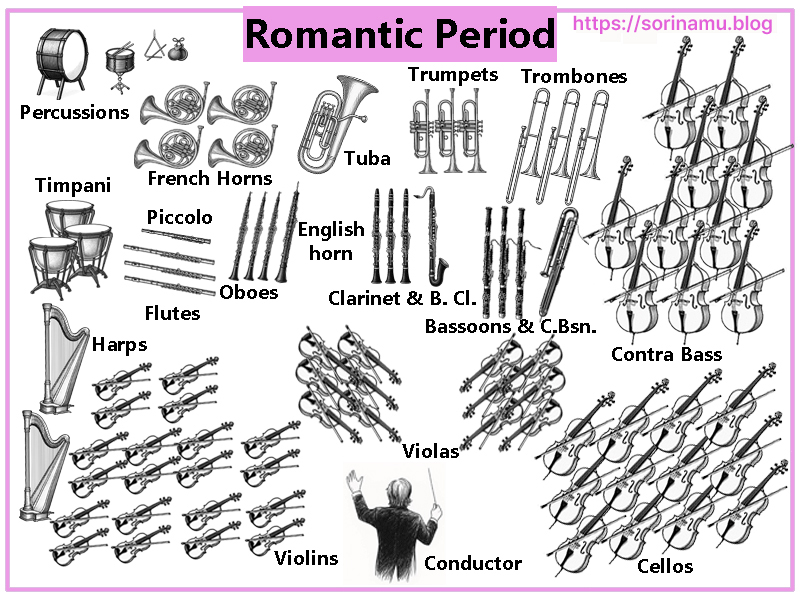
The 19th century turned music toward personal emotion and imagination. Narrative deepened, color grew richer, and the orchestra expanded in size and complexity to carry that weight. Here, the History of the Orchestra and the history of emotion move together.
Three-woodwind and even four-woodwind setups appeared. New instruments — tuba, harp, xylophone, cymbals — entered regular use. Sections grew; some string parts exceeded sixteen players. A full-time conductor unified the ensemble and shaped dramatic interpretation.
Composers strengthened each instrument’s character for both subtlety and grandeur. Orchestras expanded from around 60 to well over 100 musicians, creating a three-dimensional, dazzling sound for extreme emotion and dramatic tension.
Summary: Romantic Orchestra
Instrumentation:
- Strengthened strings: expanded in richness and volume, combined with three- or four-woodwind formation, and the introduction of harp, trombone, tuba, and a wide variety of percussion instruments.
- Increase in string-section size: the number of players in each string part grew, leading to large-scale orchestral formations.
- Woodwind formations:
(1) Three-woodwind: three of each woodwind instrument (flute, oboe, clarinet, bassoon).
(2) Four-woodwind: four of each woodwind instrument, with additional auxiliary instruments such as piccolo, English horn, bass clarinet, and contrabassoon. - Conductor-centered system: firmly established, emphasizing unified interpretation and dynamic control.
- Average size: typically ranged from 60 to over 100 musicians, depending on the composer and performance setting.
Late Romantic to Early Modern Period — Expanding a Universe of Sound
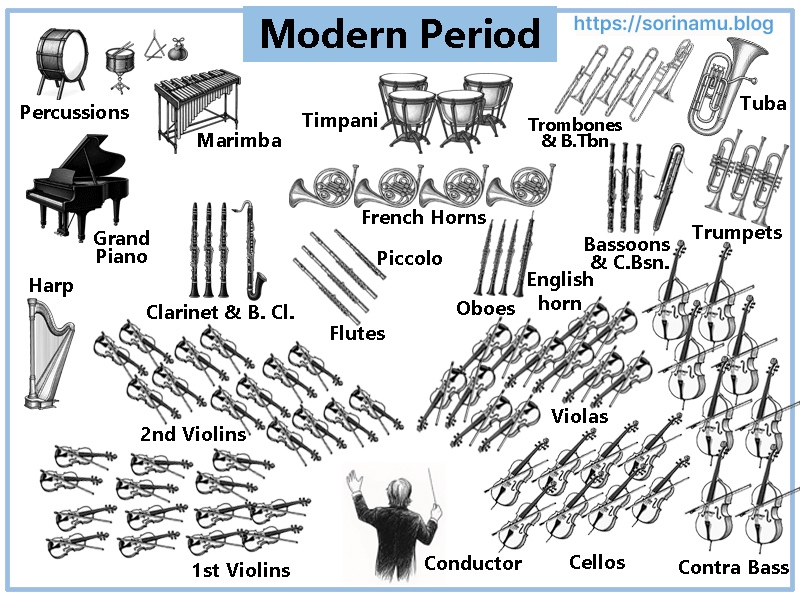
From the late 19th into the early 20th century, a standard orchestral template took hold — still common in today’s performances. Late-Romantic composers expanded scale and function to pursue maximal emotion within grand structures. Mahler and Richard Strauss mobilized dozens of players, solo voices, chorus, and organ, seeking a “cosmos of sound.”
It was more than volume: spatial depth, emotional flow, and meticulous placement were notated into the score. In Mahler’s Symphony No. 2 “Resurrection”, he sought to contain an entire life within one work; in Strauss’s Also sprach Zarathustra, literature and philosophy unfold as a tone poem at the apex of program music.
Summary: Late Romantic–Early Modern Orchestra
Instrumentation:
- Very large forces: four-woodwind or more, doubled brass, two harps, organ, solo voices, and choir.
- Woodwind formation: four-woodwind or more, with extensive use of auxiliary instruments such as piccolo, bass clarinet, and contrabassoon.
- Expressive characteristics: contrasting sonorities, emotional extremes, and a strong sense of spatial depth.
- Conductor’s role: absolute in control and interpretation, focusing on the overarching structural meaning of the work.
- Additional elements: offstage brass, organ, and vocal parts often integrated for expanded dramatic effect.
Contemporary Period — Deconstruction and Reassembly
Since the 20th century, fixed rules have loosened. Instrumentation is chosen freely for expression, ranging from minimal chamber groups to expanded electronic orchestras. Placement of instruments, the grain of sound, even silence and noise became part of the score — a reminder that the History of the Orchestra is a story of reinvention.
Summary: Contemporary Orchestra
Instrumentation:
- Diverse forces: from chamber ensembles to monumental setups; includes electronic instruments, amplification systems, and even noise as a musical element.
- Flexible structure: the traditional division of orchestral sections is dismantled; the layout adapts freely to the expressive goal of each composer.
- Expressive characteristics: extreme dynamic ranges, rhythmic experimentation, and sound textures placed at the center of musical language.
- New notation and performance concepts: graphic scores, percussion-centered orchestrations, and experimental stage layouts emerge as extensions of visual and spatial art.
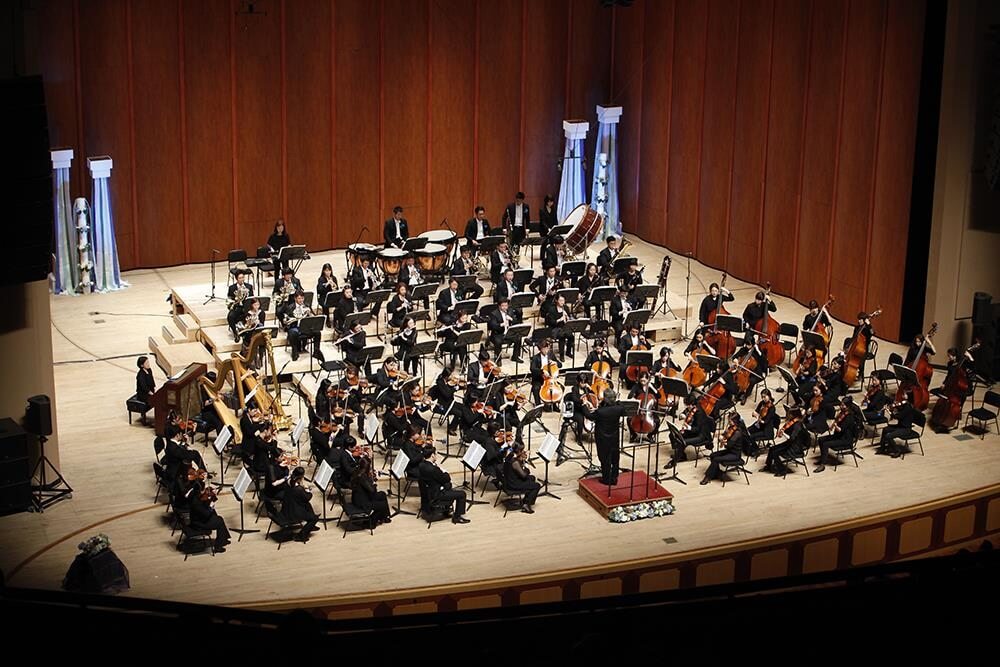
Busan Symphony Orchestra performing live on stage
Finale
An orchestra is not merely a collection of instruments. Within it are the feelings of an age, the growth of technology, and the imagination of artists. The world Bach tuned from his harpsichord and the sonic universe Mahler raised with hundreds of performers are different, yet both arrange sound to move ear and heart. Through centuries of change, the History of the Orchestra has never stopped evolving.
Today’s orchestras are flexible. Some composers return to Baroque-like small forces; others accept electronic instruments and amplification as part of the ensemble. Music remains alive, and the orchestra is still changing. When you look at the stage, the quiet geometry of instruments holds centuries of memory — an ongoing History of the Orchestra that still unfolds before our ears.
Further Reading
Symphony Listening in the 19th Century | How People Enjoyed Music before Recordings
Symphony Listening in the 19th Century | How People Enjoyed Music before Recordings