


1. Composer MBTI as an Interpretive Lens
Have you ever wondered about the Composer MBTI behind famous works?
Classical music often feels distant or difficult.
But when we begin to see composers not as monuments of history but as individual human beings, their music starts to feel surprisingly intuitive.
I find myself emotionally inclined, much like an INFP, yet when it comes time to finish a task, an INFJ-like perfectionism emerges—scrutinizing even the placement of a single rest. Because of this, the peculiar traits of great composers no longer feel like abstract material for theoretical analysis. Chopin’s preference for the intimacy of salons over grand concert halls, or another composer’s stubborn devotion to a single symphony for decades due to perfectionism, no longer feels eccentric. It feels natural—almost inevitable. I find myself thinking, I would have done the same.
Before proceeding, it is important to clarify one point.
The MBTI types mentioned in this article are not based on actual personality assessments. These composers lived long before such frameworks existed, and the types discussed here are inferred from historical records, personal correspondence, documented behavior, and artistic choices. MBTI is used solely as an interpretive lens to explore patterns between temperament, life decisions, and musical outcomes.
By using personality types as a lens, this piece connects episodes from composers’ lives with the music they left behind. When we look for the reasons behind an obsession with a particular instrument or an unusually narrow range of genres within a composer’s temperament, classical music begins to sound less intimidating and more like a collection of entirely plausible human stories. Let us take a light look at how the lives and music of great composers connect through the idea of MBTI.
2. Poets Who Gaze into the Inner Abyss (INFP & ISFP)
Frédéric Chopin (1810–1849) | INFP

Chopin devoted his life to realizing what might be called “sound that retreats inward.” More than any other composer in history, his music embodies introspection. His life reflects the archetype of an inward-looking idealist who minimized contact with the outside world and clung fiercely to his own emotional ideals.
Temperament and Life as Inevitability:
Chopin deeply disliked performing on large concert stages where thousands of eyes were fixed upon him. He once confessed, “The crowd frightens me; their breath suffocates me.” Throughout his life, he gave only about thirty public concerts. Instead, he chose the salon—a private, intimate space where only close friends and fellow artists gathered—as the sole setting in which he would reveal his inner world through the piano.
Musical Means (Piano Miniatures):
Rather than composing grand symphonies meant for public display, Chopin found refuge in the piano alone, using it to explore the finest gradations of emotion. His preference for private spaces over public stages naturally led him away from orchestral writing and toward an extensive body of solo piano works. His reclusive temperament shaped not only his life choices but the very core of his musical output.
Sergei Rachmaninoff (1873–1943) | ISFP

Rachmaninoff possessed an imposing physical stature and a stern exterior, yet a single critical remark could shake him to the core. Beneath his reserved appearance lay the hypersensitivity of a true artist.
Temperament and Life as Inevitability:
He expressed emotion not through explanation, but through texture and atmosphere. In 1897, the disastrous premiere of his Symphony No. 1—marred by poor conducting and harsh criticism—plunged him into a deep depression. He stopped composing altogether for nearly three years. This collapse illustrates the extreme vulnerability of an ISFP temperament: when external, cold logic intrudes upon an inner sensory world, it can feel like a denial of one’s very existence. Even after recovering through hypnotherapy, Rachmaninoff continued to doubt his own worth, clinging relentlessly to an ideal of complete sensory perfection.
Musical Means (Rich Harmonic Textures):
Amid the rise of intellectual modernism and experimental trends, Rachmaninoff never abandoned the pursuit of dense, emotionally saturated harmonic sonorities. He valued immediate, visceral beauty over theoretical innovation or structural novelty. For listeners with an ISFP disposition, his massive harmonies often evoke a profound sense of emotional immersion and reassurance.
3. Architects of Perfect Structure (INTJ & INFJ)
Johann Sebastian Bach (1685–1750) | INTJ

For Bach, music was not primarily the product of inspiration, but a grand project aimed at discovering and mathematically demonstrating the divine order of the universe.
Temperament and Life as Inevitability:
Despite raising a large family and enduring relentless professional demands that required him to produce new music weekly, Bach never succumbed to emotional chaos. Instead, he worked within carefully designed routines and systems, systematically assembling an immense body of work. His drive to construct invisible systems and long-term order reflects the strategic mindset of an INTJ. Bach treated music not as entertainment, but as a means of uncovering universal principles, and this intellectual conviction sustained his lifelong devotion to composition.
Musical Means (Counterpoint):
Counterpoint, his defining technique, allows multiple independent melodic lines to interlock with mathematical precision. It is the musical embodiment of a worldview that rejects emotional chance in favor of rigorous logic. For INTJ listeners, the moment when a fugue resolves perfectly often brings a uniquely intellectual catharsis.
Johannes Brahms (1833–1897) | INFJ

Brahms was a quintessential visionary who confined intense inner passion within a strict framework of control and restraint.
Temperament and Life as Inevitability:
He spent an astonishing twenty-one years composing his First Symphony, driven by the overwhelming shadow of Beethoven. Unsatisfactory drafts were destroyed before anyone else could ever see them, a testament to his severe self-discipline. Though outwardly reserved and conservative, Brahms harbored a lifelong, devoted love for Clara Schumann, his mentor’s wife. This contrast between external reserve and internal depth aligns closely with the core characteristics of an INFJ temperament.
Musical Means (Hemiola):
The frequent use of hemiola—complex rhythmic displacement—reveals the tension between Brahms’s outward adherence to classical form and the restless emotional turbulence beneath the surface. By disciplining emotion through structure in pursuit of universal expression, Brahms made a distinctly INFJ choice.
4. Free Spirits Who Refuse Boredom (ENFP & ESFP)
Wolfgang Amadeus Mozart (1756–1791) | ENFP
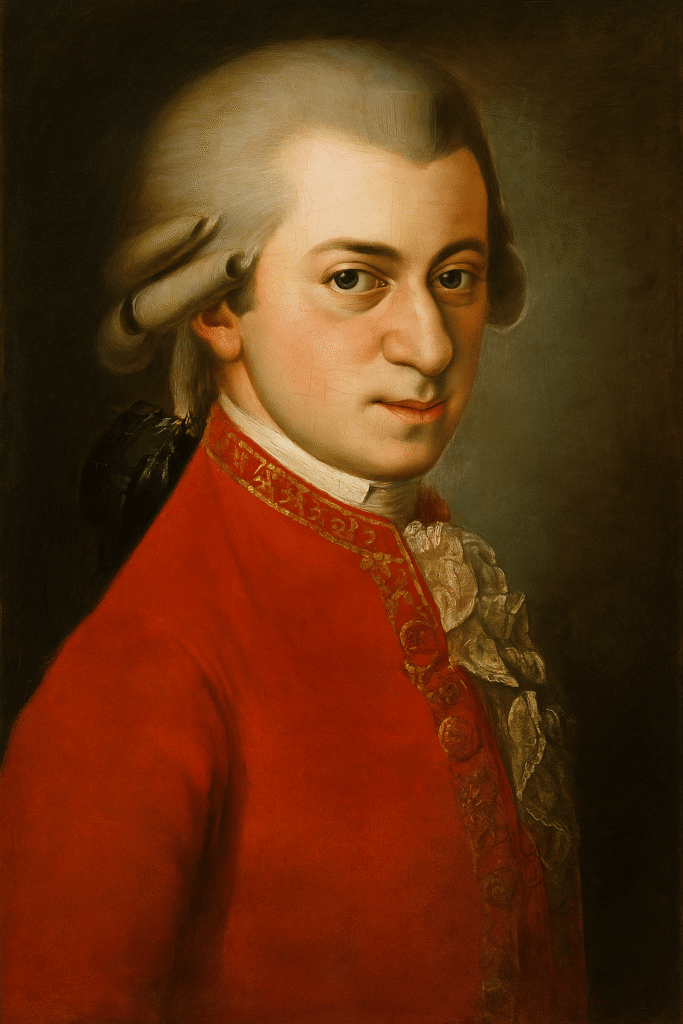
Mozart chose the uncertain life of a free artist guided by intuition over conformity, rejecting rigid court hierarchies and social conventions.
Temperament and Life as Inevitability:
He thrived on social interaction, humor, and constant stimulation. His letters overflow with playful language and irreverent jokes, revealing an outward-focused intuition (Ne) that demanded immediate expression. The near absence of revisions in his manuscripts suggests that ideas fully formed in his mind and poured out without hesitation—the hallmark of someone who cannot tolerate stagnation.
Musical Means (Musical Wit):
Mozart’s music is unpredictable and alive. Even in tragic moments, sudden playful gestures appear, and within a single work, moods shift rapidly. This restless vitality reflects a temperament that refuses to remain still.
George Gershwin (1898–1937) | ESFP

Image Source: George Gershwin (1898–1937), photographed by Carl Van Vechten, 28 March 1937. Library of Congress, Prints and Photographs Division, Van Vechten Collection (LC-USZ62-42534).
Gershwin found artistic inspiration not in formal concert halls, but in the vibrant noise of New York’s streets.
Temperament and Life as Inevitability:
Rather than isolating himself in solitude, he energized himself through parties, crowds, and direct engagement with contemporary culture. He valued immediate sensory pleasure and connection with audiences over abstract theory or rigid tradition.
Musical Means (Syncopation):
By introducing jazz syncopation and blue notes into the orchestral tradition, Gershwin chose rhythmic vitality over aristocratic refinement. His music prioritizes physical response—movement, pulse, excitement.
5. Closing Thoughts: Temperament as Musical Destiny
In the end, the music of great composers is the audible translation of temperament. Find the composer who mirrors you, and listen closely. When you begin to sense how each carefully placed note resonates with your own inner rhythm, music ceases to be mere appreciation and becomes a genuine dialogue.
Further Reading
Classical Music in Film | Moments When Sound Becomes the Story
Classical Music in Film | Moments When Sound Becomes the Story