
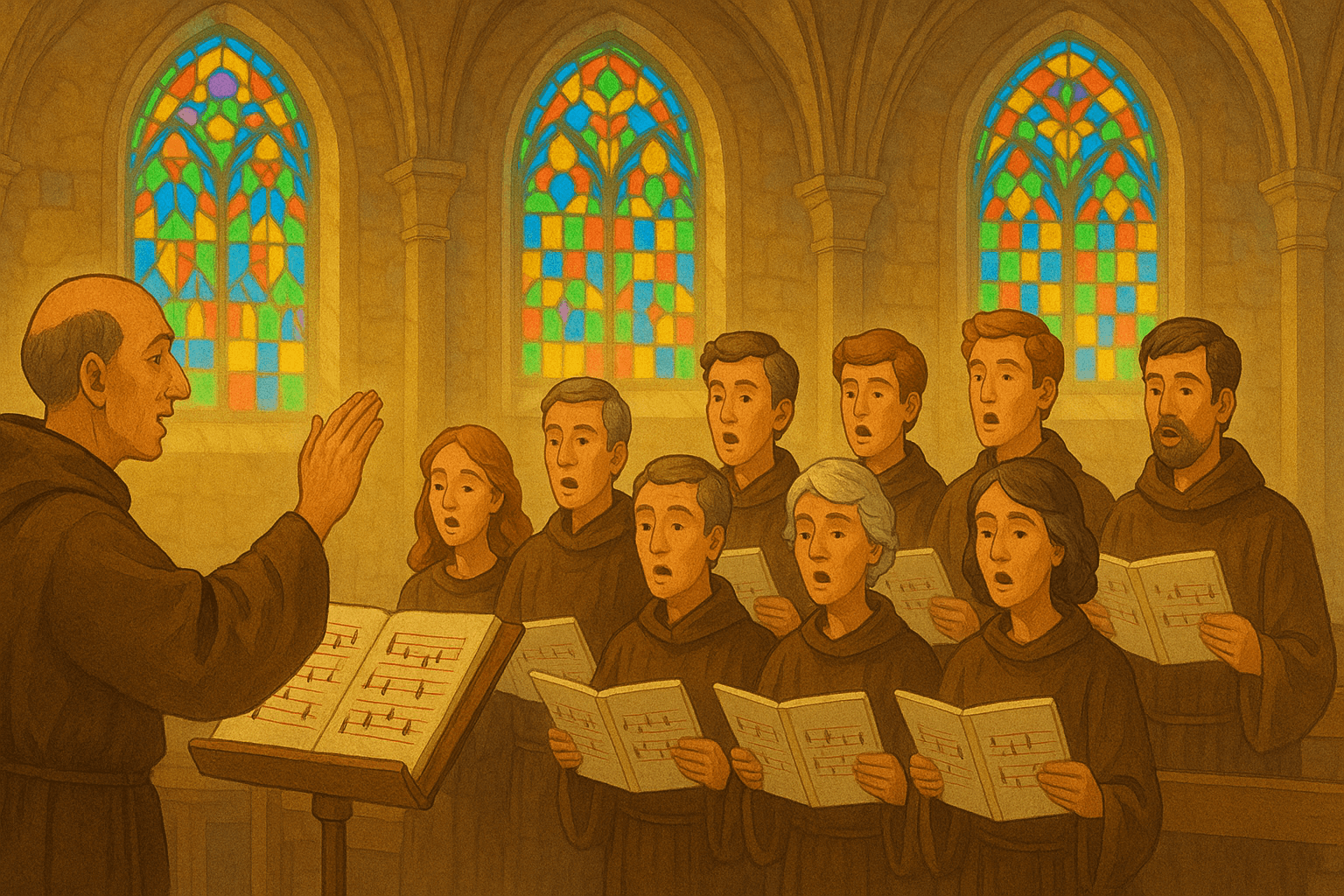
Medieval music opens the first chapter of Western music history. Starting from simple Gregorian chant, it began to record sound through musical notation and expanded into polyphony, laying the groundwork for all later music. At the center of Christian faith, music became the language of worship and, under the authority of the Church, developed into a codified and widely shared style.
Outside the Church, secular songs blossomed with themes of love and chivalry. In the later Middle Ages, new notation systems and refined rhythm paved the way for polyphonic Mass. The Medieval period marks the turning point when music moved from “sound that passes” to an art preserved in history and writing.
1. Chant and the Music of the Church
The starting point of Medieval music is the Gregorian chant sung in Christian liturgy. These chants are monophonic: even when sung by many voices together, only one melody line unfolds, without two or more independent tunes sounding at once. Ornament and polyphonic effects are excluded; a single melodic line unites the voice of the community.
Unbound by measured meter, chant follows the accent and breath of Latin scripture. Rather than individual expression, it is the communal prayer of the faithful, simple yet resonant in depth. Named after Pope Gregory I, Gregorian chant was used across Europe and helped to standardize liturgical music.
2. The Birth of Notation – Neumes
As the medieval Church expanded across Europe, singing the same melodies everywhere became essential. Oral transmission alone could not control regional variants; sound needed to be written down. The starting point was neumes, which evolved—once joined to lines that fixed pitch—into the framework of today’s staff notation.
At first, neumes were only dots and curves, a mnemonic to recall the melodic contour. Over time, scribes drew reference lines and placed signs above or below them to clarify pitch. Thus arose the early four-line staff and the idea of clefs. Chant ceased to be merely “a song remembered” and became music read and taught, a shift that reshaped composition, pedagogy, and liturgical practice.

Image source: Neumes (Cod. Sang. 359) — a 10th-century chant manuscript from St. Gallen, Switzerland, written by an anonymous scribe. Stiftsbibliothek St. Gallen (Object No. Cod. Sang. 359).

Image source: Neumes notation — an 11th-century European chant manuscript written by an anonymous scribe. Wikimedia Commons.

Image source: Pérotin – Alleluia nativitas — a late-12th-century polyphonic chant manuscript from Paris, France, written by an anonymous scribe. Wikimedia Commons.
Guido of Arezzo (c. 991–1050)
“Practitioner who turned chant teaching into a read-and-sing system.”
Nationality: Italian
Activity: Monastic circles near Arezzo; author of chant primers
Main area: Theory & pedagogy (chant instruction)
Traits: Consolidated the four-line staff, systematized syllables ut–re–mi–fa–sol–la, introduced the Guidonian hand
Hildegard of Bingen (1098–1179)
“A woman composer who cast an original light on medieval chant.”

Image source: Hildegard of Bingen – Receiving Divine Inspiration — a 12th-century frontispiece from Scivias, painted in Rupertsberg, Germany, by an anonymous illuminator. The scene depicts Hildegard receiving divine light and dictating to the monk Volmar. Wikimedia Commons.
Nationality: German
Activity: Abbess of a Benedictine convent on the Rhine; author in theology, natural science, and medicine
Main genres: Sacred chant, sequence hymns (litany), religious drama
Life and Work: Hildegard entered a convent at the age of eight and devoted her entire life to religion, scholarship, and the arts. Her influence reached popes and princes alike, as she corresponded with them and offered counsel on spiritual and political matters. She left numerous writings on theology, medicine, and natural philosophy.
In music, she composed chants and a religious drama titled Ordo Virtutum, known as the earliest surviving morality play of the Middle Ages. Her chants stand out for their unusually wide melodic range and bold intervallic movement, giving them a distinct individuality beyond the traditional Gregorian style. As one of the few women whose name and works have come down to us, she holds a unique place in medieval music history and is often called “the first female composer.”
3. Instruments of the Middle Ages
The sound world of Medieval music was enriched by instruments alongside song. In churches, organs resonated; in courts and festivals, strings and winds enlivened processions and dance.
Image Source: All instrument images used in this section come from Public Domain or Open Access museum collections.
Hurdy-gurdy — made in late 18th-century Paris, France, by an unknown maker. The Metropolitan Museum of Art (Object No. 89.4.1059).
Queen Mary’s Harp — made in 15th-century Edinburgh, Scotland, by an unknown craftsman. National Museum of Scotland (Object No. H.1991.1).
Shawm — photographed in 2014 at the Vietnam Museum of Ethnology, Hanoi, Vietnam. Photo by Daderot, Wikimedia Commons.
Citole — made around 1300 in London, United Kingdom, by an unknown maker. The British Museum (Object No. 1963,1001.1).
Vielle — reconstructed in 2013 in London, United Kingdom, by John Pringle. Wikimedia Commons.
Portative Organ — made in late 19th-century Florence, Italy, by Leopoldo Franciolini. The Metropolitan Museum of Art (Object No. 89.4.1188).
Hurdy-gurdy (Organistrum)

A string instrument whose wheel bows the strings while a keyboard changes pitch. Its steady drone supports a melodic string, useful in chant accompaniment and education. By the late Middle Ages it spread to courts and folk dance, becoming a visual and sonic emblem of medieval music.
Harp

Queen Mary’s Harp is among the oldest surviving Celtic harps and a symbol of Scottish tradition. Medieval harps had fewer strings and simpler structure than today’s, yet their clear, luminous timbre made them beloved at court. Poets and minstrels often sang to the harp; in Celtic lands the small clàrsach became a marker of cultural identity.
Shawm (early double-reed wind instrument)

Direct ancestor of the oboe, the shawm uses a double reed to produce a penetrating, grainy tone; the flared bell projects widely. It thrived at outdoor festivals, processions, and courtly feasts, and appeared occasionally in church. Ideal for dance, it powered the vitality of secular medieval music.
Citole (early plucked string instrument)

A key plucked instrument in court music, the citole foreshadows the lute. With a flat body and distinctive head, it was played with fingers or plectrum. With roots linked to the oud, it served both song accompaniment and solo playing. Though later supplanted by the lute, it remains an icon of medieval secular sound.
Vielle (early bowed string instrument)

The most widespread bowed string of the era and a direct forerunner of the violin. Rested on the lap and bowed, often with five or six strings. It could sound multiple strings at once, offering harmonic resonance for chant accompaniment as well as dances and sung poetry.
Portative Organ (small portable pipe organ)

A small, portable pipe organ. One hand works the bellows while the other plays the keys, fitting for chant accompaniment and small services. As a miniature of the great church organ, it helped disseminate organ music and technique throughout Europe.
4. The Rise of Polyphony – Organum and the Notre-Dame School
A major turning point in medieval music came with the emergence of polyphony, the practice of adding new melodic lines to plainchant. The earliest form of this style was known as organum, which flourished around Notre-Dame Cathedral in Paris.
Concept Overview: Organum
Organum refers to a technique in which a new voice is sung above the monophonic melody of Gregorian chant (the tenor). It marked the first step toward expanding music from a single melodic line into multiple voices.
Early Organum: A simple structure in which the chant melody was doubled at intervals of a fourth or fifth, moving in parallel motion.
Free Organum: The chant, held in long notes in the tenor, supported a freely moving and more decorative upper voice, creating greater independence between parts.
Notre-Dame Organum: The texture expanded from two voices to three or four, with the introduction of rhythmic modes that organized the voices into a majestic, interlocking structure.
Through this gradual evolution, organum grew from a simple liturgical melody into a grand and resonant form of sacred music, where multiple voices intertwined in solemn harmony.
Léonin (c. 1135–1201)
“The first great master of polyphony.”
Nationality: French
Activity: Cleric and composer at Notre-Dame Cathedral in Paris
Main genres: Organum, church chant
Life and Work: Léonin was a leading figure of the Notre-Dame School and is known for compiling the Magnus Liber Organi, a great collection of organum settings. He developed a new musical technique by greatly extending the original chant line to form the foundational voice, then adding a second voice above it. This established the principle of two-voice polyphony, elevating plainchant to an entirely new level of musical expression.
Léonin’s compositions reveal not mere parallel motion but a sense of structural order and proportion. His work laid the foundation for the achievements of his successor, Pérotin, who expanded this polyphonic style into three and four voices.
Pérotin (c. 1160–1230)
“Architect of grand polyphonic design.”
Nationality: French
Activity: Successor to Léonin at Notre-Dame Cathedral, Paris
Main genres: Organum, sacred chant
Life and Work: Pérotin carried forward the legacy of Léonin by expanding the organum into three- and four-part textures. He introduced distinct rhythmic patterns in each voice, enabling complex structural interplay and bringing the Notre-Dame School to its artistic peak. His works are monumental in scale and architectural in design, reflecting the grandeur of the Gothic cathedral itself.
Through these innovations, Pérotin played a decisive role in transforming medieval chant from monophony into true polyphony. Works such as Viderunt Omnes resonated magnificently within the vast acoustics of the cathedral, opening a new horizon for the sound and spirit of European sacred music.
5. Secular Music – Troubadours and Trouvères
Within the church, sacred chants resounded, but beyond its walls, secular music gave voice to human life and emotion. In southern France, troubadours, and in the north, trouvères, were poet-singers who sang of chivalry, love, satire, and narrative.
Among the troubadours, Bernart de Ventadorn stood as a central figure, representing courtly culture with lyrical songs that united love and nature. In the north, Adam de la Halle broadened the scope of secular music by extending it into dramatic forms. Meanwhile, in Germany the Minnesänger sustained their own tradition, and across Europe instrumental dance pieces such as the estampie continued to flourish.
Bernart de Ventadorn (c. 1130–1200)
“Master of troubadour lyricism.”
Nationality: French (Occitania)
Activity: Court poet and troubadour active among the nobility
Main genre: Secular song (canso)
Life and Work: Bernart de Ventadorn was a leading representative of the troubadour tradition in southern France, singing of chivalric ideals and courtly love. His songs transcend simple lyricism, combining vivid imagery of nature with finely shaped human emotion. Through this fusion of poetry and melody, he gave voice to the refined sensibility of medieval courtly culture.
Bernart’s art deeply influenced later developments of French chanson and the Renaissance madrigal. More than forty-five of his songs survive—an unusually large number for the period—making him one of the best-preserved troubadours and a vital landmark in the history of medieval secular music.
Adam de la Halle (c. 1245–1287)
“The last trouvère and pioneer of musical drama.”
Nationality: French (Arras)
Activity: Trouvère poet and musician active in noble and courtly circles
Main genres: Secular song, polyphonic song, dramatic music
Life and Work: Adam de la Halle inherited the trouvère tradition yet ventured into polyphony and theatrical form. His work Jeu de Robin et de Marion is a pastoral play combining song and dialogue, marking a turning point where medieval secular music evolved from simple lyric expression to dramatic storytelling.
He also composed polyphonic songs that elevated the musical refinement of secular art, revealing the growing diversity and potential of late medieval music. Known as “the last trouvère,” Adam served as a bridge between the poetic past and the emerging future of dramatic and polyphonic composition.
6. Ars Nova and Machaut’s Innovation
As the 14th century dawned, medieval music entered a new age of transformation. This period was defined by the term Ars Nova — “The New Art.” While the earlier traditions of chant and organum sought monumental resonance within sacred walls, the Ars Nova embraced rhythmic freedom and gave unprecedented weight to secular music.
The movement began with the theoretical treatise Ars Nova (1322) by Philippe de Vitry (1291–1361). He broke away from the older rhythmic notation, introducing a new system that divided note values with greater precision and allowed shifts in meter and tempo. Through this innovation, rhythm gained breath and subtlety; polyphonic composition found new complexity and grace, and music flourished not only in the church but in courts and cities alike.
At the heart of this era stood Guillaume de Machaut (1300–1377). Moving freely between the French court and the cathedral, he united poetry and music in equal artistry, creating both secular chansons and sacred works of striking refinement. His Messe de Nostre Dame — the first complete polyphonic Mass by a single composer — became a towering landmark, bridging the grandeur of the Middle Ages with the clarity of the coming Renaissance.
Historical Background: 14th-century France; birth of a new rhythmic notation system
Characteristics:
– Subdivision of rhythm; flexible changes in meter and tempo
– Rise of secular genres such as love songs and dances
– Polyphonic textures of greater balance and structural beauty
Significance: A turning point that carried music beyond sacred chant and liturgy into a world of diverse and human expression.
Guillaume de Machaut (1300–1377)
“Giant of the late Medieval Ars Nova.”

Image source: Guillaume de Machaut – “Portrait with Nature” — an illumination from the manuscript Œuvres poétiques, made in 14th-century Paris, France, by an anonymous illuminator. Wikimedia Commons.
Nationality: French
Activity: Poet-composer active across court and church circles
Main genres: Secular chanson, polyphonic Mass
Life and Work: Guillaume de Machaut was the foremost composer and poet of the French Ars Nova era. He produced dozens of secular chansons and sacred works, embodying the ideal of the “poet-composer” who united text and music with equal artistry. His output shaped the musical and poetic culture of 14th-century France.
Among his achievements, the four-part Messe de Nostre Dame stands as the first known complete polyphonic Mass by a single composer—a milestone in Western music history. Machaut’s works reveal refined rhythm, graceful melody, and architectural precision, opening the path from the medieval to the Renaissance spirit of musical thought.
Legacy of Medieval Music
Medieval music began with the single melodic line of chant and, through the birth of notation, the expansion of polyphony, the flowering of secular song, and the intricate rhythmic systems of the Ars Nova, it laid the foundation for all later Western music.
The simple chant melodies were the starting point of musical thought. Neumes and the five-line staff became tools to preserve and teach music. Organum added new voices above the chant, opening the door to polyphony, and the Notre-Dame School developed it into a grand architectural sound. The songs of troubadours and trouvères brought love and human emotion into music, extending it into daily life. The Ars Nova then introduced new rhythmic and structural order, reaching the summit of medieval artistry.
All these developments form a single continuum. Music that once resounded only in churches became knowledge through notation, gained depth through multiple voices, and crossed the boundaries between the sacred and the secular in pursuit of broader expression. Medieval music was not merely an ancient song, but the true beginning of the long journey that would lead to the Renaissance, the Baroque, and the Classical eras.
Further Reading
Western Music History ① Ancient Greek Music and Roman Traditions (600 BC – AD 400)